Passive income in India: real options, tax and the money it takes
Passive income is money your savings earn for you, and it needs a large pile of savings first
“Passive income” is sold online as money that arrives while you sleep. The honest version is less exciting. Passive income is money your savings earn for you. You still have to build those savings first, usually from years of active income. A ₹5 lakh deposit earning 7% pays about ₹2,900 a month. That’s useful, but it won’t replace a salary.
So think of passive income as a second source of income that grows as your savings grow.
The real options in India, and how each is taxed
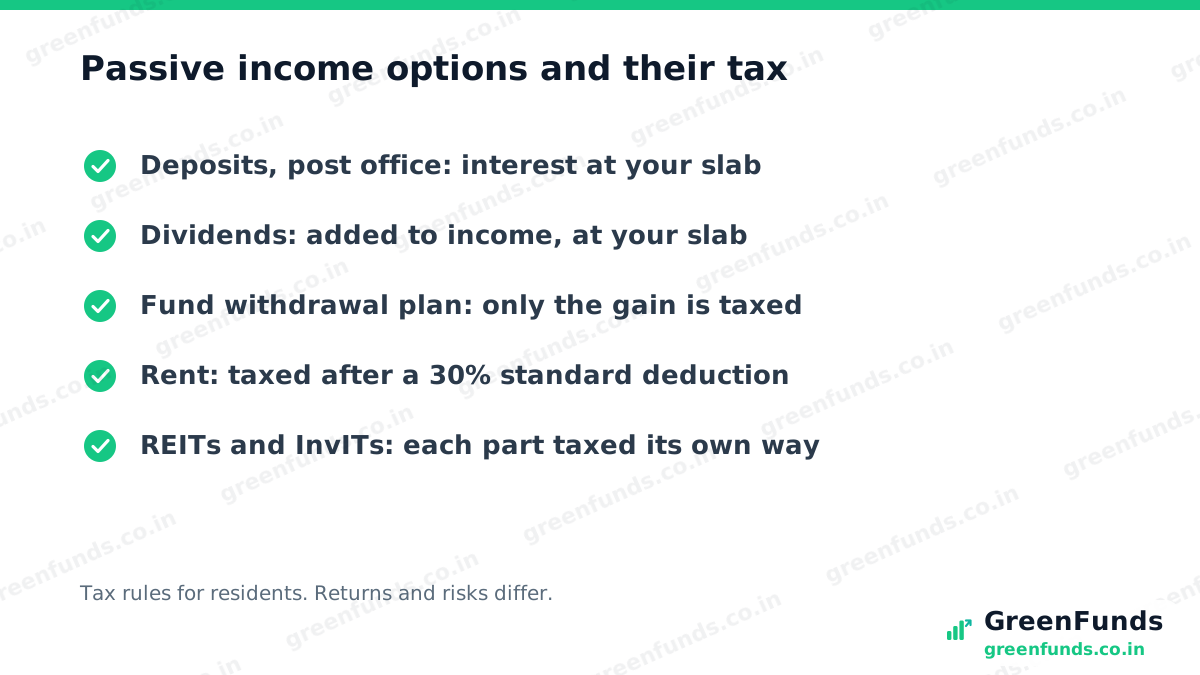
- Bank deposits. A fixed deposit or recurring deposit pays a set rate. The interest is income from other sources, taxed at your income tax slab, and the bank may cut TDS. See TDS on FD interest.
- Post office schemes. The Post Office Monthly Income Scheme pays 7.4% a year, paid every month, for October to December 2026. Its limit is 9 lakh rupees in a single account and 15 lakh in a joint one. At 9 lakh, that’s 5,550 rupees a month. The Senior Citizen Savings Scheme, for people aged 60 and over, pays 8.2% a year, credited quarterly, on up to 30 lakh rupees. A full 30 lakh pays 61,500 rupees a quarter, about 20,500 a month. Interest on both is taxed at your slab. Rates are reset every quarter.
- Dividends. Companies can share profits as a dividend. Dividends are added to your income and taxed at your slab. They aren’t guaranteed and can be cut. A fund’s payout option works differently: it hands back your own money, as IDCW payouts explain.
- A fund withdrawal plan. A systematic withdrawal plan sells a few mutual fund units every month and pays you. Only the gain part of each withdrawal is taxed. For an equity fund held over 12 months, that’s 12.5% on long-term gains above 1.25 lakh rupees a year; sooner, it’s 20%. Try the SWP calculator.
- Rent. Rent from a flat or shop is taxed after a 30% standard deduction, under the Income-tax Act, 2025. Tenants leave, repairs cost money, and property is hard to sell quickly.
- REITs and InvITs. A REIT owns rent-earning offices; an InvIT owns infrastructure such as roads or power lines. Both trade on the stock exchange. Under SEBI’s InvIT rules, an InvIT must pass at least 90% of its net distributable cash flows to unitholders. Each payout mixes interest, dividend and repayment of capital, and each part is taxed its own way. Unit prices can fall. See REITs explained.
How much money does 30,000 rupees a month take?
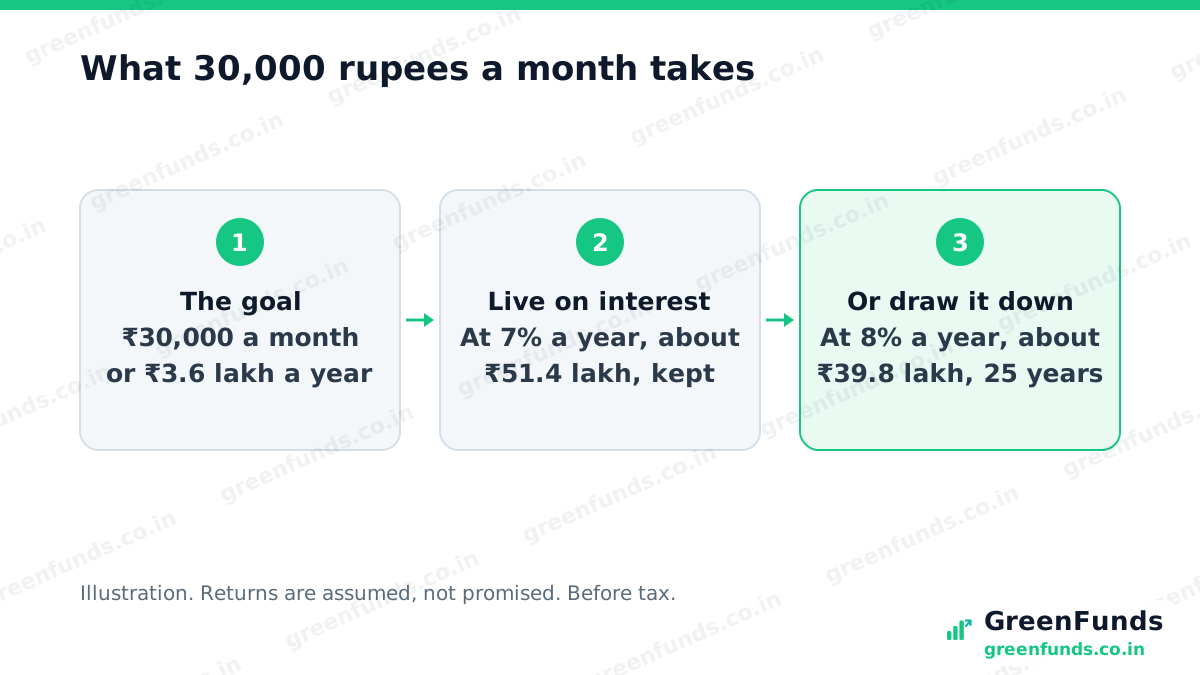
This is the number most “passive income ideas” skip. Say you want 30,000 rupees a month, or 3.6 lakh a year (an illustration, before tax):
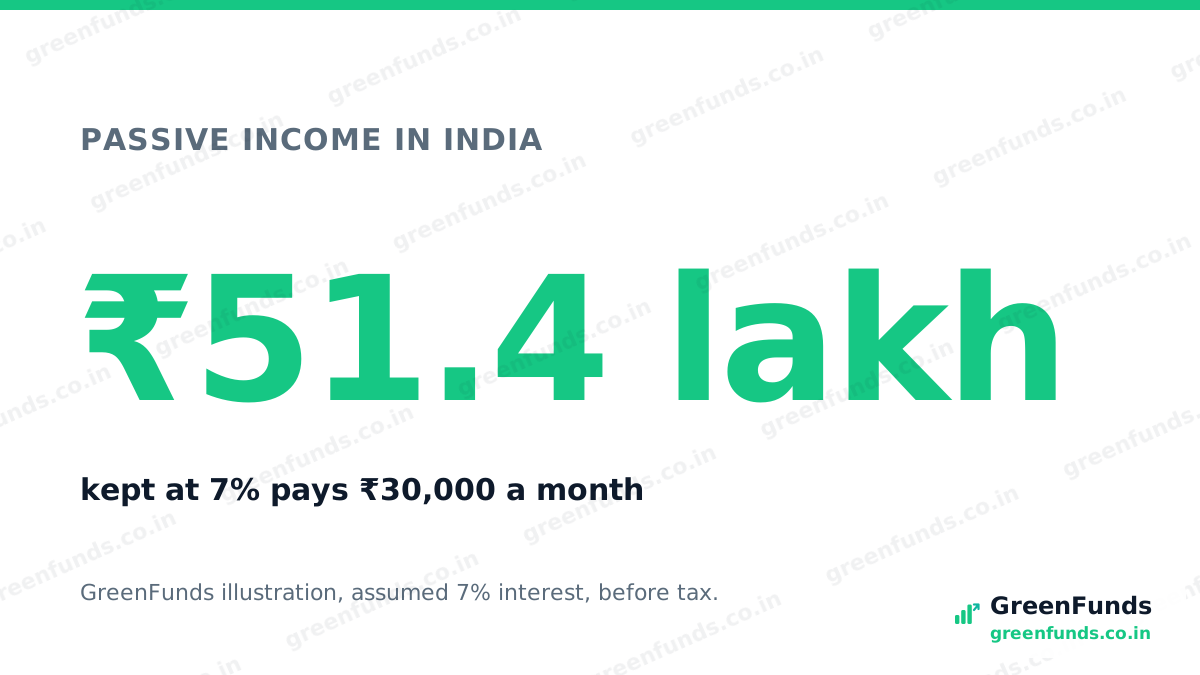
- Living only on interest at 7%: 3.6 lakh ÷ 0.07 = about 51.4 lakh rupees. The money stays intact. At 6%, you’d need 60 lakh; at 8%, 45 lakh.
- Drawing the money down: if a corpus earns an assumed 8% a year and pays out 30,000 rupees every month, about 39.8 lakh rupees lasts exactly 25 years, then hits zero.
Rising prices matter too. At 6% inflation, what 30,000 rupees buys today will cost about 96,000 rupees in 20 years. That’s why building the corpus comes first. Read how to build wealth for that part.
Did you know? The Senior Citizen Savings Scheme cap was doubled from 15 lakh to 30 lakh rupees by an amendment in 2023, per the National Savings Institute. Even at the cap, it pays about 20,500 rupees a month, which shows how much capital a monthly income really needs.
Warning signs of a passive income scam
Fraudsters love the phrase. Walk away if you see:
- A fixed high return “every month”, with no risk.
- Pay to join, then earn by recruiting others.
- Payment to a personal account, UPI ID or an unknown app.
- Pressure to decide today, or screenshots of others’ “profits”.
Real investments are sold by entities registered with SEBI or the RBI. Learn how to spot a Ponzi scheme and how fake trading apps and task scams work. If you’ve been cheated, call 1930.
The takeaway. Passive income is real, but it’s slow. It comes from a large pile of savings, earning a modest return, taxed like other income. Build the savings first, choose regulated options, and treat any promise of easy monthly money as a red flag. Gold is another asset people hold, though it pays no income; see why Indian gold prices differ from world prices.
More to read: post office schemes, recurring deposit vs SIP, what an index fund is, and how much you need to retire.
Questions people ask
What is passive income?
Passive income is money your savings or assets earn without your daily work, such as interest on a deposit, rent from a flat, or dividends from shares. It is not free money. You first need capital, built from years of saving, and the income depends on how much you have and the return it earns.
How much money do I need for 30,000 rupees a month of passive income?
As an illustration, living only on interest at 7% a year takes about 51.4 lakh rupees, which stays intact. If you are willing to use up the money while it earns an assumed 8% a year, about 39.8 lakh rupees can pay 30,000 rupees a month for 25 years before running out. Both figures are before tax and ignore rising prices.
Is passive income taxable in India?
Yes, almost always. Interest from bank deposits and post office schemes and dividends from shares or funds are added to your income and taxed at your slab rate. Rent is taxed after a 30% standard deduction. In a mutual fund withdrawal plan, only the gain part of each withdrawal is taxed, as a capital gain.
What are safe passive income options for beginners?
Lower-risk options include bank fixed deposits, recurring deposits and post office schemes such as the Monthly Income Scheme, which pays 7.4% a year for October to December 2026. They pay steady interest but rarely beat rising prices by much after tax. Market-linked options like dividends, REITs and fund withdrawal plans can earn more but can also fall.
How do I spot a fake passive income scheme?
Be wary of anyone promising a fixed high return every month, asking you to recruit others, or pushing you to pay through a personal account or app link. Check that the seller is registered with SEBI or the RBI. If you've been cheated online, call 1930 or report it at cybercrime.gov.in.
Source: Small savings rates for October to December 2026 from Ministry of Finance (DEA) Office Memorandum F.No.1/4/2019-NS, 30 September 2026, and India Post savings schemes page, updated 30 October 2026 (indiapost.gov.in): Monthly Income Scheme 7.4%, Senior Citizens Savings Scheme 8.2%; India Post scheme limits (Monthly Income Scheme 9 lakh single, 15 lakh joint); National Savings Institute, Senior Citizens' Savings Scheme, 2019 as amended in 2023 (nsiindia.gov.in): age 60 and over, 30 lakh maximum, quarterly interest; SEBI (Infrastructure Investment Trusts) Regulations, 2014, regulation 18(6), as explained in SEBI's investor education material on InvITs, 30 September 2022 (investor.sebi.gov.in); Income-tax Act, 2025 (income from other sources, house property standard deduction of 30%, capital gains at 20% and 12.5% with the 1.25 lakh exemption). Worked figures computed by GreenFunds.
Found this useful? You can buy us a coffee. It keeps GreenFunds free.Flag a possible issue
Was this helpful?
Thanks for the signal.
Comments
Share your experience or a question. Be kind, stay on topic. This is reader discussion, not financial advice.
No comments yet. Be the first to share.