Recurring deposit vs SIP: two ways to invest monthly
Both invest monthly, but one is a guaranteed deposit and one is market-linked
Investing a fixed amount every month is one of the best money habits there is: it is automatic, it averages out ups and downs, and it builds wealth quietly. Two popular ways to do it look similar on the surface but work very differently underneath: a recurring deposit, and a SIP.
The core difference. A recurring deposit (RD) is a bank product. You commit to putting in a fixed amount every month, and the bank pays a fixed, guaranteed interest rate. A SIP, or systematic investment plan, puts a fixed amount every month into a mutual fund, so the return is market-linked: it can be higher or lower, and it is not promised.
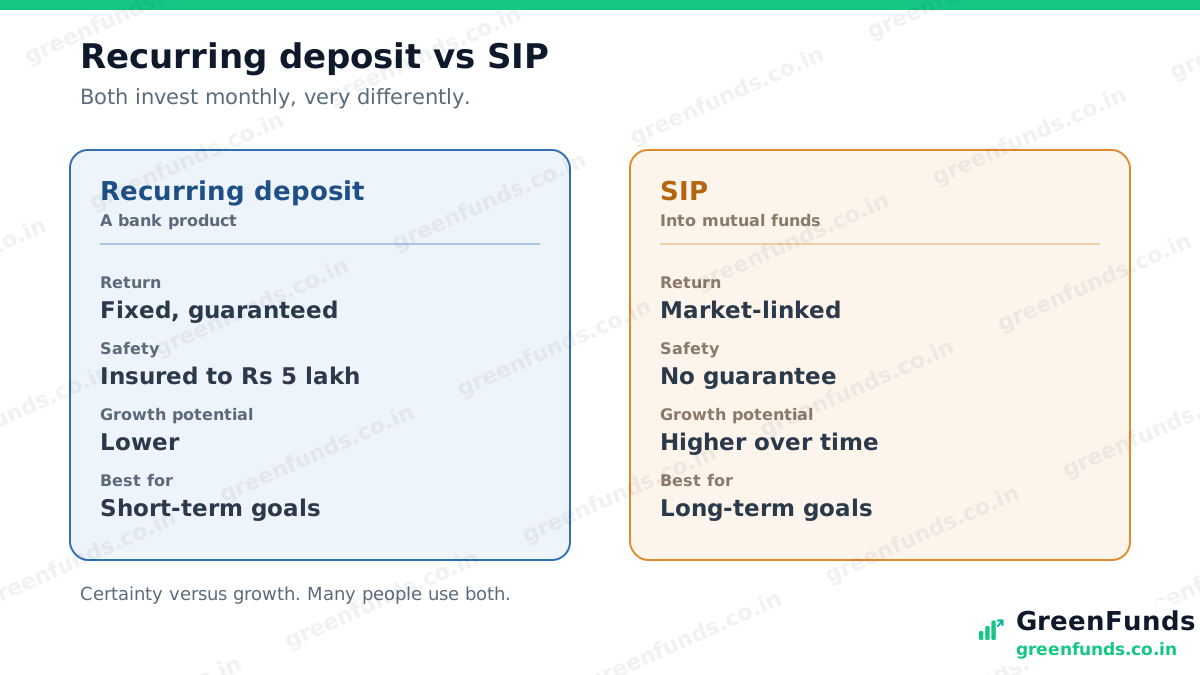
Return and safety. An RD is very safe: the return is certain and deposits are insured up to 5 lakh rupees. A SIP’s value rises and falls with the market, so it can dip, especially in the short run. In exchange, an equity SIP has historically tended to grow faster over long periods. This is the familiar trade-off: certainty versus growth, safety versus potential.
Did you know? The two are not really competitors; they suit different time horizons. An RD shines for money you need soon, where a market fall would hurt. A SIP shines for goals years away, where time smooths the swings and growth compounds. Many people use both, for different goals.
Taxation, in brief. RD interest is added to your income and taxed at your slab. An equity SIP is taxed more gently: gains are taxed only when you sell, and only the part above a yearly limit, at a lower rate. That tax difference adds to the SIP’s edge for long-term equity goals, though it comes with market risk.
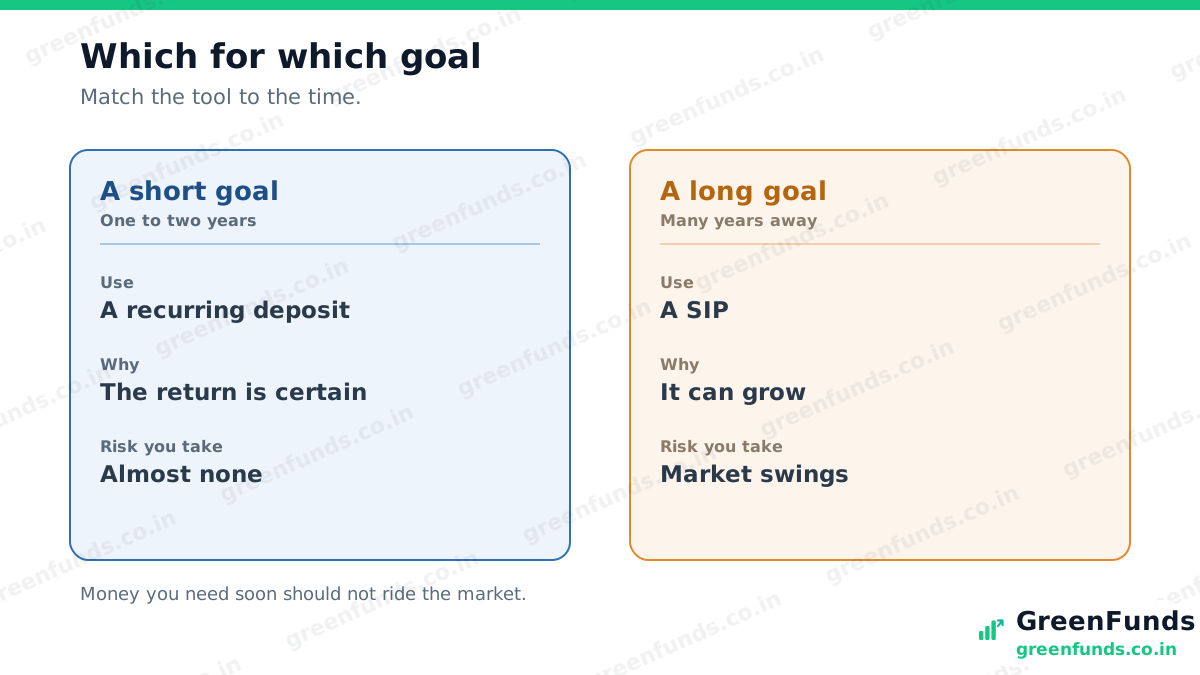
So which should you pick? Match the tool to the goal, not to a general “which is better”. For money you will need in a year or two, an RD’s certainty fits. For a goal a decade away, an equity SIP’s growth potential usually fits, if you can sit through the ups and downs. There is no shame in using both.
The takeaway. A recurring deposit gives a safe, guaranteed, monthly-saving habit; a SIP gives a market-linked one with more growth potential and more risk. Choose by your time horizon, and let the monthly discipline do the real work.
More to read: SIPs and mutual funds, explained, SIP versus lump sum, and FD versus debt fund for steady money.
Questions people ask
What is the difference between a recurring deposit and a SIP?
A recurring deposit (RD) is a bank product: you put in a fixed amount every month and get a fixed, guaranteed interest rate. A SIP (systematic investment plan) puts a fixed amount every month into a mutual fund, so the return is market-linked and not guaranteed. Both build the monthly saving habit; the difference is certainty versus market-linked growth.
Which gives higher returns, RD or SIP?
Over long periods, an equity SIP has historically tended to grow faster than an RD, because it invests in the market. But that comes with ups and downs and no guarantee, while an RD gives a lower but certain return. For a short goal, the RD's certainty often wins; for a long goal, the SIP's growth potential usually does.
Is a SIP safe like a recurring deposit?
No. An RD is very safe: the return is guaranteed and bank deposits are insured up to 5 lakh rupees. A SIP's value moves with the market, so it can fall, especially in the short term. A SIP is not unsafe, but it carries market risk that an RD does not, which is why it suits longer horizons.
Should I choose an RD or a SIP?
Match it to the goal. For money you will need in a year or two, where you cannot risk a fall, an RD's certainty fits. For a goal many years away, where you want growth and can sit through swings, an equity SIP usually fits better. Many people use an RD for short goals and a SIP for long ones.
Source: Recurring deposit: bank product, fixed rate, interest taxed at your slab, insured up to Rs 5 lakh. SIP into mutual funds: market-linked; equity gains taxed at 12.5% above Rs 1.25 lakh a year. Verify current rates and rules.
Flag a possible issue
Was this helpful?
Thanks for the signal.
Comments
Share your experience or a question. Be kind, stay on topic. This is reader discussion, not financial advice.
No comments yet. Be the first to share.