FD vs debt fund: a bank promise or a market product?
One gives a fixed, guaranteed return; the other is market-linked

When you want steady, lower-risk returns, two options come up again and again: a fixed deposit and a debt fund. They can look similar from the outside, but they work very differently underneath. One is a promise from a bank; the other is a product that moves with the market.
The core difference. A fixed deposit (FD) is a bank promise: you lock a sum for a chosen term, and the bank pays a fixed, guaranteed interest rate. You know exactly what you will get. A debt fund is a mutual fund that lends your money out by holding bonds and similar instruments, so its return is market-linked and not promised, though usually far steadier than equity.
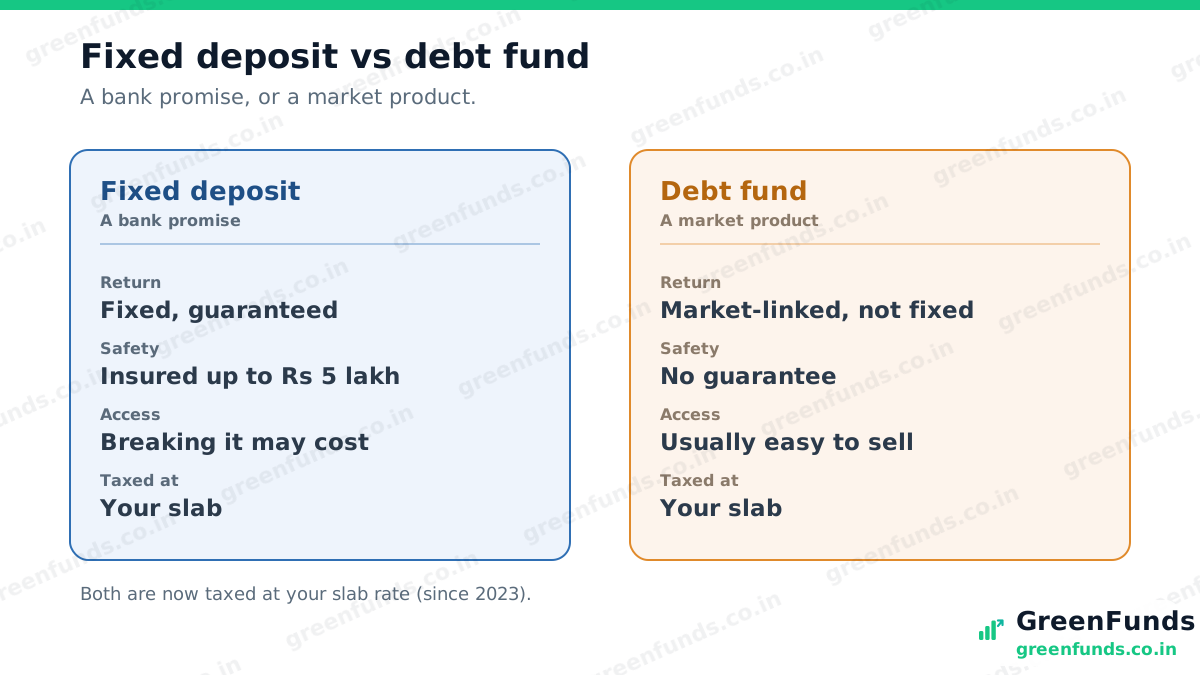
Safety and access. An FD is as safe as money gets: the return is guaranteed and deposits are insured up to 5 lakh rupees per bank per depositor. A debt fund has no such guarantee; its value can dip if interest rates move or, rarely, if a bond it holds defaults. On access, an FD can charge a penalty if you break it early, while a debt fund is usually easy to sell when you need the money.
The 2023 change that reshaped the choice. For years, debt funds had a tax advantage over FDs for long holdings. That changed. For units bought on or after 1 April 2023, debt fund gains are now taxed at your income slab rate, with no special long-term rate, exactly like FD interest.
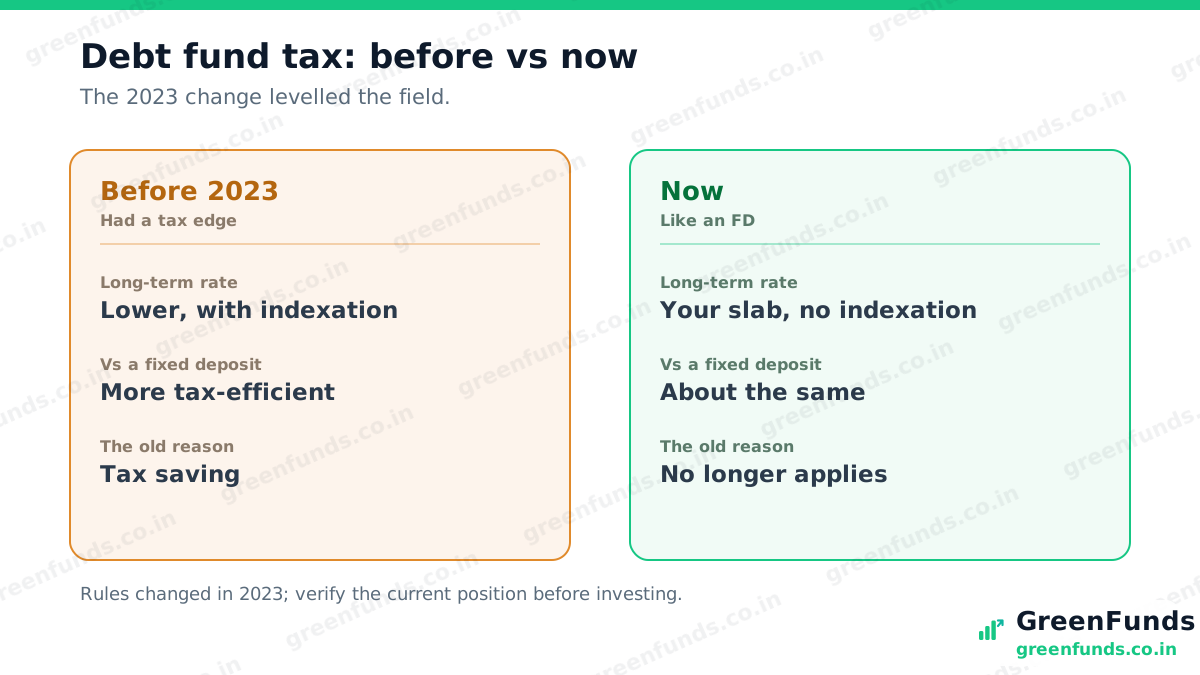
Did you know? Because debt fund gains and FD interest are now both taxed at your slab rate, the tax reason many people used to prefer debt funds has largely gone. The choice today is really about certainty and insured safety (the FD) versus easier access and a market-linked return (the debt fund).
So which fits? If you want a guaranteed return and insured safety, and can lock the money, an FD suits you. If you want easier access and a market-linked return, and can sit through small ups and downs, a debt fund suits you. Neither is “better”; they serve different needs, and both belong to the lower-risk part of a plan.
The takeaway. An FD is certainty from a bank; a debt fund is a steadier market product with easy access. With tax now similar for both, choose on what matters to you: a guaranteed, insured return, or flexibility and market-linked growth.
More to read: liquid funds and same-day money, how mutual fund gains are taxed, and understanding risk and return.
Questions people ask
What is the difference between an FD and a debt fund?
A fixed deposit (FD) is a promise from a bank: you lock money for a term and get a fixed, guaranteed interest rate. A debt fund is a mutual fund that invests in bonds and similar instruments, so its return is market-linked and not guaranteed, though it is usually steadier than equity. In short, an FD gives certainty; a debt fund gives flexibility and a market-linked return.
Are debt funds safe like fixed deposits?
Not exactly. An FD gives a guaranteed return and bank deposits are insured up to 5 lakh rupees per bank per depositor. A debt fund has no guarantee; its value can move with interest rates and, rarely, with a bond default. Debt funds are lower-risk than equity, but they are not risk-free the way an insured FD is.
How are debt funds taxed now?
For units bought on or after 1 April 2023, debt fund gains are taxed at your income slab rate, with no special long-term rate or indexation. That is the same way FD interest is taxed. So the tax edge debt funds once had over FDs has largely gone. Rules can change, so verify the current position before investing.
Should I choose an FD or a debt fund?
It depends on what you want. If you value a guaranteed return and insured safety, and you are comfortable locking the money, an FD fits. If you want easier access and a market-linked return, and can accept small ups and downs, a debt fund fits. Since both are now taxed at your slab, the choice is mostly about certainty versus flexibility, not tax.
Source: Debt fund taxation: gains are taxed at your income slab (Finance Act 2023, for units bought on or after 1 April 2023). FD interest is also taxed at your slab. Deposit insurance covers up to Rs 5 lakh per bank per depositor (DICGC). Verify current rules.
Flag a possible issue
Was this helpful?
Thanks for the signal.
Comments
Share your experience or a question. Be kind, stay on topic. This is reader discussion, not financial advice.
No comments yet. Be the first to share.