Post office schemes: rates, lock-in and tax side by side
Nine government-backed savings schemes, one table, rates reset every quarter
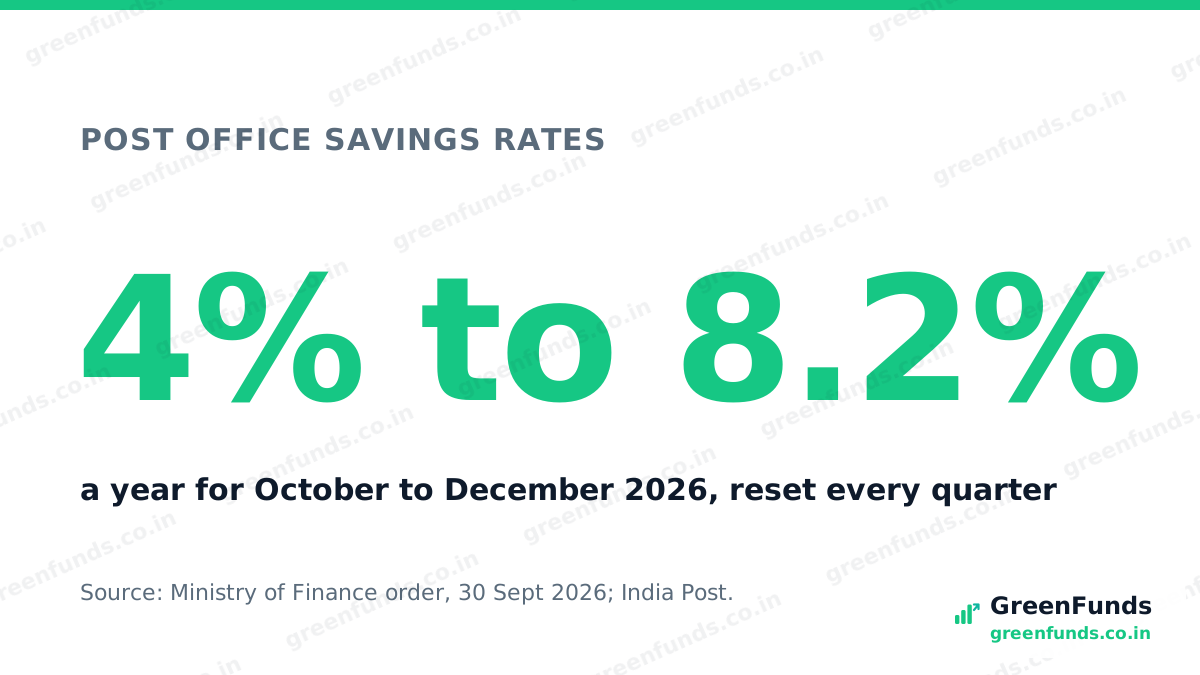
Post office schemes are savings plans run by the government and sold at any post office. Together they’re called small savings schemes. There are nine of them, and each pays a fixed rate that the government resets every quarter.
The October to December 2026 rates. The Ministry of Finance kept every rate unchanged from the July to September quarter, per an order dated 30 September 2026. The table uses the rates India Post lists for this quarter.
| Scheme | Rate a year | How long your money is locked | Tax in simple words |
|---|---|---|---|
| Savings account | 4% | Not locked | Interest counts as income |
| Recurring deposit | 6.7% | 5 years, early close after 3 | Interest is taxed |
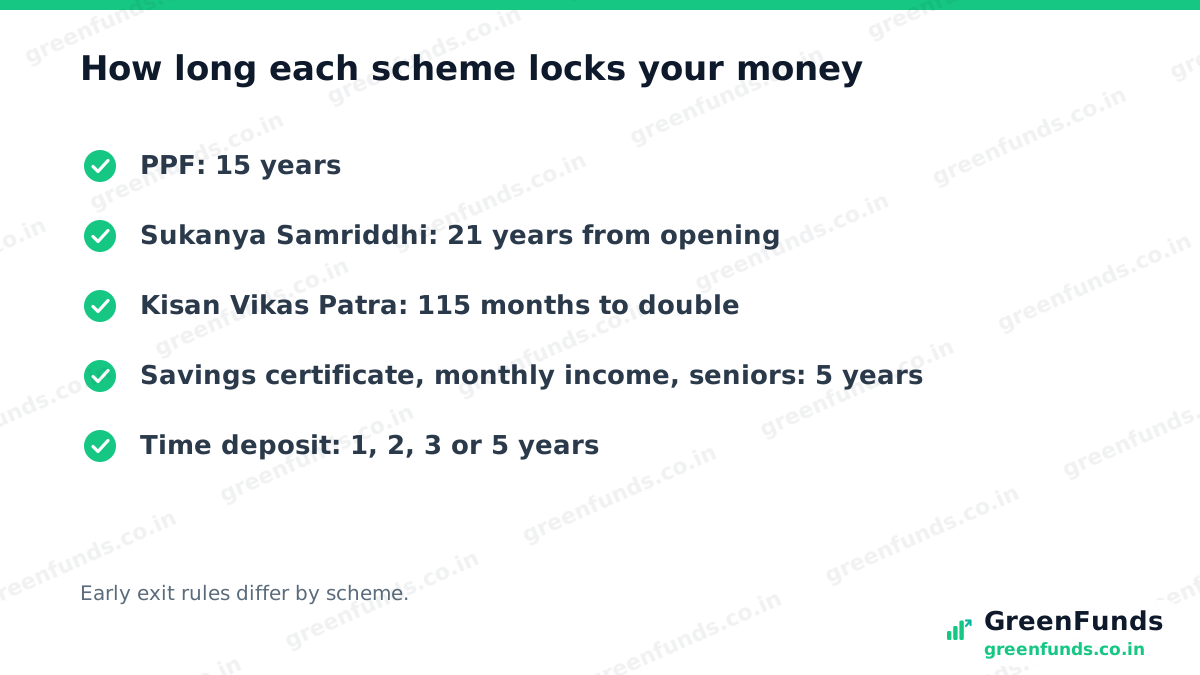
| Time deposit | 6.9% to 7.5%, by term | 1, 2, 3 or 5 years | 5-year deposit can lower tax, old regime; interest taxed |
| Monthly income scheme | 7.4%, paid monthly | 5 years | No deduction; interest taxed |
| Senior citizens savings scheme | 8.2%, paid quarterly | 5 years, can extend | Deposit can lower tax, old regime; interest taxed |
| Public Provident Fund | 7.1% | 15 years | Deposit can lower tax, old regime; interest not taxed |
| Sukanya Samriddhi | 8.2% | 21 years from opening | Deposit can lower tax, old regime; maturity tax-free |
| National Savings Certificate | 7.7% | 5 years | Deposit can lower tax, old regime; interest taxed |
| Kisan Vikas Patra | 7.5% | Doubles in 115 months; exit after 2.5 years | No deduction; interest taxed |
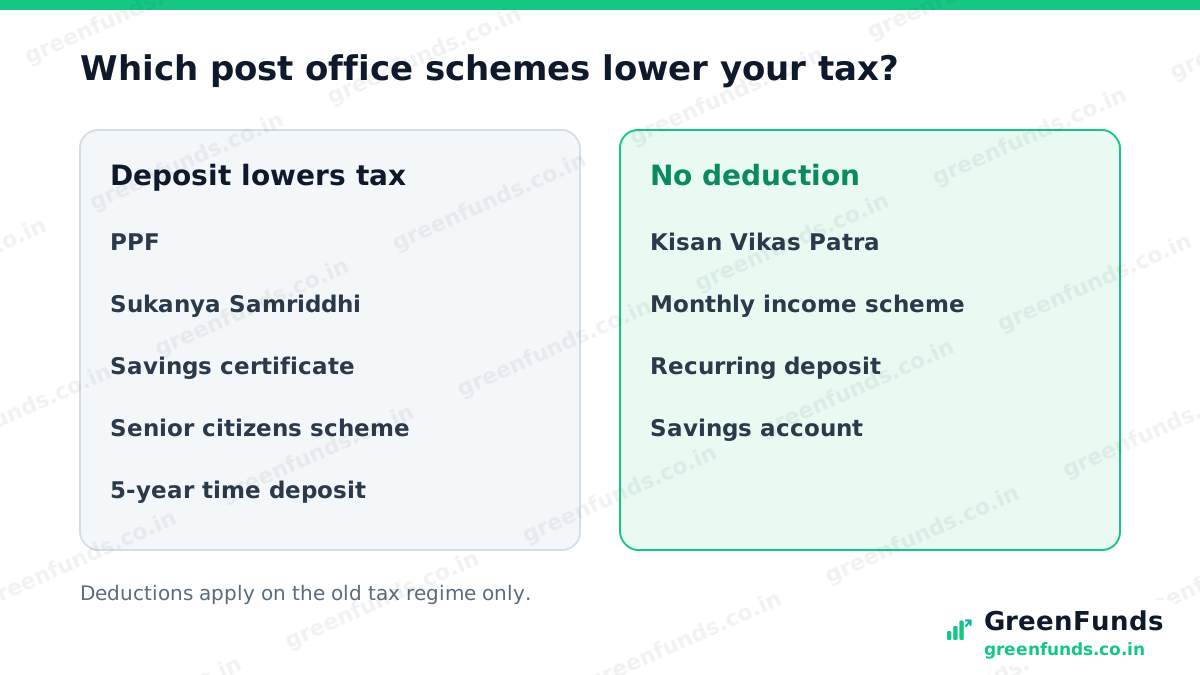
The “lower tax” schemes count towards the same yearly deduction limit people know as Section 80C, and only on the old tax regime. Interest from small savings counts as income from other sources, per the Income Tax Department, unless the scheme is tax-free.
Rates reset every quarter. The government reviews these rates every three months and announces the next quarter’s rates just before it begins. The next review is due before 1 January 2027. So treat any rate here as this quarter’s, and check indiapost.gov.in before you open an account.
An illustration from India Post. Put 1,500 rupees a month into a post office RD for 60 months. That’s 90,000 rupees in. India Post’s own handbook shows about 1,07,049 rupees at maturity, at the 6.7% rate. Run your own amount through the RD calculator.
A note on Mahila Samman. The Mahila Samman Savings Certificate, a 2-year certificate for women and girls at 7.5%, took new accounts from 1 April 2023 to 31 March 2025, per India Post’s handbook. India Post still lists its rate for existing accounts. Ask your post office before you plan around it.
A scam check. The real schemes are listed above, at rates the government publishes every quarter. Anyone selling a “post office scheme” that doubles money in months is running a scam, not a scheme. If you’ve already paid, see how to file a cyber crime complaint.
Which one fits? It depends on the goal, not the rate. A lock-in of 15 years suits retirement, not a goal three years away. A bank fixed deposit or a tax saver FD may sit closer to a time deposit. Compare in rupees with the PPF calculator or the Sukanya Samriddhi calculator.
More to read: RD vs SIP, Kisan Vikas Patra and the post office monthly income scheme.
Questions people ask
What are the post office interest rates for October to December 2026?
The Ministry of Finance kept them unchanged from the July to September quarter. India Post lists 4% on the savings account, 6.7% on the recurring deposit, 6.9% to 7.5% on time deposits, 7.4% on the monthly income scheme, 7.1% on PPF, 7.5% on Kisan Vikas Patra, 7.7% on NSC and 8.2% on both the senior citizens scheme and Sukanya Samriddhi.
How often do post office interest rates change?
The government reviews them every quarter and announces the next quarter's rates just before it starts. The October to December 2026 rates were set by an order dated 30 September 2026. Check the current quarter's rates on indiapost.gov.in.
Which post office schemes save tax?
On the old tax regime, deposits in PPF, Sukanya Samriddhi, NSC, the senior citizens scheme and the 5-year time deposit can lower your taxable income, within the overall yearly limit. Kisan Vikas Patra, the monthly income scheme and the recurring deposit give no such deduction.
Is money in post office schemes safe?
These are government small savings schemes, so the government is behind them. That is different from a bank deposit, which is covered by deposit insurance up to a limit. What you give up is flexibility: most schemes lock your money for years.
Source: Ministry of Finance, Department of Economic Affairs, Office Memorandum F.No.1/4/2019-NS dated 30 September 2026 (rates for 1 October to 31 December 2026 unchanged from the previous quarter), dea.gov.in; India Post savings schemes page (indiapost.gov.in, last updated 30 October 2026) for each rate; India Post savings schemes handbook for terms and tax notes; Income Tax Department guidance on income from other sources and on the Sukanya Samriddhi exemption. Rates change every quarter; check the current notification.
Found this useful? You can buy us a coffee. It keeps GreenFunds free.Flag a possible issue
Was this helpful?
Thanks for the signal.
Comments
Share your experience or a question. Be kind, stay on topic. This is reader discussion, not financial advice.
No comments yet. Be the first to share.