NSC explained: the 5-year government savings certificate
A safe, fixed-rate certificate with a tax deduction, locked for 5 years
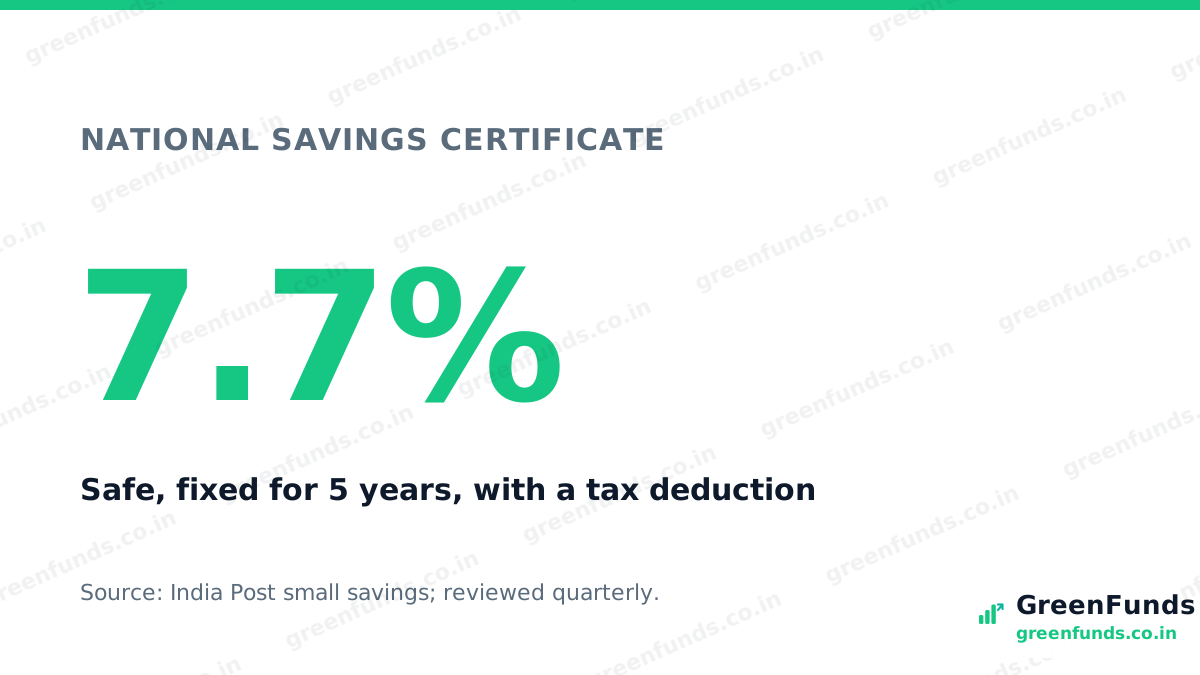
The National Savings Certificate, or NSC, is one of the simplest safe investments in India: you buy a certificate for a fixed five years, it earns a fixed rate backed by the government, and you get your money plus interest at the end. It is a favourite for people who want low risk and a tax deduction in one place.
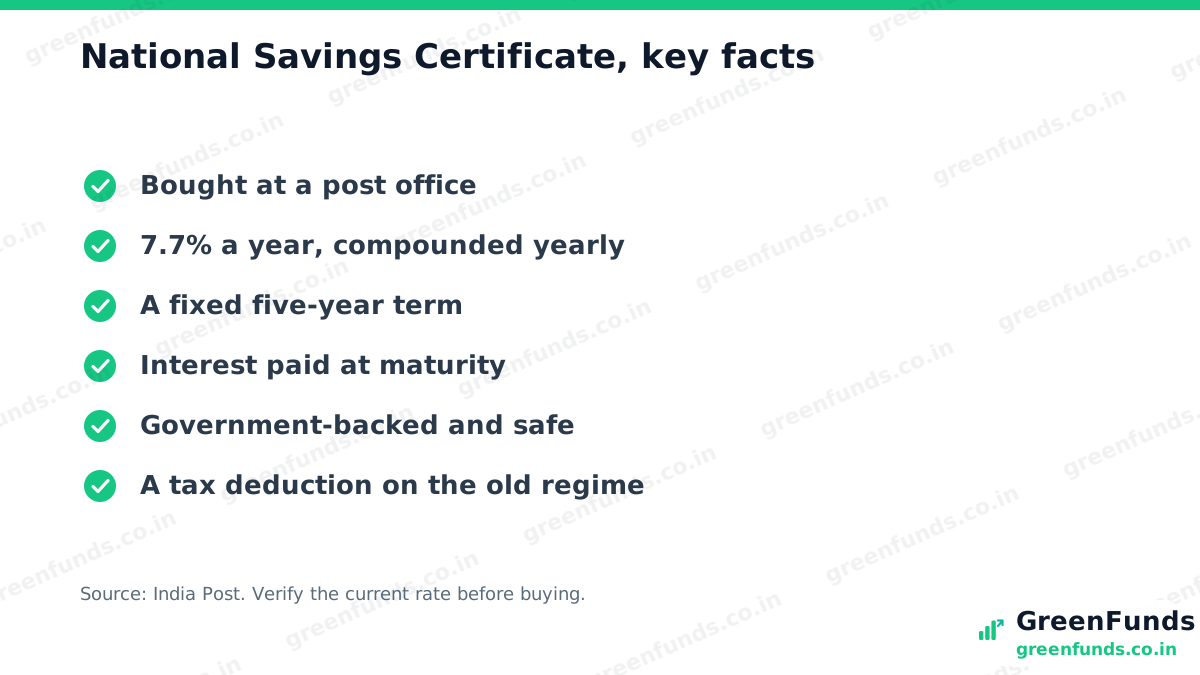
How it works. You buy an NSC at a post office for any amount above a small minimum. It runs for five years at a fixed interest rate, compounded yearly. You do not receive interest along the way; it builds up and is paid out together with your capital when the certificate matures. Because it is government-backed, the money is safe.
What it pays. The rate is 7.7% a year, compounded yearly. The government reviews the rate every quarter, so a new certificate might carry a different rate, but once you buy, your certificate keeps its rate for the full five years. That certainty is part of the appeal.
Did you know? NSC has a quirk that saves alert investors extra tax: the interest it earns each year is reinvested, and that reinvested interest, except in the final year, can itself count toward your yearly tax-saving deduction on the old regime. So the same certificate can give you a small deduction in later years too.
The tax picture. On the old regime, the amount you invest can count toward the 1.5 lakh rupee deduction commonly called Section 80C. The interest is taxable, but because of the reinvestment quirk above, much of it can be offset by the deduction in the years it accrues. On the new regime, there is no such deduction.
The trade-offs. The money is locked for five years, so it is not for funds you may need sooner. And because the interest is taxable, a person in a high slab keeps less of it than a fully tax-free option like the public provident fund would give. Weigh it against those alternatives for your goal.
The takeaway. NSC is a safe, fixed-rate, five-year certificate with a handy tax deduction and a reinvestment quirk that can save a little extra. Just mind the five-year lock-in and the taxable interest, and compare the current rate with other 80C options before you buy.
More to read: ELSS vs PPF vs FD, the 80C options compared, the public provident fund, explained, and the main tax-saving deductions.
Questions people ask
What is the National Savings Certificate (NSC)?
It is a government-backed savings certificate you buy at a post office for a fixed five-year term. It pays a fixed rate of interest, compounded yearly and paid in full at maturity, and the money is safe because it is backed by the government. It is popular as a low-risk, tax-saving option.
What is the NSC interest rate?
It is 7.7% a year, compounded yearly, with the interest paid out together with your capital at the end of the five years. The government reviews the rate each quarter, so new certificates may carry a different rate, but once you buy, your certificate keeps its rate for the full term. Check the current rate before buying.
Does NSC qualify for a tax deduction?
Yes, on the old tax regime. The amount you invest can count toward the 1.5 lakh rupee deduction commonly called Section 80C. There is also a useful quirk: the yearly interest is reinvested, and that reinvested interest (except in the final year) can itself count toward the deduction. It gives no deduction on the new regime.
NSC or a tax-saver fixed deposit, which is better?
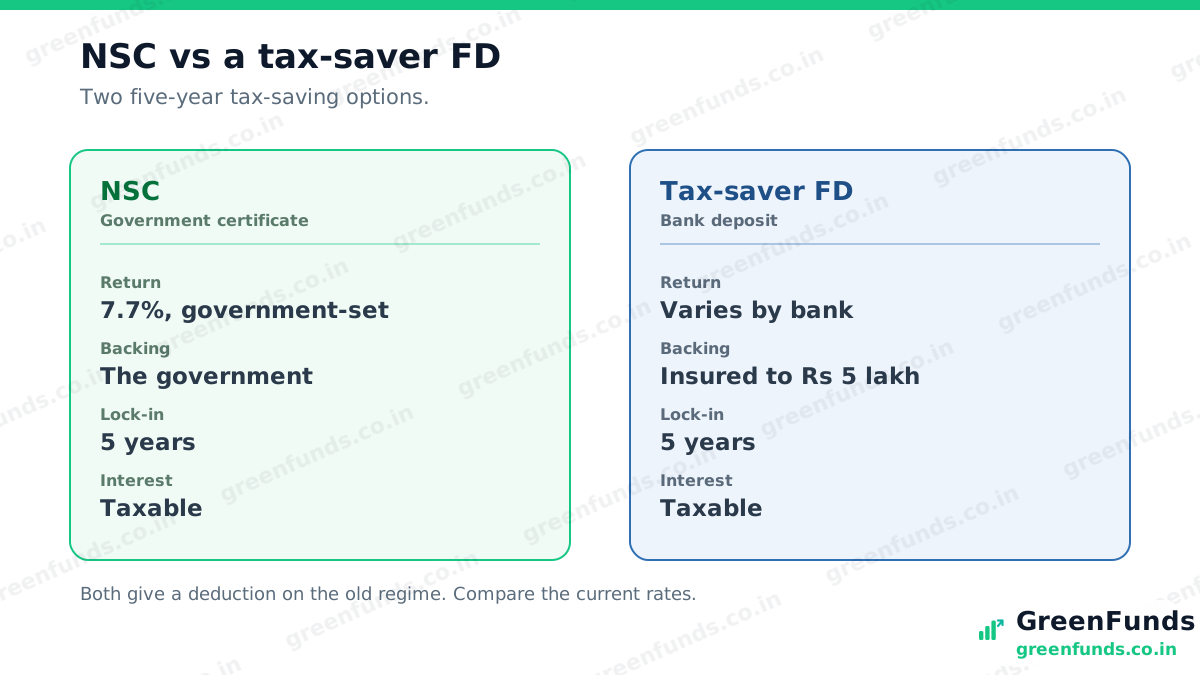
Both are five-year, low-risk, 80C options. NSC is backed by the government and carries a government-set rate; a tax-saver FD is backed by a bank at a rate the bank sets, with deposit insurance up to 5 lakh rupees. The interest is taxable in both. Choose on the rate on offer and which backing you prefer; check current rates before deciding.
Source: India Post small savings. NSC rate 7.7% a year, compounded yearly, paid at maturity (reviewed quarterly by the Ministry of Finance). 5-year term; deduction commonly under Section 80C, old regime. Verify current figures on indiapost.gov.in.
Flag a possible issue
Was this helpful?
Thanks for the signal.
Comments
Share your experience or a question. Be kind, stay on topic. This is reader discussion, not financial advice.
No comments yet. Be the first to share.