ELSS vs PPF vs tax-saver FD: the 80C options compared
Same tax break, very different lock-in, risk and tax at exit
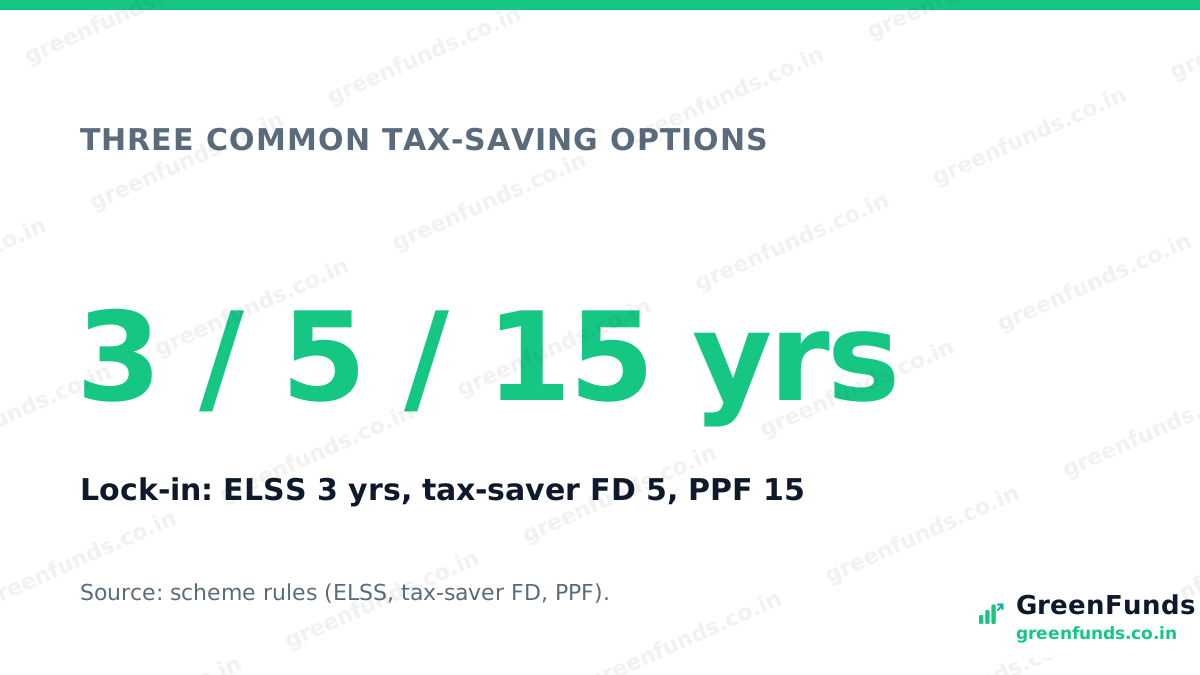
Every year the government lets you keep more of your salary from tax if you lock some money into certain approved savings. Up to 1.5 lakh rupees you put in can be left out of the income you are taxed on. Three of the most common places people use for this are an equity-linked saving scheme (a type of tax-saving stock-market fund, short name ELSS), the public provident fund (PPF, a government savings account), and a five-year tax-saver fixed deposit (FD). They earn you the same tax break, but that is where the similarity ends.
The catch most people miss. The deduction of up to 1.5 lakh rupees, commonly called Section 80C, only works if you file under the old tax regime. Under the new regime, which is now the default, none of these three give you that deduction at all. So before you pick any of them to save tax, the first question is which regime you are on. Our lesson on the old versus new regime walks through that choice.
Did you know? The reason to choose ELSS, PPF or a tax-saver FD for the tax break exists only on the old regime. If you are on the new regime, you would pick these for what they are (growth, safety, a fixed return), not for a deduction, because there is no deduction to claim.
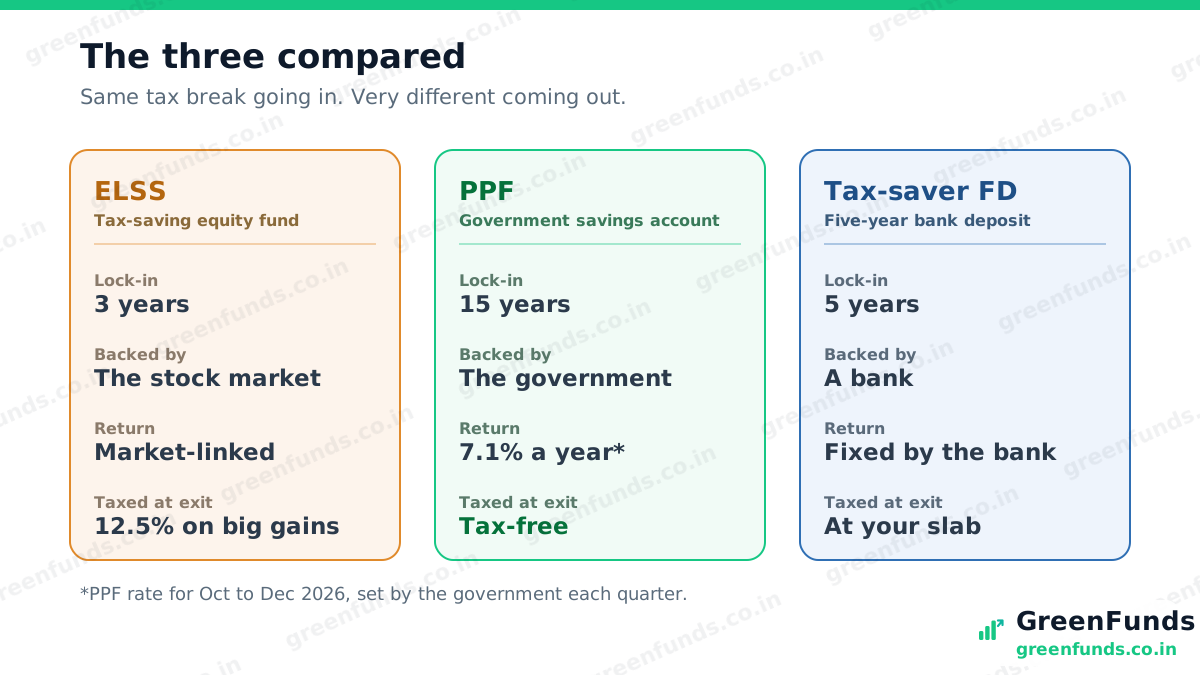
How long your money is locked. This is the clearest difference. The equity-linked saving scheme has the shortest lock-in of the three, at 3 years. The tax-saver fixed deposit locks money for 5 years. The public provident fund locks it for 15 years, though it allows partial withdrawals from the seventh year and can be extended after that. If you may need the money sooner, the lock-in matters as much as the return.
How the return works, and the risk. PPF and the FD both pay a fixed, pre-set return, so you know roughly what you will get. For October to December 2026 the government set the PPF rate at 7.1% a year; a tax-saver FD rate is set by your bank. ELSS is different: it invests in the stock market, so its value rises and falls and the return is not promised. Over long periods the stock market has tended to grow, but it can fall in any given year, which is why the short 3-year lock-in still carries real ups and downs.
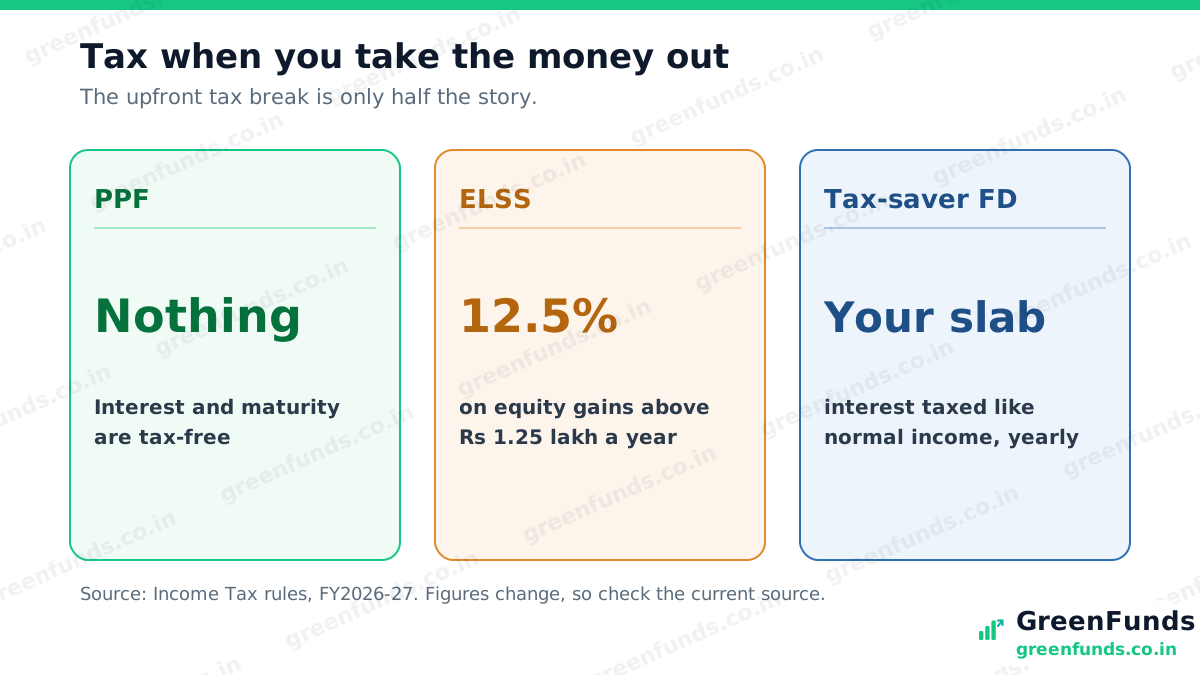
Tax when you take the money out. This is the part that surprises people, because the upfront deduction is only half the story. PPF is the most tax-friendly: its interest and the final maturity amount are both tax-free. A tax-saver FD is the least: its interest is added to your income and taxed at your slab rate every year, so a person in a high slab keeps less of it. ELSS sits in between: its gains are taxed only when you sell, and only the part above 1.25 lakh rupees of equity gains in a year is taxed, at 12.5%. See how gains on investments are taxed for the fuller picture.
A rupee example. Say you put 1.5 lakh rupees into one of them (an illustration). In PPF at 7.1%, the interest each year is tax-free, so every rupee it earns stays yours. In a tax-saver FD at a similar rate, if you are in the 30% slab, nearly a third of the interest goes back in tax each year. In ELSS, you carry stock-market risk for 3 years, but the gains are taxed lightly and only above the yearly 1.25 lakh rupee limit. Same tax break going in, three different outcomes coming out.
How to think about choosing. This is not about one being best. It is about matching the tool to your situation: the lock-in you can live with, how much ups and downs you can stomach, and your tax slab. Someone who cannot take any risk and wants tax-free interest leans one way; someone comfortable with the market and wanting the shortest lock-in leans another. Many people use more than one. Decide the regime first, then the fit.
More in this cluster: the main tax-saving deductions explained, old versus new tax regime, the public provident fund in detail, and, for the equity side, what mutual funds are.
Questions people ask
What is the difference between ELSS, PPF and a tax-saver FD?
All three can qualify you for the same yearly tax deduction of up to 1.5 lakh rupees. But they differ in three ways that matter. Lock-in: an equity-linked saving scheme (ELSS) locks money for 3 years, a tax-saver fixed deposit for 5 years, and a public provident fund (PPF) for 15 years. Risk: ELSS invests in the stock market so its value moves up and down, while PPF and the FD give a fixed, pre-set return. Tax at exit: PPF's interest and maturity are tax-free, FD interest is taxed at your income slab, and ELSS gains above 1.25 lakh rupees in a year are taxed at 12.5%.
Which has the shortest lock-in among 80C options?
The equity-linked saving scheme (ELSS) has the shortest lock-in of the three main options, at 3 years. A tax-saver fixed deposit locks money for 5 years, and the public provident fund (PPF) for 15 years, though PPF allows partial withdrawals from the seventh year and can be extended.
Do ELSS, PPF and tax-saver FD save tax in the new tax regime?
No. The deduction of up to 1.5 lakh rupees commonly called Section 80C is available only if you choose the old tax regime. Under the new regime, which is now the default, none of these three give you that deduction. So the tax-saving reason to pick them applies only to people on the old regime. Verify the current rules before deciding, as the tax law was rewritten recently.
Is PPF or FD interest tax-free?
PPF interest and the maturity amount are tax-free. A bank fixed deposit is different: its interest is added to your income and taxed at your slab rate every year, even a tax-saver FD. The tax-saver FD gives you the upfront deduction, but the interest it pays is still taxable.
What return does PPF give right now?
The government sets the PPF rate every quarter. For October to December 2026 it is 7.1% a year. It has held at 7.1% for several quarters, but it can change each quarter, so check the latest Ministry of Finance notification. A tax-saver FD rate is set by your bank, and an ELSS return is not fixed at all because it follows the stock market.
Source: Small savings rates: Ministry of Finance notification for Oct to Dec 2026 (PPF 7.1%). Equity gains tax: Income Tax rules after Budget 2024, unchanged in Budget 2026. Deduction limit: Income Tax Act. Figures change, so check the current source.
Flag a possible issue
Was this helpful?
Thanks for the signal.
Comments
Share your experience or a question. Be kind, stay on topic. This is reader discussion, not financial advice.
No comments yet. Be the first to share.