Capital gains tax on your investments
Tax on the profit when you sell
When you sell an investment for more than you paid, that profit is called a capital gain. Capital gains tax is simply the tax you pay on that profit. How much you pay depends on what you sold and how long you held it, and a few simple rules can keep the bill low and legal.
What a capital gain is
A capital gain is the profit when you sell an investment for more than you paid. Buy units for ₹2 lakh, sell for ₹3 lakh, and your capital gain is ₹1 lakh. You are taxed on that ₹1 lakh gain, not on the full ₹3 lakh you receive.
Short term or long term
How much tax you pay depends mostly on how long you held the investment before selling.
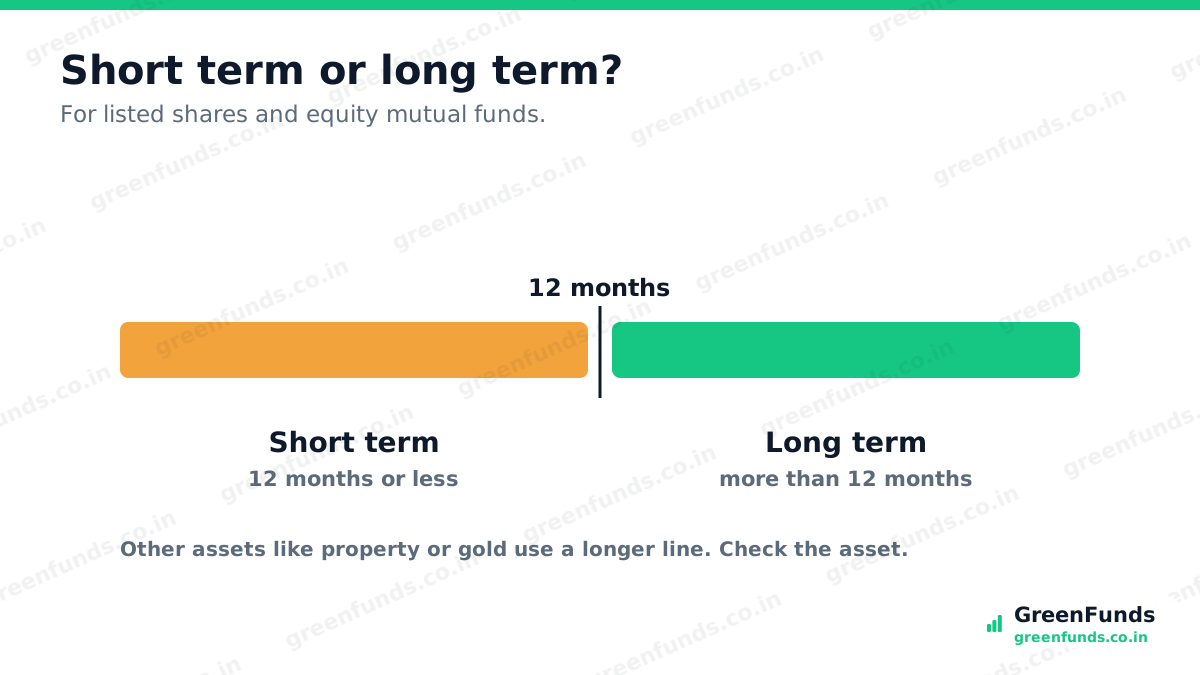
For listed shares and equity mutual funds, the line is 12 months. Hold for 12 months or less and it is a short-term capital gain. Hold for more than 12 months and it is long term, which is usually taxed more gently. For other assets, like property or gold, the long-term line is longer, so check the rule for the asset you are selling.
Tax on shares and equity mutual funds
These are the rules most young investors meet first.
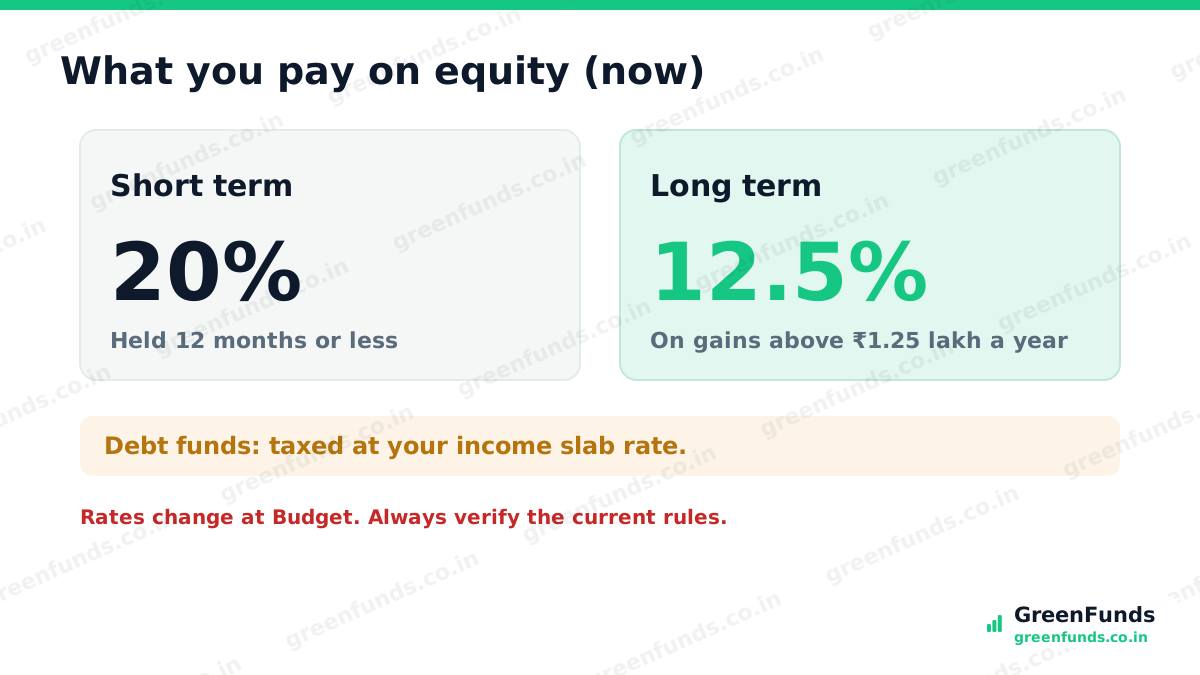
Under the current rules:
- Short-term gains on listed equity are taxed at 20%.
- Long-term gains are taxed at 12.5%, and only on the amount above ₹1.25 lakh of such gains in a financial year. There is no indexation.
A small surcharge and a 4% health and education cess can apply on top. These rates and limits change at Budget time, so treat them as the position now and confirm the current figures on incometax.gov.in.
A rupee example. You put ₹2 lakh into an equity fund and sell after two years for ₹3.5 lakh. Your long-term gain is ₹1.5 lakh. The first ₹1.25 lakh is exempt, so you pay 12.5% on the remaining ₹25,000, which is about ₹3,125, plus cess. Illustration only; verify the current rules.
Debt funds, gold and property
- Debt mutual funds bought on or after 1 April 2023 are taxed at your income slab rate, whatever the holding period. The old long-term benefit no longer applies to them.
- Gold and property have their own holding periods and rules, and property bought before 23 July 2024 may have an indexation option. These are detailed, so check the specific rule or ask a tax professional.
The rules worth knowing
- Use the ₹1.25 lakh exemption. You can book up to that much long-term equity gain each year tax free. Many investors do this deliberately.
- A switch is a sale. Moving from one fund to another triggers tax on the gain, even though no cash reaches you.
- Losses can be set off. A capital loss can usually be adjusted against a capital gain, which lowers your tax. The rules on which loss offsets which gain are specific, so check them.
Common mistakes
- Selling just before the long-term line. Holding a few extra days to cross 12 months can change the rate.
- Forgetting tax on switches and rebalancing. Every sale counts, even internal ones.
- Ignoring the yearly exemption. Letting gains pile up unbooked can mean a bigger bill later.
Tax should shape your decisions a little, not run them. Invest for the goal first, then use these rules to keep what is yours.
Next, see how new vs old tax regime affects your slab, or start with tax basics and Section 80C.
Questions people ask
What is capital gains tax?
It is the tax on the profit you make when you sell an investment like shares, mutual funds, gold or property for more than you paid. You are taxed on the gain, not the full amount you receive.
What is the difference between short-term and long-term capital gains?
It depends on how long you held the investment. For listed shares and equity mutual funds, 12 months or less is short term and more than 12 months is long term. Long-term gains are usually taxed more gently. The holding period differs for other assets.
How much tax do I pay on selling shares or equity mutual funds?
Under current rules, short-term gains on listed equity are taxed at 20%, and long-term gains at 12.5% on the amount above 1.25 lakh rupees in a financial year, with no indexation. These rates can change at Budget time, so confirm the current figures on incometax.gov.in.
How are debt mutual funds taxed now?
For units bought on or after 1 April 2023, gains are added to your income and taxed at your slab rate, whatever the holding period. There is no special long-term rate for them any more. Confirm the current rule, as this area has changed recently.
Is there any capital gains exemption?
Yes. On long-term equity gains, the first 1.25 lakh rupees of gains in a financial year is exempt, and you pay tax only on the amount above that. Booking some gains each year within this limit is a common, legal way to use it.
Do I pay tax when I switch mutual funds?
Yes. Switching from one fund to another counts as selling the first one, so any gain is taxable just like a normal redemption, even though no money reaches your bank account.
When do I pay capital gains tax?
You report capital gains in your income tax return for the year you sold. If the tax due is large, you may also need to pay advance tax during the year. A tax professional can confirm what applies to you.
Sources
- Income Tax Department, incometax.gov.in Capital gains rates, holding periods and limits change at Budget time; always confirm the current rules before you act.
- Union Budget 2024 and 2026 announcements Budget 2024 revised equity rates and the exemption; Budget 2026 kept the core equity rates unchanged. Verify the latest.