Types of mutual funds, explained
The main fund families, by what they hold
Figures checked 2026-10-18
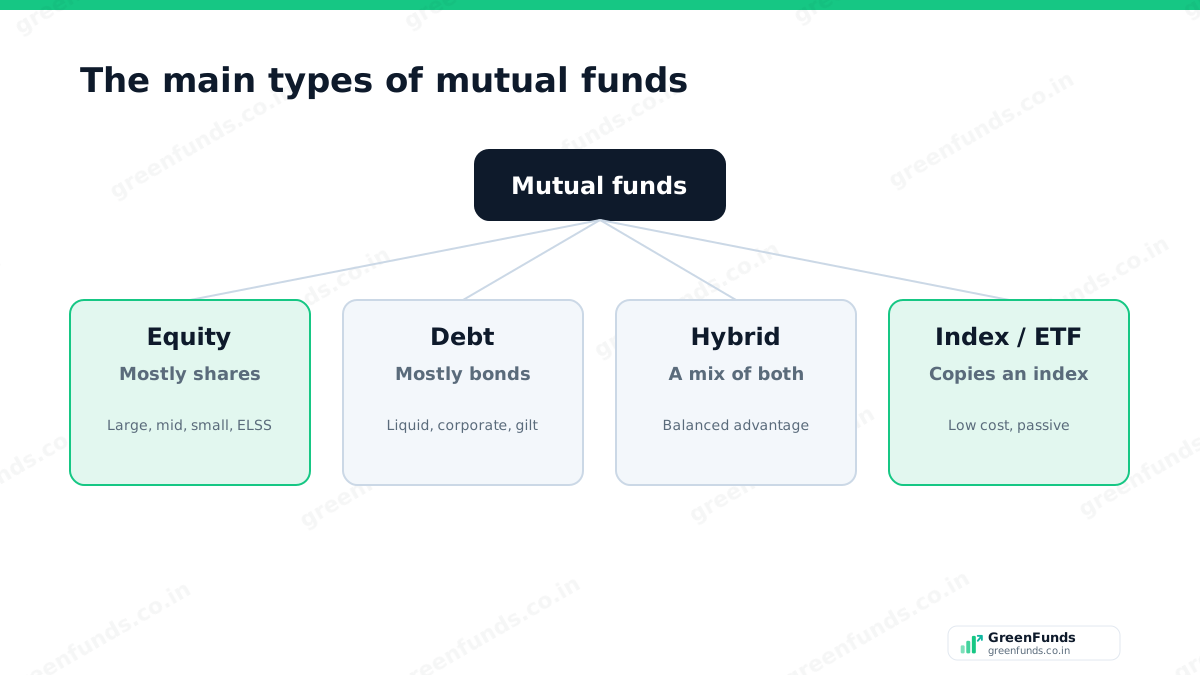
Mutual funds come in a few main families, grouped by what they invest in: equity funds hold company shares, debt funds lend to governments and companies, hybrid funds mix the two, and index funds simply copy the market. India’s regulator, SEBI, sorts them this way so you can compare like with like. You do not need every sub-type; the main families are enough to pick one that fits your goal. This is the companion to the complete mutual funds and SIP guide.
Equity funds: mostly shares
Equity funds put most of your money into company shares. They aim for higher long-term growth, and in return they swing more from year to year. The main sub-types are defined by the size of the companies they hold.
- Large cap: the 100 biggest listed companies by market value. The steadiest equity option.
- Mid cap: companies ranked 101 to 250. More growth potential, more wobble.
- Small cap: companies ranked 251 and beyond. The highest growth potential and the highest risk.
- Flexi cap and multi cap: free to spread across all three sizes, so the manager is not boxed in.
- ELSS (Equity Linked Savings Scheme): a tax-saving equity fund with a three-year lock-in, eligible for a Section 80C deduction. More in tax basics and 80C.
- Sectoral or thematic: concentrated in a single sector or theme, such as banking or technology. Higher risk, because all the eggs sit in one basket.
Those size labels are a ranked list, not marketing. The exact cut-offs are in large, mid and small cap, what they mean.
Debt funds: mostly bonds
Debt funds lend money to governments and companies and earn interest. They are steadier than equity and usually lower-returning. They are grouped by how long they lend for and how safe the borrowers are:
- Overnight and liquid funds: for very short parking of a few days to a few months. A liquid fund can even pay you back the same day, within a cap.
- Ultra-short, low-duration and money market funds: for several months up to a year or so.
- Corporate bond and banking and PSU funds: lend mainly to strong companies and institutions.
- Gilt funds: lend only to the government, so almost no default risk, but their prices move with interest rates.
- Credit risk funds: chase higher returns by lending to weaker borrowers, so they carry more default risk.
Debt funds are not risk-free. A borrower can default, and bond prices fall when interest rates rise. See what happens when a bond in your debt fund goes bad.
Hybrid funds: a mix of both
Hybrid funds hold shares and bonds together in one scheme, so you get a ready-made blend:
- Conservative hybrid: mostly debt, with a little equity.
- Balanced and aggressive hybrid: more equity, for more growth.
- Balanced advantage (dynamic asset allocation): shifts the equity and debt mix automatically as markets move.
- Multi-asset: adds a third asset such as gold.
- Arbitrage: aims for low-risk returns from price differences, and is often taxed like equity.
A single hybrid fund can be a simple one-stop option for someone who does not want to manage a mix themselves.
Index funds and ETFs: the passive route
An index fund does not try to beat the market. It simply copies an index, such as the Nifty 50, holding the same companies in the same weights, at a very low cost.
An ETF (Exchange Traded Fund) is the same idea, but it trades on the stock exchange like a share, so it needs a demat account and has a live price through the day.
Active versus passive
An actively managed fund pays a manager to pick holdings and try to beat a benchmark. A passive fund just tracks the benchmark cheaply. After fees, a large share of active funds fail to beat their benchmark over long periods, partly because the measuring stick got tougher: since 1 February 2018, funds are judged against the Total Return Index, which counts dividends. For many beginners, a low-cost index fund is a sensible default. A good active fund is still a fair choice. What rarely makes sense is paying active fees for a fund that quietly hugs the index.
Two more families
- Solution-oriented funds: retirement and children’s funds, which usually carry a lock-in.
- Fund of funds: a fund that invests in other funds rather than directly in shares or bonds.
So which type do you need?
The honest answer is that the type follows your goal, not the other way round.
- Money you need within a year: a liquid or short-duration debt fund.
- A long-term goal, five years or more: an equity fund, often a simple flexi cap or a low-cost index fund.
- Somewhere in between, or you want one simple holding: a hybrid fund.
Match the family to your time frame and your stomach for ups and downs, then work out the specific fund using the how to pick a mutual fund framework.
Back to the complete mutual funds and SIP guide, or browse the money basics path.
Questions people ask
How many types of mutual funds are there?
SEBI groups schemes into five broad families: equity, debt, hybrid, solution-oriented, and other (which includes index funds and ETFs). Within those sit many sub-categories, but you only need the main families to start.
Which type of mutual fund is best for beginners?
There is no single best type, only a best fit for your goal and time frame. For a long-term goal many beginners start with a simple, low-cost index fund or a flexi cap fund. For money you need within a year, a liquid or short-duration debt fund fits better. The horizon decides, not the label.
What is the difference between equity and debt funds?
Equity funds mostly hold company shares, aiming for higher long-term growth with bigger ups and downs. Debt funds mostly lend to governments and companies and earn interest, which is steadier but usually lower-returning. Hybrid funds mix the two.
Are index funds better than active funds?
Index funds copy a market index at very low cost, while active funds pay a manager to try to beat it at a higher cost. After fees, many active funds do not beat their benchmark over the long run, which is why a low-cost index fund is a sensible default for many people. Both are valid choices.
What is an ELSS fund?
ELSS stands for Equity Linked Savings Scheme, a type of equity fund that gives a tax deduction under Section 80C in return for a three-year lock-in. It is the only mutual fund category with an 80C tax benefit.
Sources
- SEBI, scheme categorisation for mutual funds The official fund categories and their definitions. Verify current categories here.
- AMFI (Association of Mutual Funds in India) Industry data and investor awareness resources.