Atal Pension Yojana: a guaranteed pension for later life
Small contributions now for a fixed, government-guaranteed pension at 60
Many people reach their sixties with no regular income waiting for them. Atal Pension Yojana is a government scheme built to fix exactly that for workers who do not have a formal pension: you put in a small amount each month now, and from age 60 you get a fixed pension for life, guaranteed by the government.
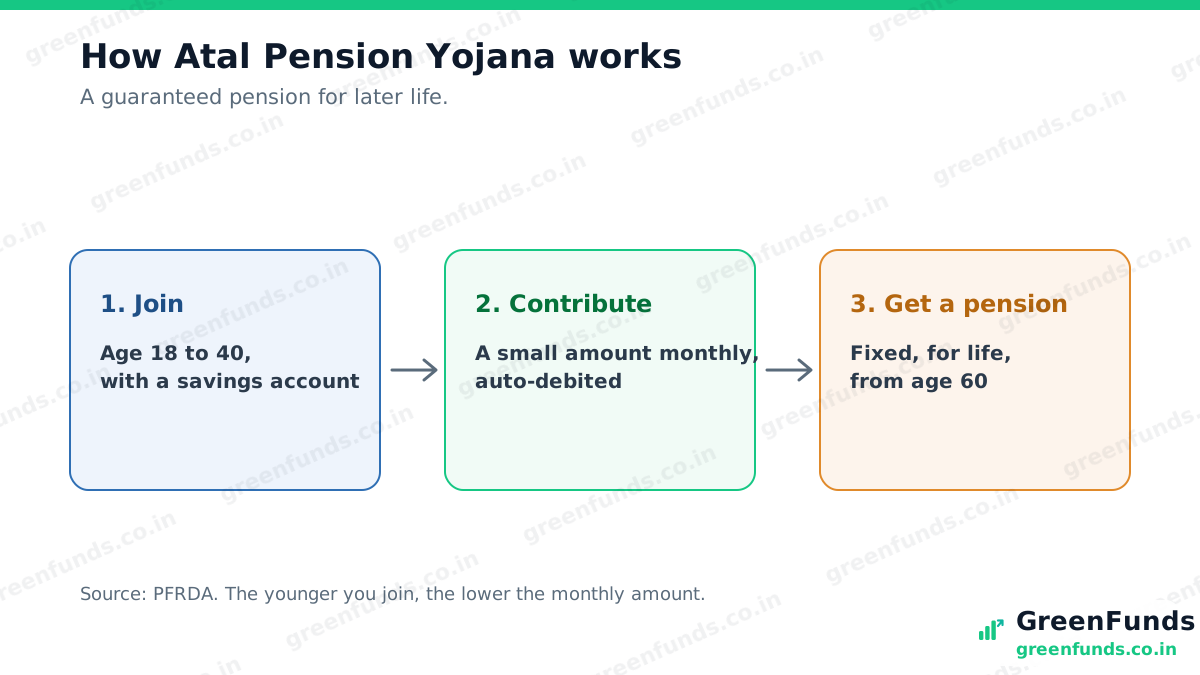
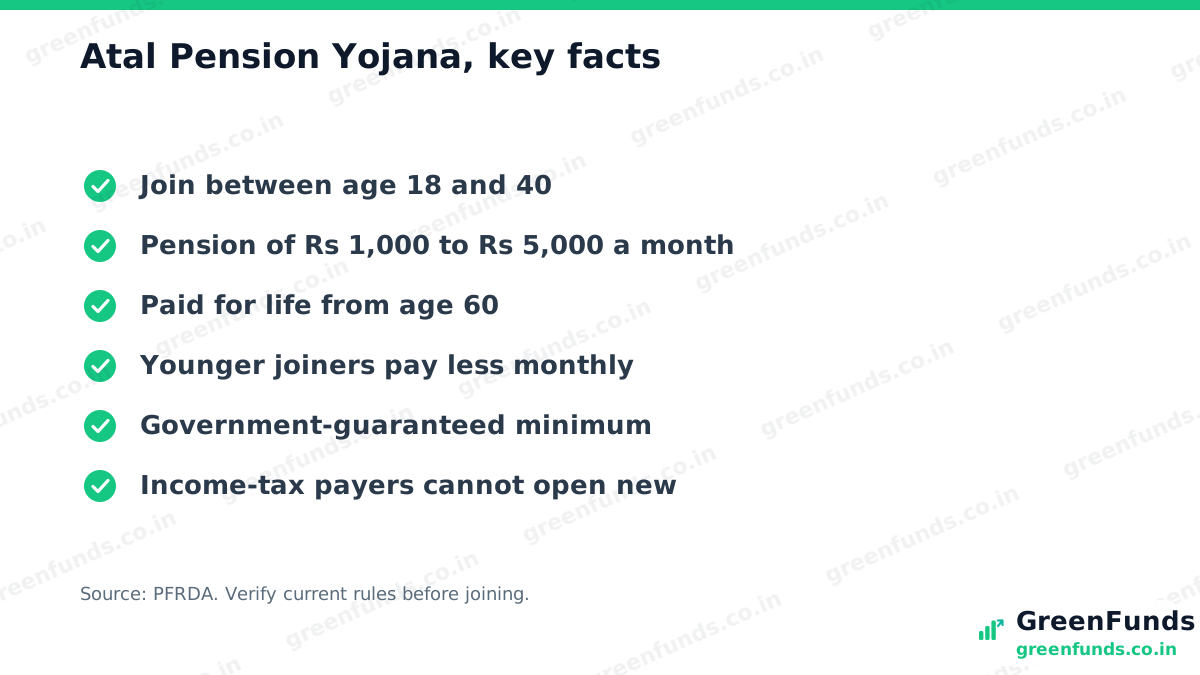
How it works. While you are working, you contribute a small sum every month, auto-debited from your bank account. You choose how big a pension you want, between 1,000 and 5,000 rupees a month. From age 60, that pension is paid to you for life. It is run under the pension regulator PFRDA and is aimed mainly at people in the informal sector.
The start-young advantage. The monthly contribution depends on two things: the pension you choose, and the age you join. The younger you start, the smaller the monthly amount for the same pension, because your money has more years to build up. Joining at 18 costs far less per month than joining at 39 for the very same pension.
Did you know? Since 1 October 2022, anyone who is or has been an income-tax payer cannot open a new Atal Pension Yojana account. The scheme is deliberately aimed at people outside the tax net, mostly informal-sector and lower-income workers, which is who it is designed to protect.
Who can join, and the guarantee. Any Indian citizen aged 18 to 40 with a savings account can join, subject to the income-tax rule above. The standout feature is the government guarantee: if the scheme’s investments do not earn enough, the government makes up the difference so your minimum pension is assured. The pension also continues to your spouse after you, and the built-up amount goes to your nominee after both.
The trade-offs. The money is locked until 60, and the pension amounts, while guaranteed, are modest, so this is a safety-net pension rather than a full retirement plan on its own. For many, it works best alongside other savings. And remember the income-tax eligibility rule before you plan around it.
The takeaway. Atal Pension Yojana turns small monthly contributions into a fixed, government-guaranteed pension for life after 60, aimed at those without a formal pension. Start young to pay less, check the income-tax eligibility rule, and treat it as a dependable base, not the whole plan.
More on retirement: NPS, the low-cost pension account, the retirement planning guide, and PPF versus EPF.
Questions people ask
What is Atal Pension Yojana?
It is a government pension scheme, run under the pension regulator PFRDA, aimed mainly at workers in the informal sector. You contribute a small amount every month while working, and from age 60 you receive a fixed monthly pension for life, guaranteed by the government. You choose a pension level between 1,000 and 5,000 rupees a month.
Who can join Atal Pension Yojana?
Any Indian citizen aged 18 to 40 with a savings bank account can join. However, since 1 October 2022, anyone who is or has been an income-tax payer cannot open a new account. The scheme is targeted at people outside the tax net, typically informal-sector and lower-income workers. Confirm the current eligibility with your bank.
How much pension does Atal Pension Yojana give?
You pick a guaranteed monthly pension of 1,000, 2,000, 3,000, 4,000 or 5,000 rupees, payable for life from age 60. The monthly contribution you pay depends on the pension you choose and the age you join: the younger you start, the smaller the monthly amount for the same pension. If investment returns fall short, the government guarantees the minimum pension.
What happens to Atal Pension Yojana money after death?
The pension continues to your spouse after your death. After both of you, the money built up in the account is returned to your nominee. So the scheme is designed to protect a couple and leave the corpus to the family. Check the exact terms with your bank, as conditions apply.
Source: PFRDA scheme. Join age 18 to 40; guaranteed pension of Rs 1,000 to Rs 5,000 a month from 60. Since 1 October 2022, income-tax payers cannot open a new account. Verify current rules on the PFRDA or your bank's site.
Flag a possible issue
Was this helpful?
Thanks for the signal.
Comments
Share your experience or a question. Be kind, stay on topic. This is reader discussion, not financial advice.
No comments yet. Be the first to share.