Retirement planning in India: a beginner's guide
Start early, let compounding do the work
Figures checked 2026-10-23
Retirement planning sounds like something for older people. It is the opposite. The single most powerful thing in retirement saving is time, and the person with the most time is the one just starting out. This guide is the hub: it explains why to start now, the main tools India gives you, and a simple way to begin, then links out to the deeper pages.
On this page: Why start now · The main tools · How much, and where · A simple plan · Myths
Go deeper: Compounding · Inflation · Mutual funds and SIP · PPF explained · Activate your UAN and see your EPF
Why start now
Retirement is really just your future salary, paid by your past self. The engine that funds it is compounding: your returns earn returns, and that snowball needs years to get big. A ten-year head start usually matters more than a bigger monthly amount later.
The other half of the story is inflation. Money sitting idle loses buying power every year, so the goal is not just to save but to grow your savings faster than prices rise. That is why retirement money, which you will not touch for decades, is one place where some growth-focused investing makes sense.
Did you know? A fixed deposit and a long-term equity fund can feel similar over one year, but over 30 years the gap is enormous, because compounding rewards both the rate and the time. For a goal that far away, starting is worth more than optimising.
The main retirement tools
India gives you a few strong, tax-friendly ways to build a retirement corpus. Most people use a combination rather than just one.
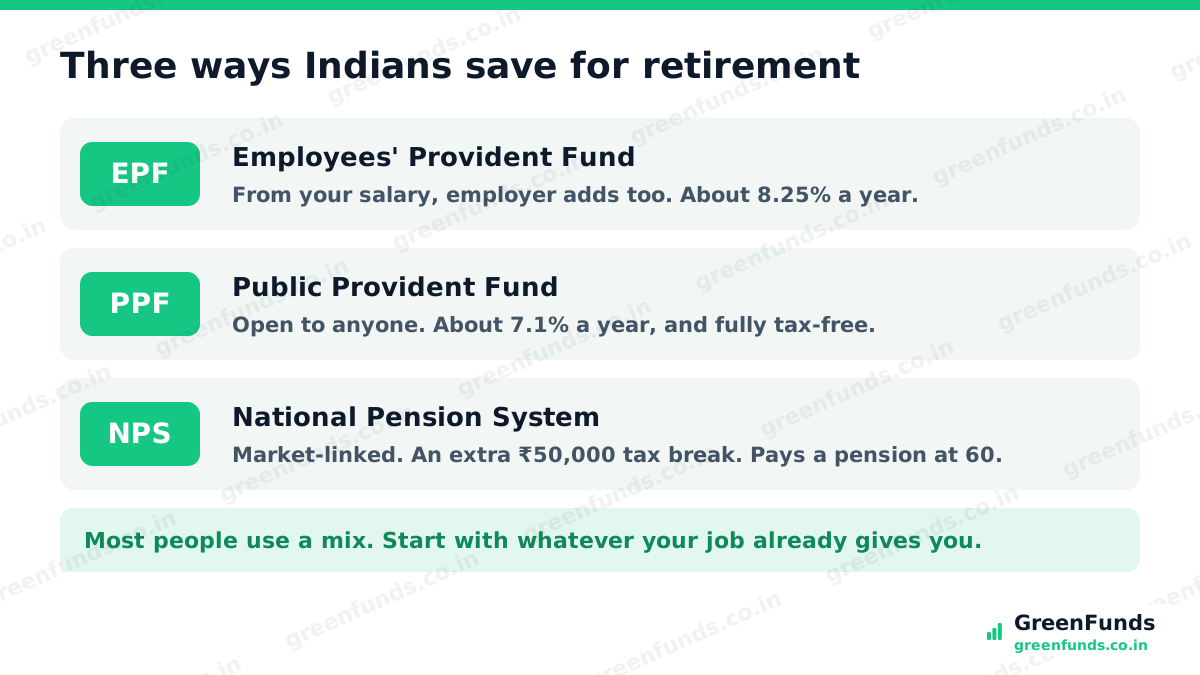
EPF: the one from your salary
If you are salaried, you already have a head start. A slice of your pay goes into the EPF (Employees’ Provident Fund) each month and your employer matches part of it.
Did you know? The EPF paid 8.25% for FY2024-25 (set by the EPFO’s board, with the Finance Ministry’s concurrence). That is a solid, low-risk return, and the employer’s contribution is effectively extra pay you only get if you stay invested. The rate is reviewed yearly, so check epfindia.gov.in. Start by activating your UAN so you can actually see it.
PPF: open to everyone
The PPF (Public Provident Fund) is a government-backed account anyone can open, salaried or not. You can put in up to ₹1.5 lakh a year, it has a 15-year term, and the interest is fully tax-free. The rate has been 7.1% a year since 2020, reset by the government each quarter.
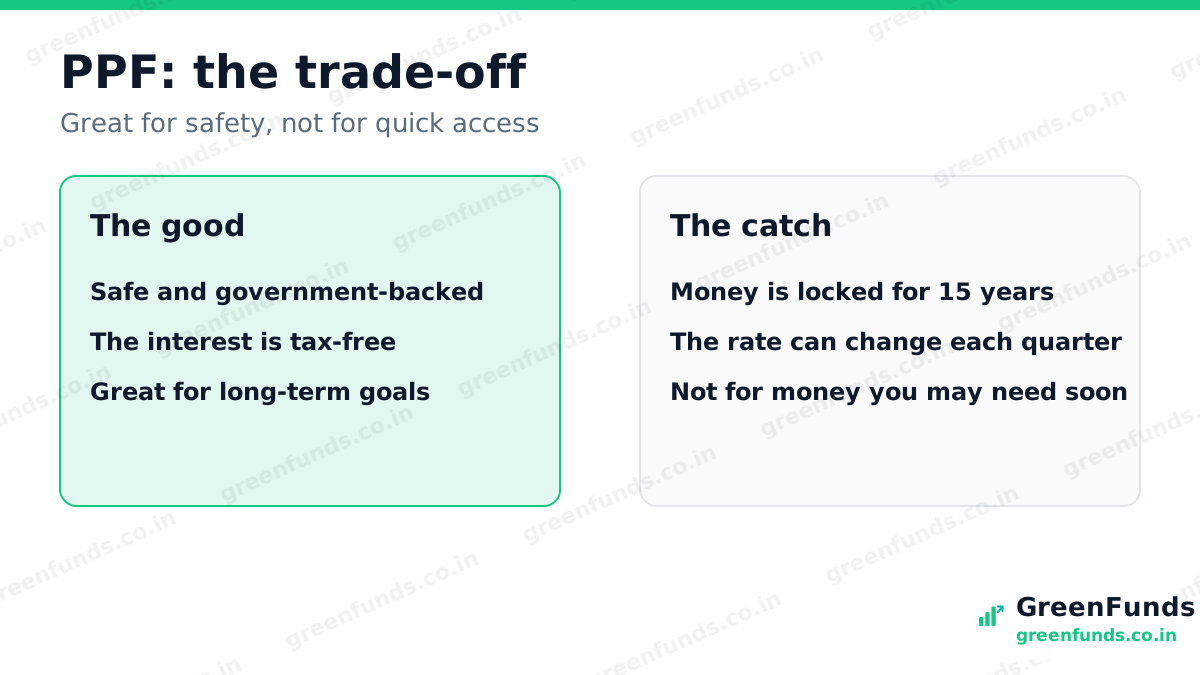
As the diagram shows, PPF trades access for safety and tax-free growth. That lock-in is a feature for a retirement goal, not a bug. The fuller picture is in PPF explained.
NPS: the pension builder
The NPS (National Pension System) is a market-linked retirement account. You choose how much goes to equity and bonds, and it grows until you turn 60. At 60 you can take up to 60% as a lump sum and must use at least 40% to buy an annuity, which pays you a regular pension.
Its standout feature is tax: under the old regime, NPS gives an extra deduction of up to ₹50,000 under Section 80CCD(1B), on top of the ₹1.5 lakh 80C limit. The lump sum at 60 is tax-free, while the annuity pension is taxed as income. Tax rules change, so confirm the current position before planning around them.
Mutual funds: growth for the long run
Beyond the three above, ordinary mutual funds, especially low-cost equity index funds through a monthly SIP, are how many people build the growth part of their retirement. They carry market risk and swing in the short term, which is exactly why a decades-long goal suits them.
How much, and where
Two questions decide a retirement plan: how much to save, and how to split it.
How much. A common rule of thumb is to aim for a corpus of roughly 25 to 30 times your yearly expenses, so your investments can support you without a salary. Treat that as a direction to head in, not an exact target, and let a SIP do the heavy lifting over time.
Where. The rough idea is to keep steady, guaranteed money (EPF, PPF) as your base and let growth money (equity funds, the equity part of NPS) do the compounding while you are young, shifting toward safety as you near retirement. One old rule of thumb is to hold roughly “100 minus your age” as a percentage in equity, higher when young, lower later. It is a starting point, not a rule, and your own comfort with risk matters more.
A simple plan to start
- Build a small emergency fund first, so you never have to break a retirement investment in a crisis.
- Activate your UAN and know your EPF is running.
- Open a PPF account for tax-free, long-term money, even with a small yearly amount.
- Start a monthly SIP into a low-cost fund, and raise it as your income grows.
- Consider NPS, especially if you want the extra tax deduction.
- Review once a year, not daily.
Myths and mistakes
- “I will start when I earn more.” The cost of waiting is the compounding you skip, which is the most expensive thing to lose.
- “EPF alone is enough.” For many it is not, once inflation is counted. It is a strong base, not the whole plan.
- “Equity is gambling.” Over a few years it can be volatile; over decades, broad, low-cost funds have historically grown faster than inflation. Timeframe changes everything.
- “Retirement money should be fully safe.” Being too safe for too long lets inflation quietly shrink it. Match the risk to the timeframe.
Putting it together
Retirement planning is less about clever products and more about starting early, automating it, and leaving it alone. Use the tax-friendly tools India gives you, keep a base of steady savings and a growth engine of low-cost funds, and let compounding work for the decades you have. The best day to start was years ago. The second best is today.
New here? Begin with the money basics path.
Questions people ask
When should I start saving for retirement?
As early as you can. The biggest lever in retirement is not how much you earn but how long your money compounds. Starting in your twenties, even with a small amount, usually beats starting later with a larger one.
EPF, PPF or NPS, which is best for retirement?
They do different jobs, so most people use a mix. EPF comes out of your salary and your employer adds to it. PPF is open to anyone and is tax-free. NPS is market-linked and gives an extra tax break while building a pension. The right blend depends on your job and goals.
How much money do I need to retire?
It depends on your yearly expenses, not a single magic number. A common rule of thumb is a corpus of about 25 to 30 times your annual spending, adjusted for inflation. Treat that as a starting point to aim at, not a promise, and revisit it as life changes.
What is the NPS tax benefit?
Under the old tax regime, NPS gives an extra deduction of up to ₹50,000 under Section 80CCD(1B), over and above the ₹1.5 lakh Section 80C limit. Tax rules change and this is not available in the new regime, so confirm the current position on incometax.gov.in.
Do I need equity or mutual funds for retirement?
For a goal decades away, some equity, usually through mutual funds or the equity part of NPS, has historically helped money grow faster than inflation. It swings in the short term, so it suits long horizons, not money you need soon.
Is PPF better than a fixed deposit for retirement?
They are different tools. PPF interest is tax-free and the account is built for the long term, but your money is locked in. A fixed deposit is flexible but its interest is taxed at your slab. Which fits depends on your timeframe and tax situation.
Sources
- EPFO (Employees' Provident Fund Organisation) EPF interest rate and rules. The rate is reviewed yearly; verify the current one here.
- National Savings Institute / Finance Ministry, small savings PPF interest rate and rules. Small-savings rates are reset each quarter; confirm the current rate.
- PFRDA / NPS Trust NPS rules on contributions, withdrawal and annuity. Confirm current rules here.
- Income Tax Department, Government of India Deduction limits (80C, 80CCD) and tax treatment. These change with each Budget.