Cyber crime complaint: what to do, step by step
Call 1930 first, then file on cybercrime.gov.in and tell your bank
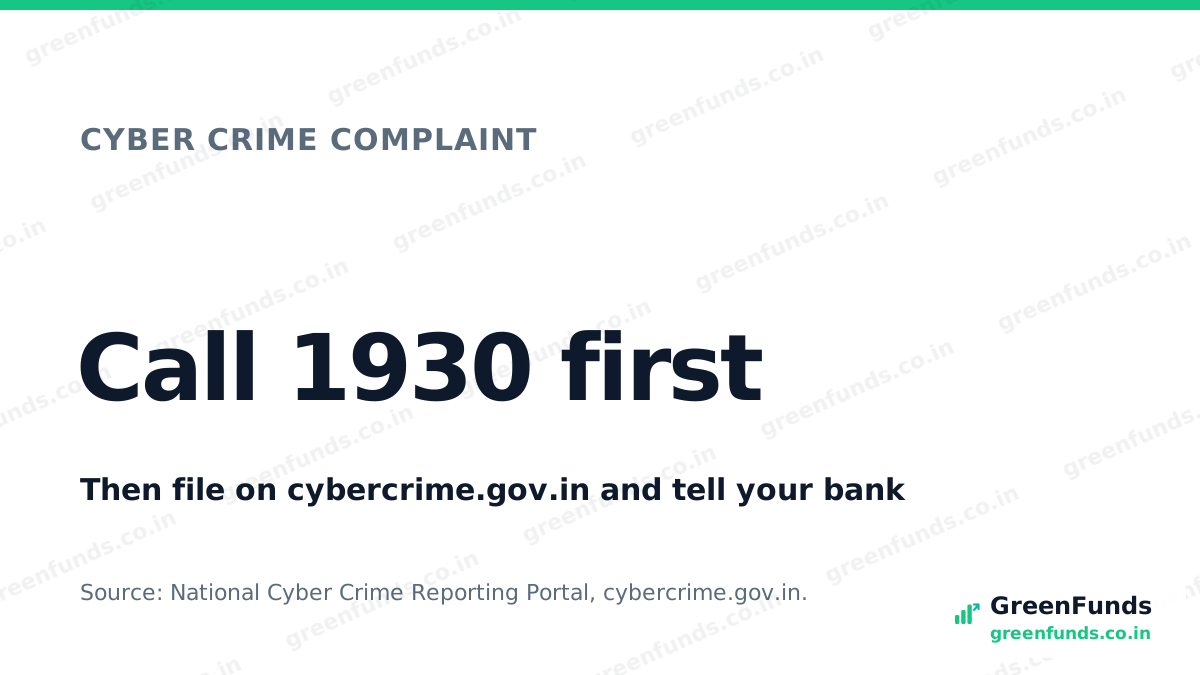
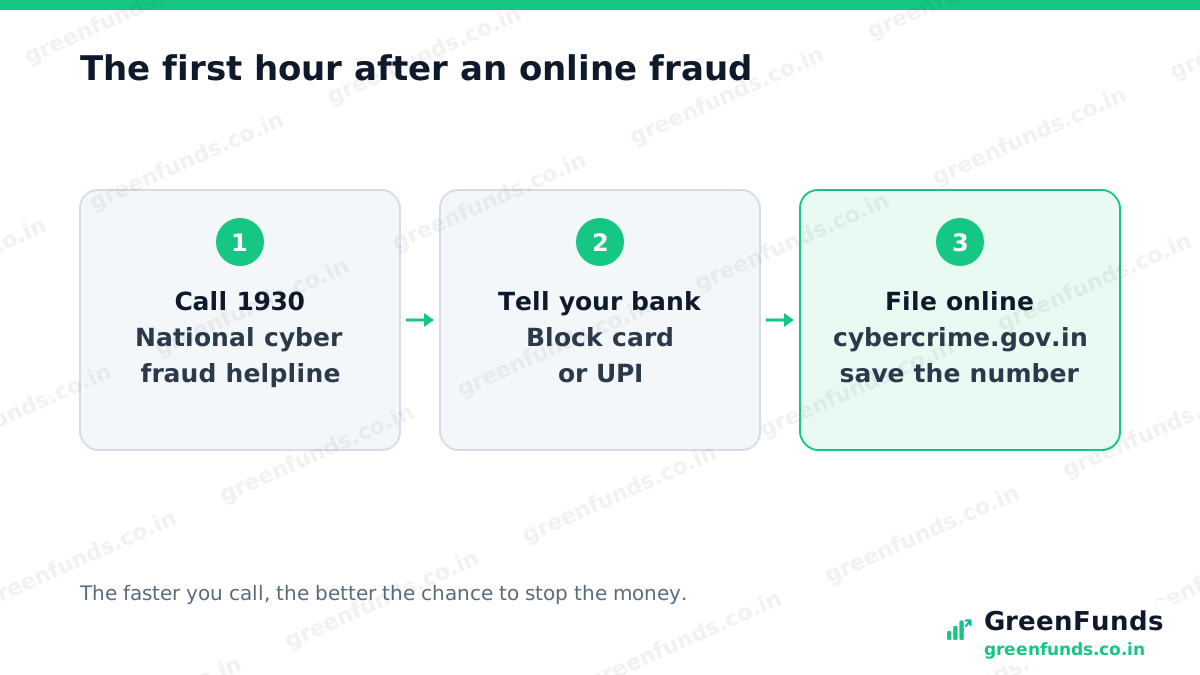
A cyber crime complaint is how you report money or data lost to an online fraud. Three moves, in this order: call 1930, tell your bank, then file in writing on the cybercrime portal. Speed matters more than anything else.
Why the order matters. The 1930 helpline is the fastest way to flag stolen money with the banks it passed through. Your bank can block your card or account so the scammer can’t take more. The written complaint on cybercrime.gov.in is the formal record that police and banks act on.
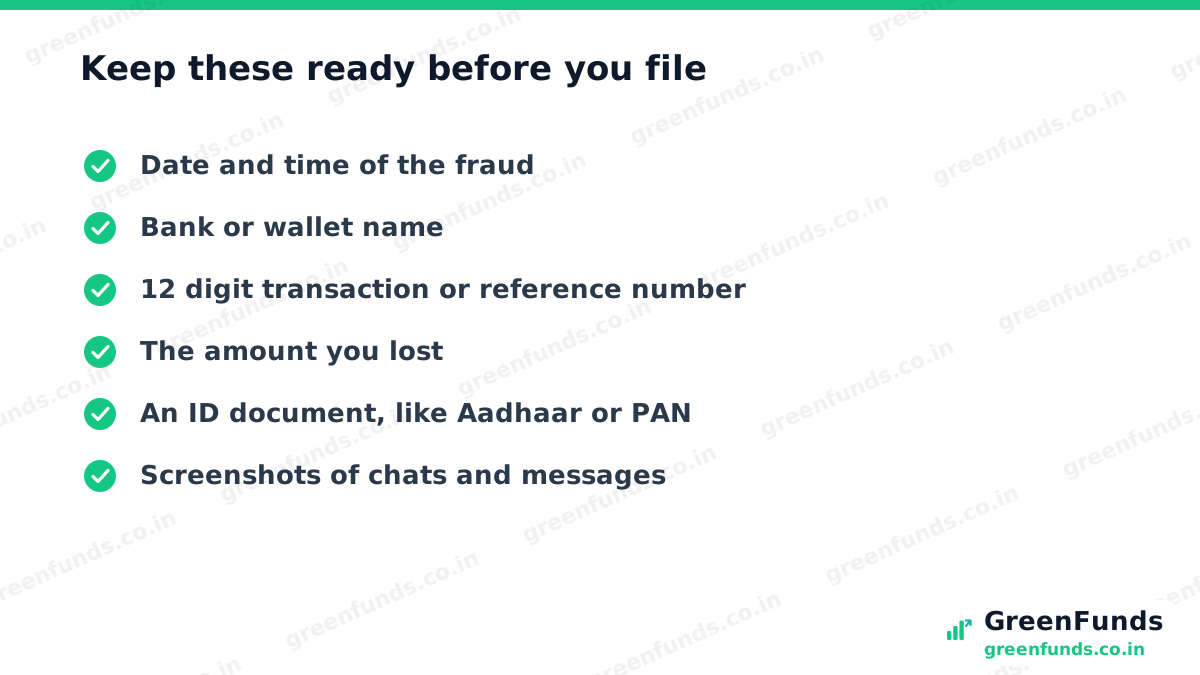
What to keep ready. The portal asks for the date and time, a short account of what happened, an ID document, and for a money fraud, the 12 digit transaction ID or UTR number. Screenshots of chats and messages help too. Never share an OTP or UPI PIN with anyone while you sort this out, not even someone who says they’re from the bank or the police.
What happens after you file
You get a complaint reference number by SMS and email. Use it with the check status option on the portal. If the response isn’t right, the portal lists nodal and grievance officers for each State and Union Territory.
Your money-back right under RBI rules
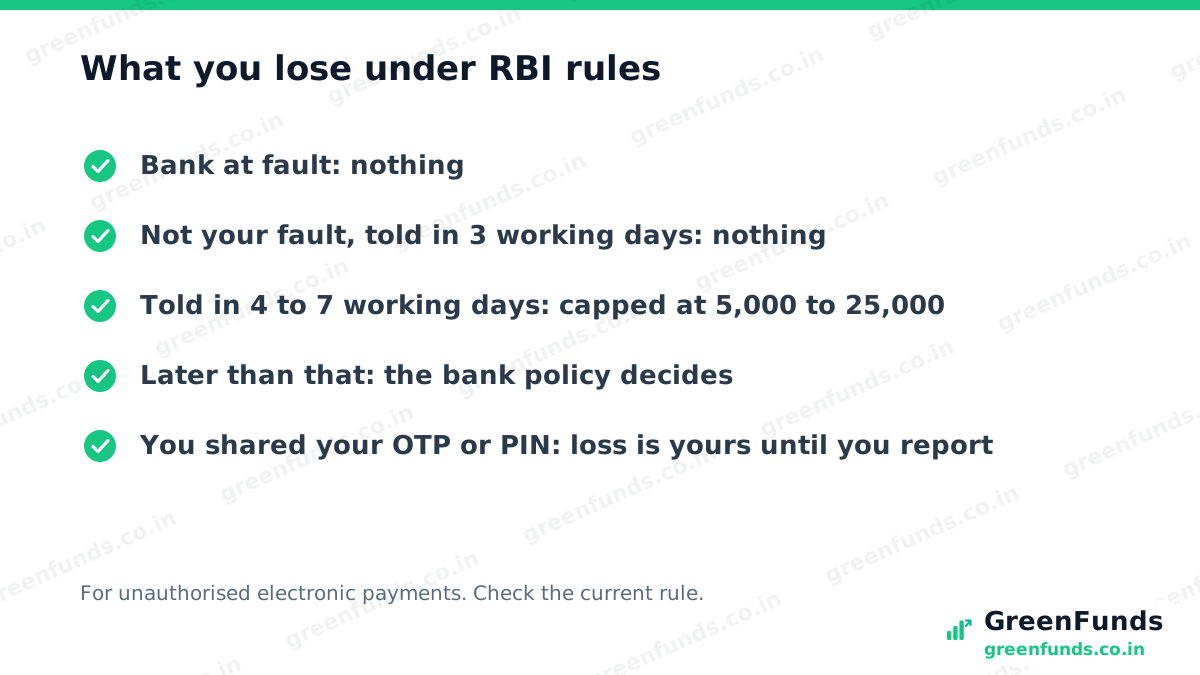
The Reserve Bank’s 2017 circular on unauthorised electronic transactions is the rule your bank follows. It covers card, net banking and other electronic payments. How much you lose depends on who was at fault and how fast you told the bank. This is the zero liability rule.
The bank must credit the disputed amount within 10 working days of your report. It must settle the complaint within 90 days. And it has to prove you were at fault.
An illustration. Say a stranger uses your stolen card details to spend 18,000 rupees from a savings account, and you report it the same day. The bank wasn’t at fault, but neither were you, and you told them within three working days. Your liability is zero. Report it on day six instead, and your loss could be capped at 10,000 rupees for that kind of account. These rules can change, so check rbi.org.in before you rely on them.
Know the scam you’re reporting
Naming the scam helps you describe it clearly in the complaint. Read up on the one that hit you:
- UPI scams and how to report a UPI fraud
- The digital arrest scam, a fake police or customs call (see digital arrest)
- The KYC update scam, often a phishing link
- The SIM swap scam, where your number is hijacked
- The task scam, paid likes that turn into deposits
- Fake trading apps that show fake profits
- Fake customer care numbers found through search
- Illegal loan apps that pose as a quick personal loan
- How to spot a Ponzi scheme before you pay in
More to read: protect yourself from online fraud and UPI safe habits.
-
Call 1930 right away
Dial 1930, the national cyber fraud helpline under the Ministry of Home Affairs. Do it the moment you spot the fraud. The call starts the process of flagging the money with the banks involved, before the scammer can move it on.
-
Tell your bank and block what you can
Call your bank or use its app to report the transaction as unauthorised. Block the card, UPI or net banking if the scammer may still have access. Note the time you reported it: under RBI rules, how fast you told your bank decides how much of the loss you may bear.
-
Open the official portal
Go to cybercrime.gov.in, the National Cyber Crime Reporting Portal. Type the address yourself. The real site ends in gov.in, so avoid lookalike sites and links sent by strangers.
-
Keep these details ready
The portal's checklist asks for the incident date and time, a description of at least 200 characters, and a soft copy of an ID such as Aadhaar, PAN, voter ID, passport or driving licence (JPEG or PNG, up to 5 MB). For a money fraud, add the bank or wallet name, the 12 digit transaction ID or UTR number, the date and the amount. Attach evidence like screenshots, statements and chat records, each file up to 10 MB.
-
Register and file the complaint
Sign in with your name and an Indian mobile number, using the one-time password the portal sends. Choose the financial fraud option, fill in the details and upload your evidence. Submit, and save the complaint reference number you get by SMS and email.
-
Track it, and escalate if needed
Use the check status option on the portal with your acknowledgement number to follow the complaint. If the response is not right, the portal lists State and UT nodal and grievance officers you can contact.
Questions people ask
Online fraud complaint kaise kare?
Call 1930 first, as soon as you notice the fraud. Then tell your bank and block your card or UPI if needed. After that, file a written complaint on cybercrime.gov.in with the transaction ID, amount, date and screenshots, and save the acknowledgement number.
What is the number for a cyber crime complaint in India?
1930 is the national cyber fraud helpline, run under the Ministry of Home Affairs. Call it for any money lost to an online, UPI, card or banking fraud. The written complaint goes on cybercrime.gov.in.
Will my bank refund money lost to an online fraud?
Under RBI's 2017 rules, you bear nothing if the bank was at fault, or if a third party caused it and you told the bank within three working days. Told in four to seven working days, your loss is capped at 5,000 to 25,000 rupees depending on the account. If you shared your OTP or PIN, you bear the loss until you report it. Check the current rule on rbi.org.in.
How long does the bank have to credit the money?
RBI's rules say the bank must credit the disputed amount to your account within 10 working days of your report, and settle the complaint within 90 days. The bank has to prove you were at fault, not the other way round.
How do I track my cybercrime.gov.in complaint?
Use the check status option on the portal with the acknowledgement number you got by SMS and email. Keep that number safe, your bank may also ask for it.
Source: National Cyber Crime Reporting Portal (cybercrime.gov.in): complaint checklist, Report and Track and check status pages; RBI circular RBI/2017-18/15, DBR.No.Leg.BC.78/09.07.005/2017-18, 6 July 2017, on customer liability in unauthorised electronic banking transactions (rbi.org.in). Rules and portal steps change; confirm the latest on these sites.
Found this useful? You can buy us a coffee. It keeps GreenFunds free.Flag a possible issue
Was this helpful?
Thanks for the signal.
Comments
Share your experience or a question. Be kind, stay on topic. This is reader discussion, not financial advice.
No comments yet. Be the first to share.