Post office monthly income scheme: a fixed payout every month
Deposit a lump sum once, get interest paid to you every month for five years
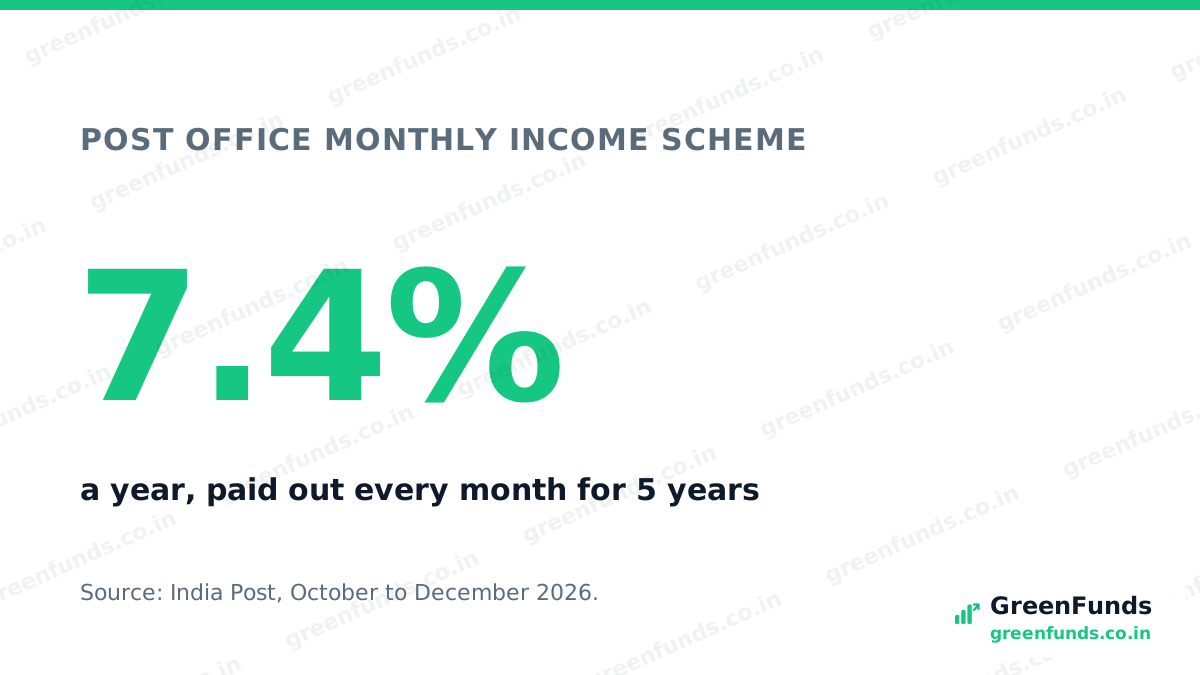
The post office monthly income scheme takes one lump sum and pays you interest every month. After five years, you get the deposit back. It’s often called POMIS or MIS, and it’s one of the government’s small savings schemes.
The rate now. India Post lists 7.4% a year, paid monthly, for October to December 2026. The Ministry of Finance kept small savings rates unchanged for this quarter. Rates are reviewed every three months.
The limits. The minimum is 1,000 rupees. The most you can put in is 9 lakh rupees in a single account, or 15 lakh rupees in a joint account, per India Post. A parent or guardian can open one for a minor.
A payout example. Here’s what the 7.4% rate pays, as an illustration.
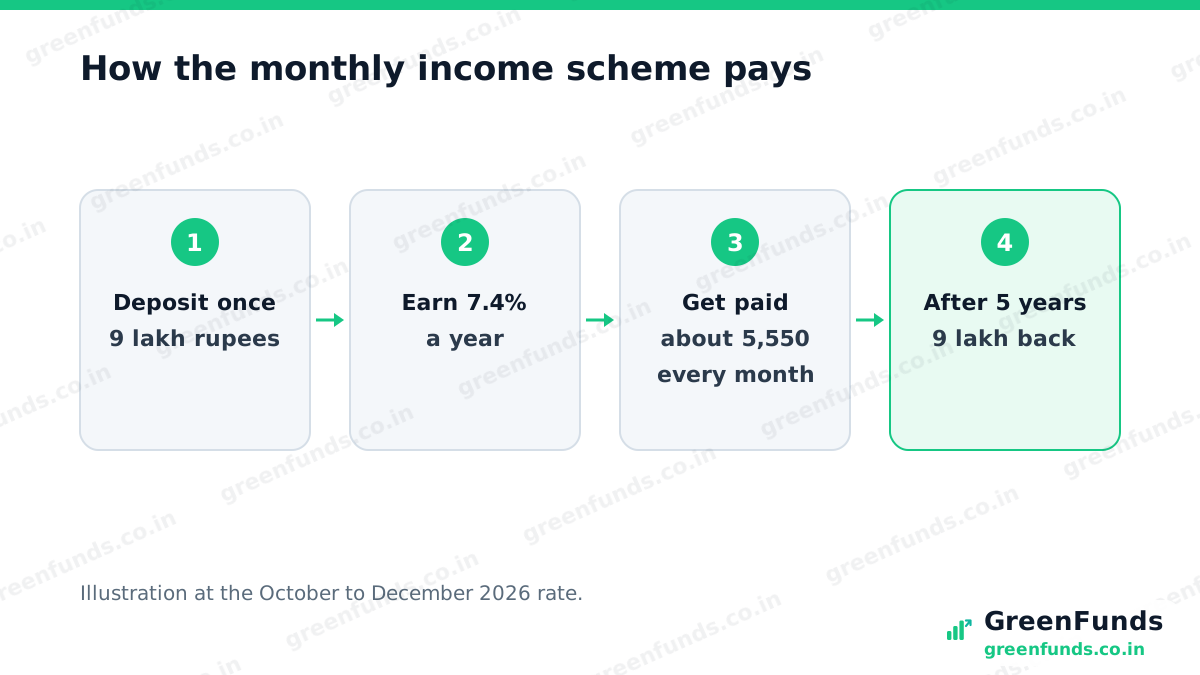
Say you put in 9 lakh rupees. A year’s interest at 7.4% is 66,600 rupees. Split over 12 months, that’s 5,550 rupees a month. A 15 lakh joint account pays about 9,250 rupees a month. The payout lands in your post office savings account or bank account.
How it’s taxed. There’s no tax deduction on the amount you put in. The monthly interest counts as income from other sources, per the Income Tax Department. So it’s taxed at your income tax slab. Your real return is lower than 7.4% once tax is paid.
Closing early. The account runs five years. You can close it early, at a cost.
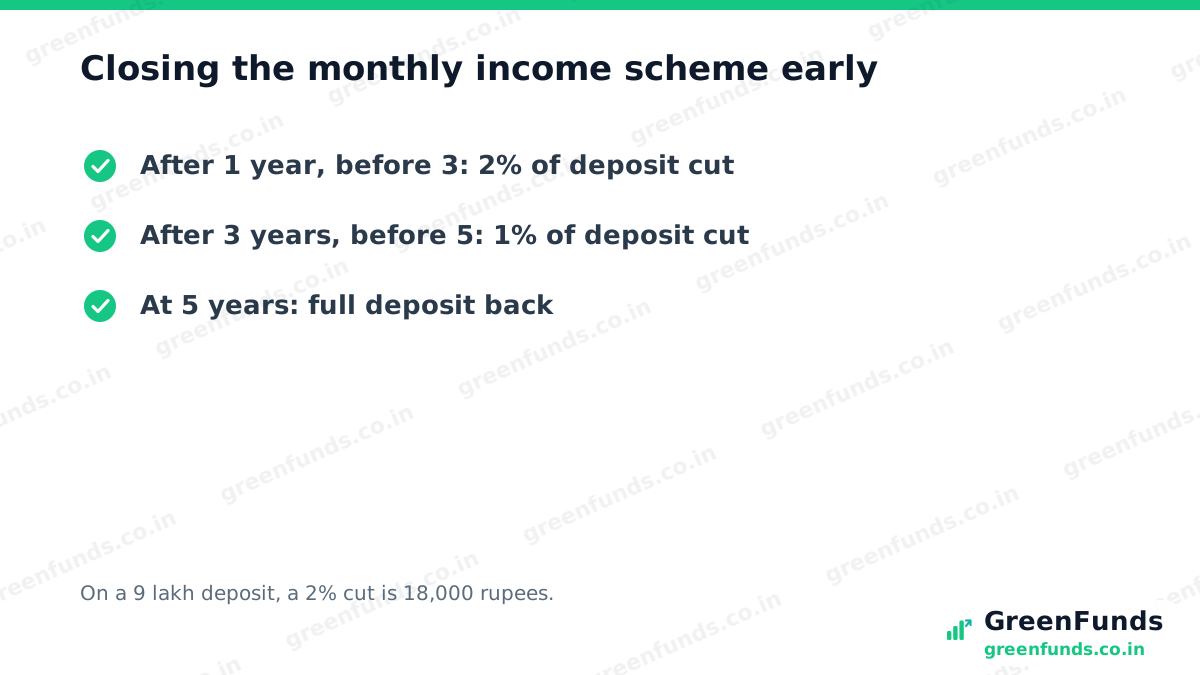
On a 9 lakh deposit, a 2% cut is 18,000 rupees. That’s a reason to keep money here only if you won’t need it. If the holder dies, the account is closed and the money goes to the nominee or legal heir.
What it suits. POMIS suits someone who wants a steady monthly income from a lump sum, like a retirement payout. If you’re 60 or older, compare it with the Senior Citizen Savings Scheme, which India Post lists at 8.2%, paid every quarter. A bank monthly-payout fixed deposit is another option to compare in rupees.
More to read: all post office schemes side by side and Kisan Vikas Patra. For the scheme’s short definition, see POMIS. For other ways to earn a regular income from savings, and how much money they really take, see passive income in India.
Questions people ask
How much will I get every month from the post office monthly income scheme?
At the October to December 2026 rate of 7.4% a year, a 9 lakh rupee single account pays about 5,550 rupees a month. A 15 lakh joint account pays about 9,250 rupees a month. The rate is reviewed every quarter, so check indiapost.gov.in before you open one.
What is the maximum limit in the post office monthly income scheme?
9 lakh rupees in a single account and 15 lakh rupees in a joint account, per India Post. The minimum is 1,000 rupees.
Is the monthly income scheme interest taxable?
Yes. There's no deduction on the amount you deposit, and the monthly interest counts as income from other sources, per the Income Tax Department. It's taxed at your slab.
Can I close the monthly income scheme early?
Yes, with a cost. Close it after one year but before three, and 2% of the deposit is deducted. Close it after three years but before five, and 1% is deducted, per India Post.
Source: India Post savings schemes page (indiapost.gov.in, last updated 30 October 2026): 7.4% a year, payable monthly; India Post savings schemes handbook for limits (9 lakh rupees single, 15 lakh joint), term and premature closure deductions; Ministry of Finance Office Memorandum F.No.1/4/2019-NS, 30 September 2026 (rates unchanged for October to December 2026); Income Tax Department guidance on income from other sources. Rates change every quarter; check the current rate.
Found this useful? You can buy us a coffee. It keeps GreenFunds free.Flag a possible issue
Was this helpful?
Thanks for the signal.
Comments
Share your experience or a question. Be kind, stay on topic. This is reader discussion, not financial advice.
No comments yet. Be the first to share.