Tax saver FD: a fixed deposit that cuts your tax, with a 5-year lock
A 5-year bank FD that counts towards the 1.5 lakh rupee deduction on the old regime
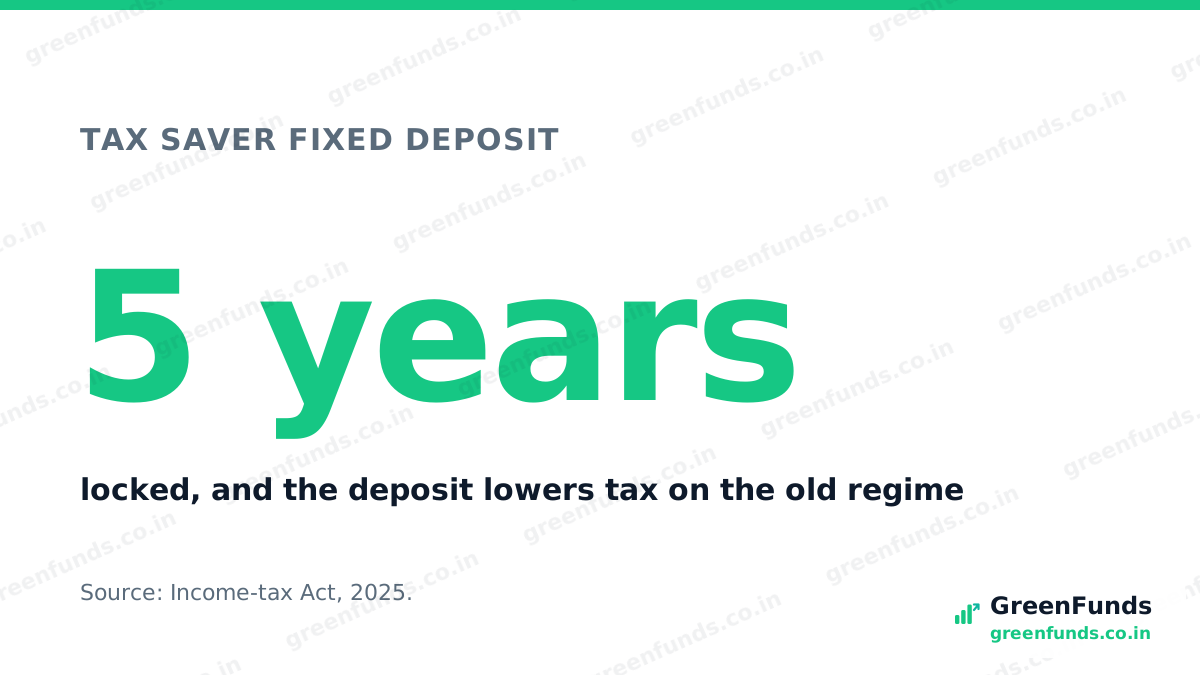
A tax saver FD is a fixed deposit with one extra rule and one extra perk. The rule: your money is locked for 5 years. The perk: what you deposit can lower your taxable income, if you file under the old tax regime.
How the tax benefit works. The deposit counts towards the yearly deduction of up to 1.5 lakh rupees long known as section 80C. Under the Income-tax Act, 2025, in force from 1 April 2026, that deduction now sits in section 123. The deduction is the same; only the number changed. It applies only on the old regime, so check your tax regime first.
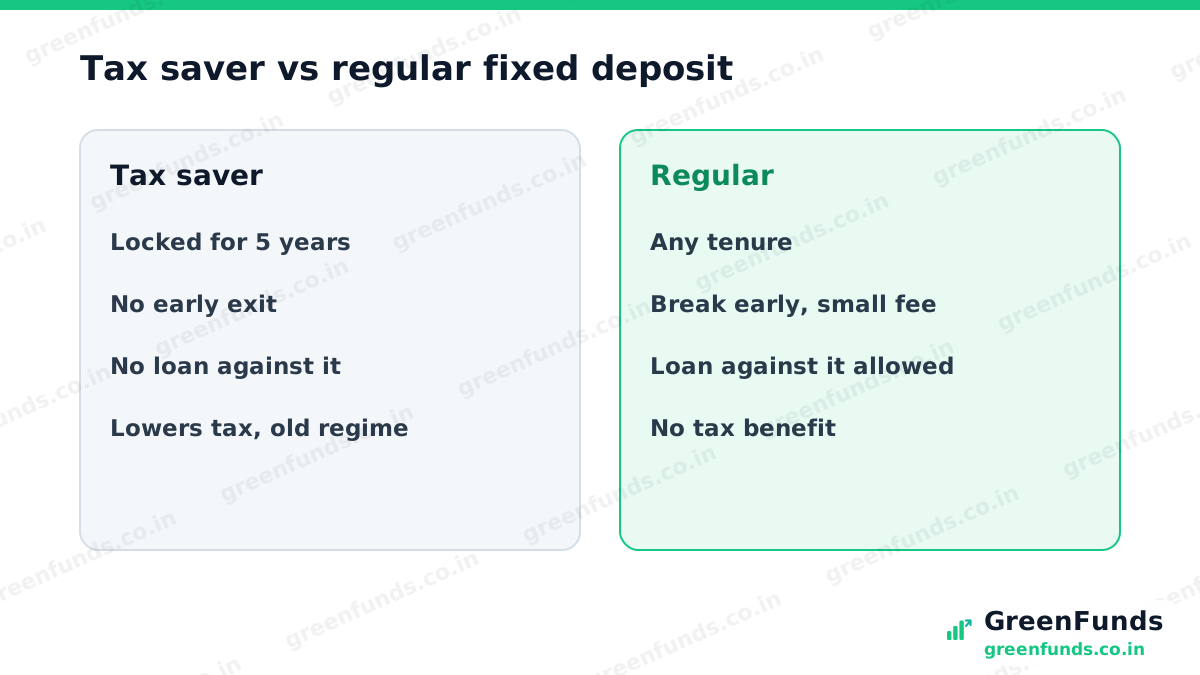
The catches. Three rules make it different from a normal FD.
- No early exit. You cannot close it before 5 years, even with a penalty.
- No loan against it. Banks do not lend against a tax saver FD.
- The interest is taxed. Only the deposit gets the deduction. The interest is added to your income each year and taxed at your slab rate, and the bank cuts TDS once your interest from that bank crosses the yearly limit. If your income is below the taxable limit, Form 15G or 15H can stop the TDS.
Did you know? The 1.5 lakh rupee limit is shared. Your own EPF contribution, PPF deposits, ELSS investments, life insurance premiums and home loan principal all count towards the same limit. Many salaried people fill most of it through EPF alone, so add up what you already have before putting more into a tax saver FD.
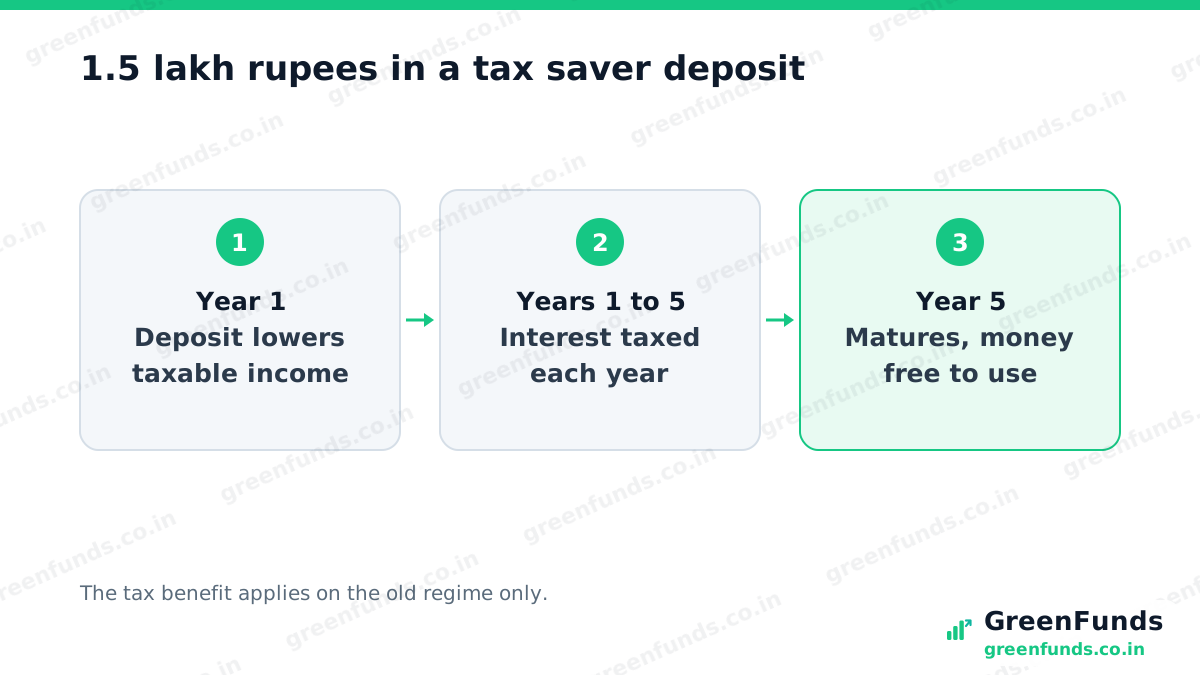
A rupee example. Say you put 1.5 lakh rupees into a tax saver FD at 6.5% a year, compounded quarterly (an illustration; rates differ by bank). On the old regime at the 30% slab, the deduction can cut your tax for that year by up to ₹46,800, counting the 4% cess. After 5 years, the FD is worth about ₹2,07,063. The ₹57,063 of interest is taxed at your slab along the way, so the real gain is smaller than it looks.
How it compares. Among the common ways to use the same limit, the tax saver FD is the most familiar but not the most tax-efficient. PPF interest is fully tax-free, though the money is locked for 15 years. ELSS has the shortest lock-in, 3 years, but its value moves with the stock market. Our ELSS vs PPF vs FD guide lays them side by side.
Who it suits. Someone on the old regime with room left in the 1.5 lakh rupee limit, who wants a fixed, known return and is sure the money can sit for 5 years. The post office 5-year time deposit works the same way for the deduction. On the new regime, there is no tax reason to choose it.
The takeaway. A tax saver FD trades 5 years of locked money for a deduction on the old regime. The deposit is deductible, the interest is not. Check your regime and your remaining limit first, and use our FD calculator to see the maturity amount.
More to read: ELSS vs PPF vs FD, old vs new tax regime, and FD vs debt fund.
Questions people ask
What is a tax saver FD?
It is a bank fixed deposit with a 5-year lock-in. The amount you deposit, up to 1.5 lakh rupees a year, counts towards the deduction long known as section 80C, now section 123 of the Income-tax Act, 2025. The deduction works only if you file under the old tax regime.
Is the interest on a tax saver FD tax-free?
No. Only the deposit gets the deduction. The interest is added to your income every year and taxed at your slab, and the bank cuts TDS once your interest from that bank crosses the yearly limit. That is the main difference from PPF, where the interest is tax-free.
Can I break a tax saver FD early?
Not before 5 years. Unlike a regular FD, it cannot be closed early, and you cannot take a loan against it. Put in only money you are sure you will not need for 5 years.
Is a tax saver FD useful on the new tax regime?
Not for tax. The new regime does not allow this deduction, so on the new regime a tax saver FD is just an FD you cannot break for 5 years. A regular FD gives the same kind of return with more freedom.
Source: Income-tax Act, 2025 (section 123 and Schedule XV, the deduction long known as section 80C), in force 1 April 2026; bank tax saver deposit terms; Income Tax Department TDS thresholds from 1 April 2025. Rules and rates change, check incometax.gov.in and your bank.
Found this useful? You can buy us a coffee. It keeps GreenFunds free.Flag a possible issue
Was this helpful?
Thanks for the signal.
Comments
Share your experience or a question. Be kind, stay on topic. This is reader discussion, not financial advice.
No comments yet. Be the first to share.