How to build wealth in India: the honest maths of getting rich
Wealth comes from saving a steady share of income, investing it, and giving it time to compound
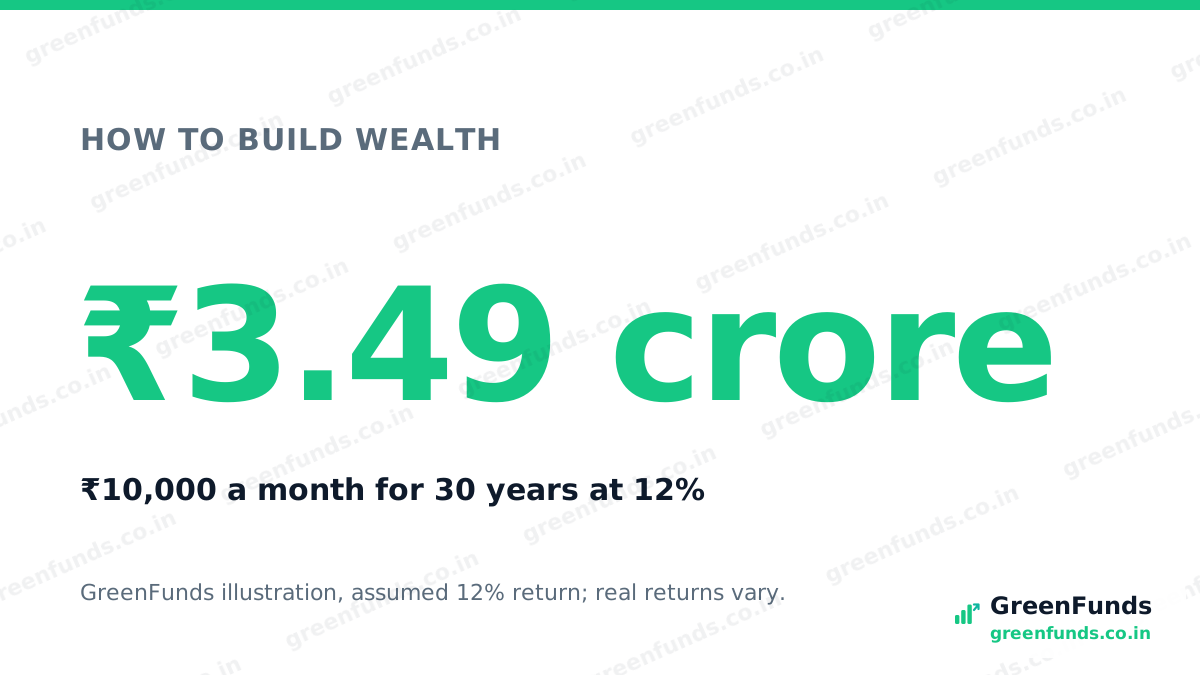
Most “how to become rich” advice sells a shortcut. The real route is slow and fairly boring. Wealth comes from three levers you control: how much you save, how long you stay invested, and how well you avoid the costs that undo it.
Lever 1: how much of your salary you save
Your savings rate matters more than picking the perfect investment. The 50-30-20 rule is a simple start: about half your take-home pay for needs, 30% for wants and 20% for saving. On a 50,000 rupee salary, that’s 10,000 rupees a month.
The trick that works for most people is to save first, not last. Set a SIP to go out the day after your salary lands, and live on the rest. When you get a raise, raise the SIP before your spending rises. That habit fights lifestyle creep. The 50/30/20 lesson shows how to split a real payslip.
Lever 2: time, and compounding
Compounding means your returns start earning returns. It’s slow at first and powerful later. Here’s a SIP of 10,000 rupees a month at an assumed 12% a year, computed the same way as our SIP calculator (an illustration, before tax and costs):
| Years | You put in | It grows to | Of which, growth |
|---|---|---|---|
| 10 | ₹12 lakh | about ₹23 lakh | about ₹11 lakh |
| 20 | ₹24 lakh | about ₹98.9 lakh | about ₹74.9 lakh |
| 30 | ₹36 lakh | about ₹3.49 crore | about ₹3.13 crore |
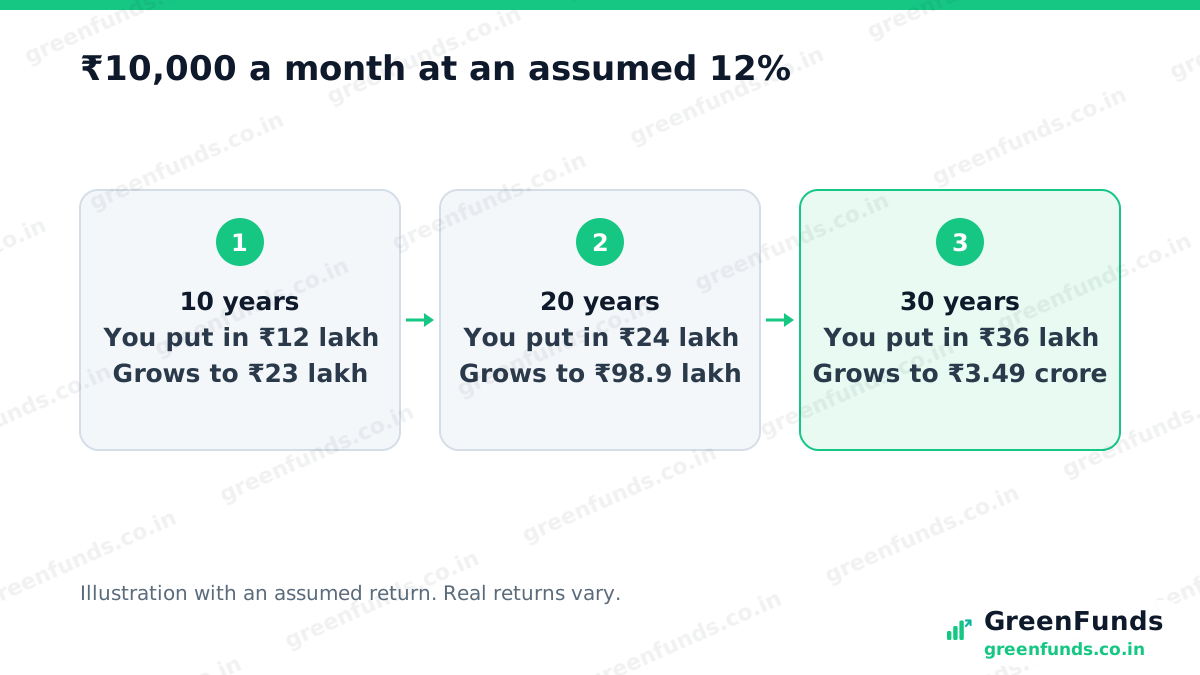
Look at the last 10 years. The pot grows by about 2.5 crore rupees, far more than in the first 20 years together. That’s why starting early beats starting big. Start 10 years late and the same SIP ends near 98.9 lakh, not 3.49 crore.
Raising the SIP helps too. If you increase it by 10% every year, the same start reaches about 1.97 crore rupees in 20 years.
“How to get rich in 10 years.” Ten years is short for compounding. At the same assumed 12%, reaching 1 crore rupees in 10 years needs about 43,500 rupees a month. It’s possible on a high income, but it’s mostly saving, not magic.
Real returns are never this smooth. Equity funds can fall sharply in a bad year, so this money must be money you won’t need for a long time. A low-cost index fund is one simple way people get market returns.
Did you know? In the 30-year example above, your own deposits are only about a tenth of the final amount. The rest is growth on growth, and most of it arrives in the final decade, which is why stopping early costs so much.
Lever 3: avoid what undoes it
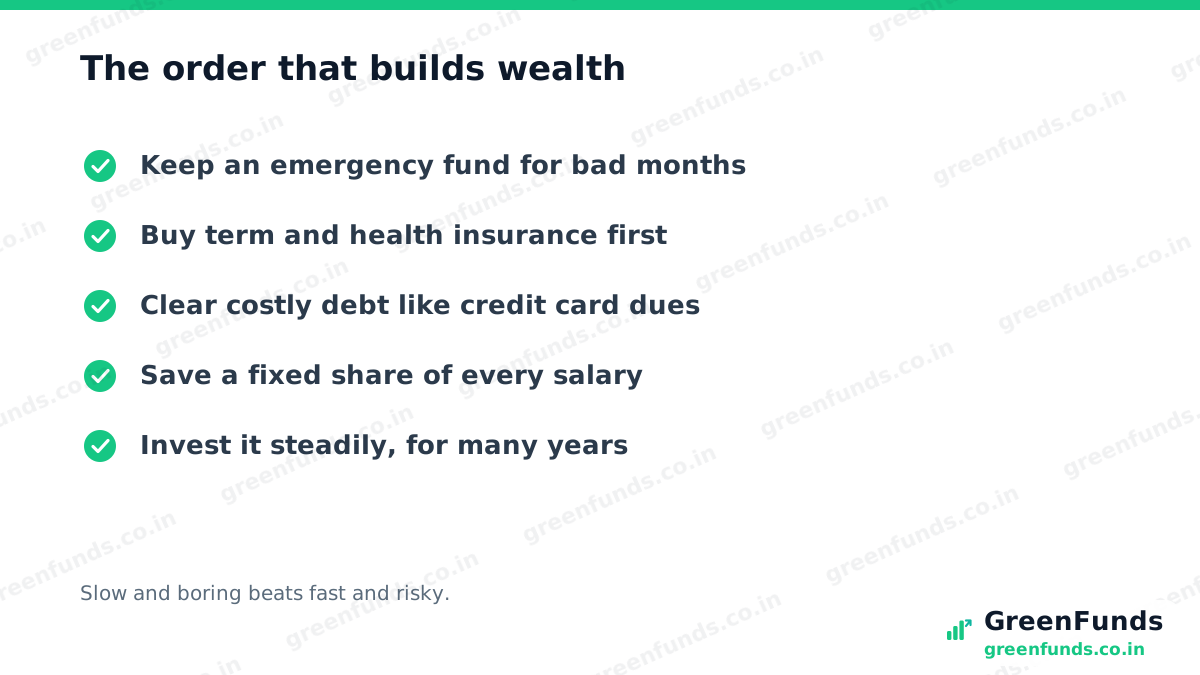
- High-interest debt. Credit card dues and costly personal loans charge interest far higher than any investment reliably earns. Clearing them is a guaranteed “return”. See how to get out of credit card debt. If you are turning a card bill into EMIs, check the real cost of a credit card EMI first. On a big loan like a home loan, even a lower rate through a balance transfer frees money to invest. Before prepaying a costly personal loan, check its foreclosure charges.
- An emergency with no cushion. Keep an emergency fund so a job loss doesn’t force you to sell investments at a bad time.
- Insurance first. One hospital bill or the loss of an earner can wipe out years of saving. Get health insurance and, if anyone depends on your income, term insurance.
- Get-rich-quick promises. “Double your money in a year” means a 100% return. No regulated product promises that. Such pitches, often in WhatsApp groups or apps, are classic warning signs of a Ponzi scheme.
The takeaway. Getting rich in India is mostly a savings habit plus time. Save first, invest steadily in regulated products, keep insurance and an emergency fund, and stay away from costly debt and fast-money offers. Once the pile is large, it can pay you a passive income. Some people also keep a small slice in gold; read why gold costs more in India than the world price.
More to read: compounding explained, the emergency fund, recurring deposit vs SIP, and what 1% a year costs you.
Questions people ask
How can I become rich on a salary in India?
Save a fixed share of every salary, invest it steadily in diversified, regulated investments, and leave it alone for many years. As an illustration, 10,000 rupees a month at an assumed 12% a year grows to about 23 lakh rupees in 10 years, 98.9 lakh in 20 years and 3.49 crore in 30 years. Real returns vary.
How can I get rich in 10 years?
It takes a high savings amount, because 10 years is short for compounding. As an illustration, reaching 1 crore rupees in 10 years at an assumed 12% a year needs a SIP of about 43,500 rupees a month. Stretching the goal to 20 or 30 years needs far less each month.
Can I get rich with no money?
You can start with very little, but you can't skip the saving. The first step is to stop paying interest on credit card dues and build a small emergency fund. Then start a small monthly SIP and raise it every time your salary goes up. Time does more of the work than the starting amount.
How much of my salary should I save?
A common starting rule is 50-30-20: about 50% for needs, 30% for wants and 20% for saving and investing. On a 50,000 rupee take-home salary, that's 10,000 rupees a month to save. Saving more, earlier, makes a large difference over decades.
Is it possible to get rich in one month or one year?
Not safely. Turning money into double in a year means a 100% return, which no regulated investment promises. Offers like that, often pushed through WhatsApp groups, trading apps or recruit-and-earn plans, are a common sign of fraud. Check SEBI or RBI registration before paying anyone.
Source: SIP figures computed by GreenFunds with the same monthly compounding as the GreenFunds SIP calculator (/tools/sip-calculator/): contributions at the end of each month, monthly rate equal to the yearly rate divided by 12, assumed 12% a year, before tax and costs. Budget split from the GreenFunds 50-30-20 guide. Return assumptions are illustrations, not forecasts.
Found this useful? You can buy us a coffee. It keeps GreenFunds free.Flag a possible issue
Was this helpful?
Thanks for the signal.
Comments
Share your experience or a question. Be kind, stay on topic. This is reader discussion, not financial advice.
No comments yet. Be the first to share.