How much term insurance cover? Two ways to work it out
Size term cover from what your family would need, minus what you already have
Term insurance pays your family a fixed amount if you die during the policy term. It has no savings part, which keeps it cheap. The hard question is the amount. Too little leaves a gap. Too much costs premium you didn’t need to pay.
New to it? The lesson on term insurance explains the basics. And if you’ve been offered a policy that also “returns your money”, see term vs endowment, the real cost first.
Two ways to size it. Both give a starting number, not a final answer.
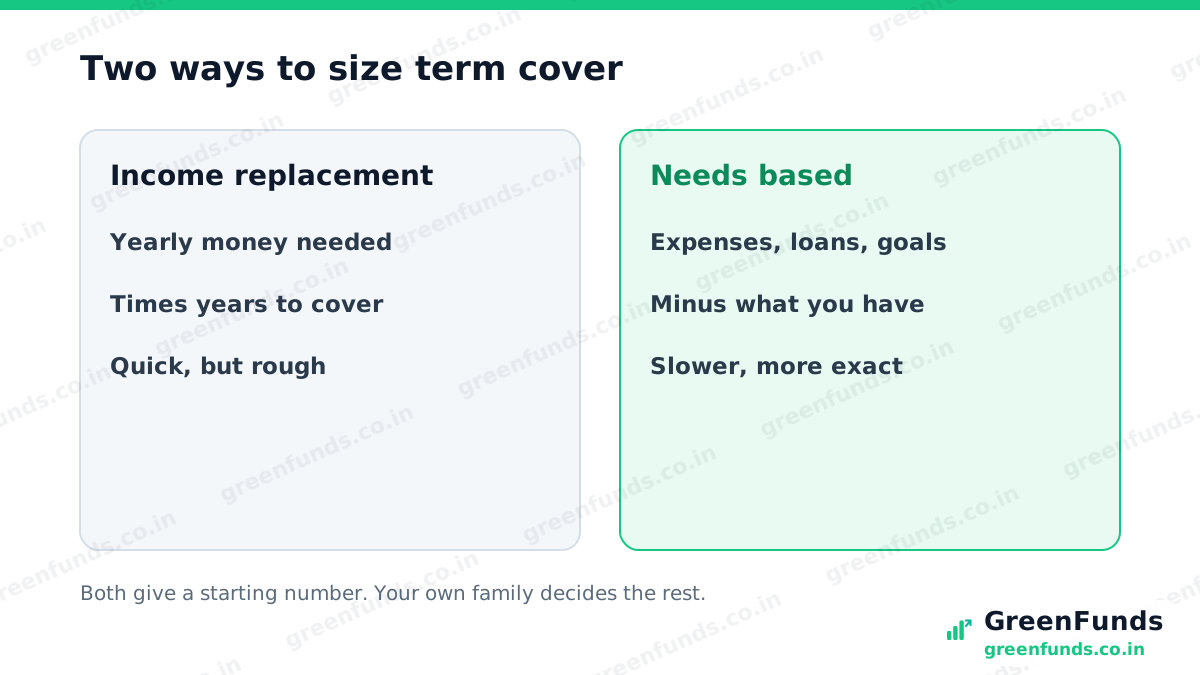
Method 1: income replacement. Ask how much money your family would need each year without you, and for how many years. Multiply. If they’d need 6 lakh a year for 20 years, that’s 1.2 crore. It’s quick, but it ignores loans you owe and money you already have.
Method 2: needs based. Add up what the money must do, then take away what’s already there.
- Expenses: yearly family costs, times the years until they can manage alone.
- Loans: anything still owed, like a home loan, so it doesn’t fall on them.
- Goals: big costs you’d want covered, like a child’s education.
- Minus assets: savings and investments your family could use.
A rupee illustration. Say Kabir earns 12 lakh a year (illustrative numbers, not a suggestion). His family would need 6 lakh a year for 20 years. He owes 30 lakh on a home loan and wants 20 lakh set aside for his daughter’s education. He has 15 lakh in savings and investments.
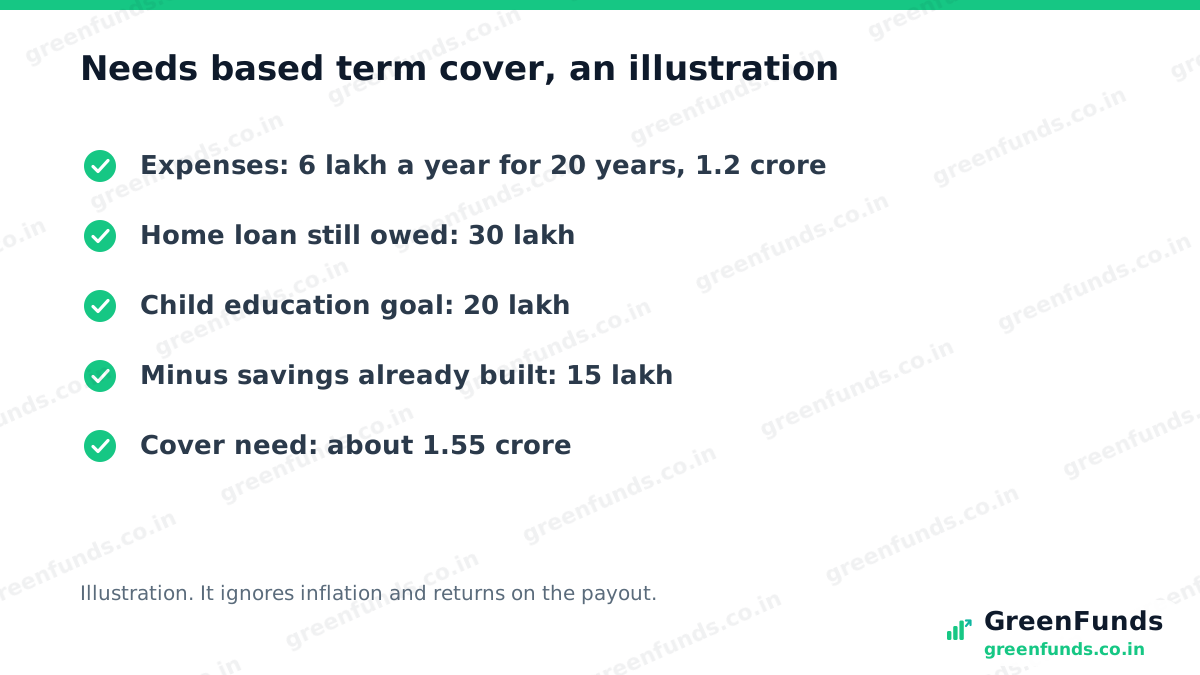
1.2 crore plus 30 lakh plus 20 lakh, minus 15 lakh, is about 1.55 crore. This simple sum ignores two forces that pull in opposite directions: inflation raises future costs, while the payout can earn returns once invested. Treat the result as a range, not an exact figure.
What moves the number.
- Employer cover. Group life cover usually ends with the job. Leaving it out keeps your plan intact when you switch jobs.
- Your spouse’s income. A second earner can lower what the family needs from the payout.
- The term. Cover usually needs to last until loans are cleared and children are earning, not forever.
- Health cover. Term insurance doesn’t pay hospital bills. For that, see our health insurance guide and how much health cover.
Before you sign. Name a nominee, so the money reaches the right person. Disclose your health and habits truthfully. And use the 30-day free-look period to read the wording; IRDAI raised it from 15 days in June 2024.
The takeaway. Size term cover from your family’s needs, minus what they’d already have. Run both methods, compare, and revisit the number when your loans, income or family change.
If one partner runs the home, price that work too; see term insurance for homemakers.
More to read: term insurance, critical illness insurance, why to avoid mixing insurance and investment, and the government’s 436 rupee PMJJBY life cover.
Questions people ask
Term insurance kya hai?
Term insurance is pure life cover for a fixed number of years. You pay a yearly premium. If you die during the term, your nominee gets a fixed amount, called the sum assured. If you outlive the term, nothing is paid back, which is why it costs so little.
How much term insurance cover do I need?
Two methods give a starting point. Income replacement: the yearly money your family would need, times the years they'd need it. Needs based: their expenses plus loans plus big goals, minus savings and investments you already have. Your own numbers decide the result.
Should I count my employer's life cover?
Count it carefully. Group cover from a job usually ends when the job does. If you leave it out of the sum, your plan doesn't break when you change jobs.
Can I cancel a term policy if I change my mind?
Yes, within the free look period. IRDAI raised it to 30 days from 15 days in June 2024, counted from when you receive the policy document. Check the policy for any amount the insurer can keep.
Source: IRDAI press release, Reforms in Life Insurance Business, 12 June 2024 (free look period raised to 30 days), irdai.gov.in. Figures on this page are illustrations, not suggested amounts.
Found this useful? You can buy us a coffee. It keeps GreenFunds free.Flag a possible issue
Was this helpful?
Thanks for the signal.
Comments
Share your experience or a question. Be kind, stay on topic. This is reader discussion, not financial advice.
No comments yet. Be the first to share.