How much health insurance cover? A way to think it through
Size health cover from one big bill, your family and your job cover, not from a round number
There’s no single right amount of health cover. The useful question is different: if the worst hospital year happened, how much would land on you? Four questions get you to a sensible range, without picking a round number out of the air.
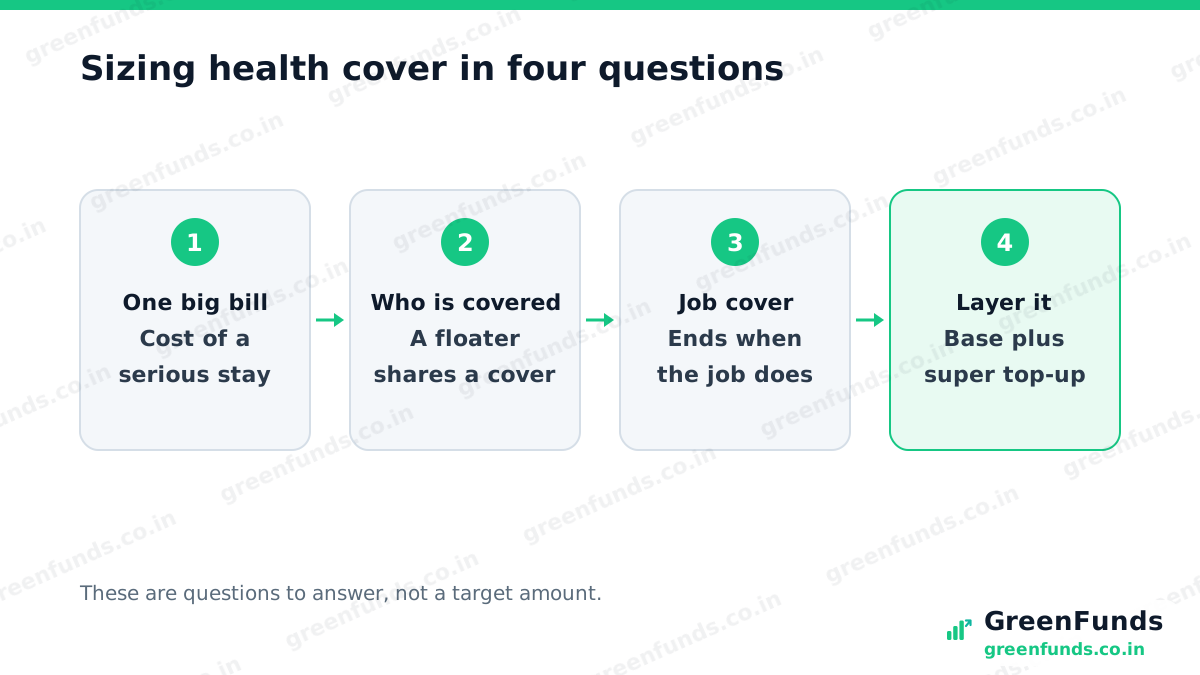
1. What would one big bill cost near you? Treatment costs differ a lot by city and hospital. Ask a hospital you’d actually use for a package estimate for a serious stay, like a major surgery. That one number is your anchor. Your sum insured is the most the policy pays in a year, so it should cover at least that.
2. Who shares the policy? A family floater puts one sum insured across everyone. If two people need hospital care in the same year, both draw from one pot. More members, or older members, means more chance of two claims in a year.
3. How much does your job cover really count? Employer cover is useful while it lasts. But it ends when the job ends, and that can be exactly when you’d struggle to buy new cover. A personal policy stays with you. It also starts your own waiting periods and 60-month clock, which a job policy doesn’t carry when you leave.
4. Can you layer it? A super top-up adds a big layer above a deductible, for much less premium than raising the base. You set the deductible near your base cover. Bills up to it go to the base policy. Bills past it land on the top-up.
A family’s cover stack, as an illustration. Say Ravi and Priya live in a metro with two children (illustrative numbers, not a suggestion):
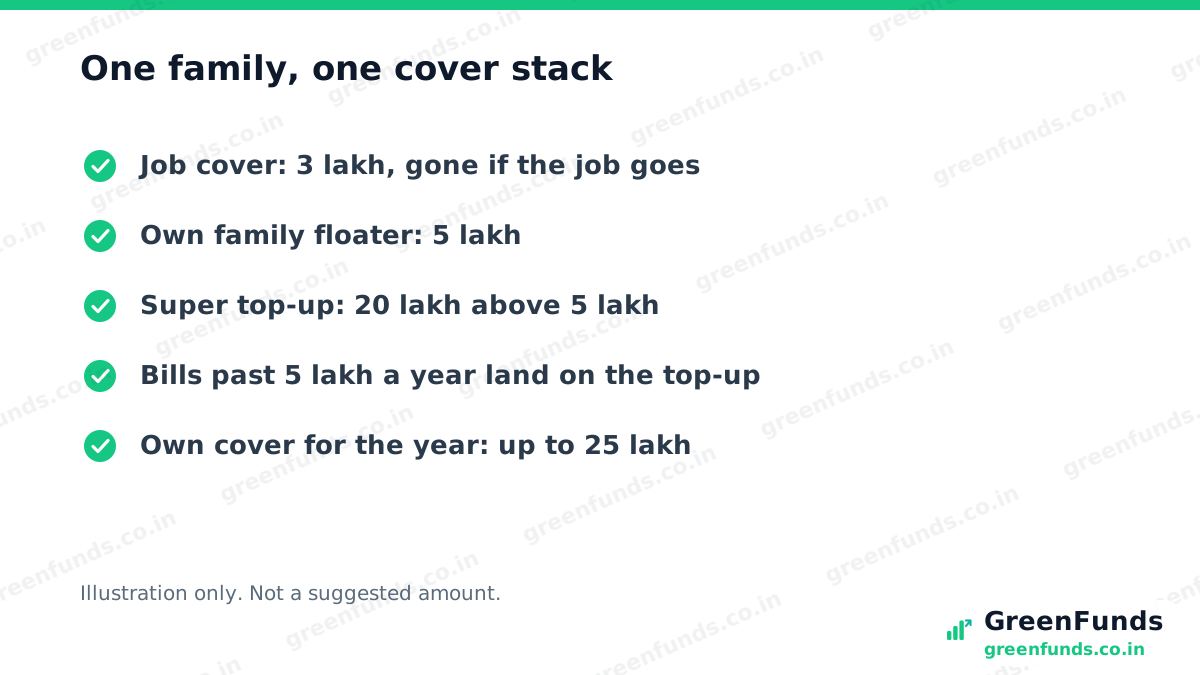
- Ravi’s employer gives 3 lakh. It’s gone if he changes jobs.
- They hold their own 5 lakh family floater.
- They add a 20 lakh super top-up above a 5 lakh deductible.
So their own cover for the year is up to 25 lakh, plus 3 lakh while Ravi’s job lasts. Under IRDAI’s 2024 master circular, they can choose which policy to claim first, and the insurers coordinate the rest.
What else moves the number.
- Rising costs. Hospital costs rise over time, so cover that looks big today shrinks in real terms. Inflation is why people review cover every few years.
- Policy limits. A room rent limit or co-pay can leave you paying part of a bill, even with a large sum insured.
- Parents. Older parents in a floater draw on the same pot as everyone else. Some families give them a separate policy for that reason.
The takeaway. Start from one real bill, not a round number. Count only the cover you control. Layer with a super top-up if the base gets expensive. And keep an emergency fund for what no policy pays.
Choosing between one shared policy and separate ones? Read family floater vs individual cover.
More to read: our health insurance guide, super top-up vs top-up, and critical illness insurance.
Questions people ask
How much health insurance cover do I need?
There isn't one right number. Start from what one serious hospital stay would cost at a hospital you'd actually use, then adjust for how many people share the policy, how much of your cover depends on your job, and whether a super top-up can add a cheap upper layer.
Is my employer's health insurance enough?
It helps, but it ends when the job ends, which can be exactly when you need it most. So it helps to know how much cover you'd still have without it.
Is a family floater enough for a family of four?
A floater shares one sum insured across everyone. If two members are hospitalised in the same year, both claims draw from the same pot. So a floater sized for one big bill can run short in a bad year.
Can I increase my health cover later?
Usually, yes, at renewal. Under IRDAI's 2024 master circular, an insurer can't re-underwrite you at renewal except for the extra cover you ask for. So the increase may need fresh checks and may carry its own waiting periods.
Source: IRDAI Master Circular on Health Insurance Business, 29 May 2024 (renewal, claims under multiple policies); IRDAI standard deductible definition in policy wordings, irdai.gov.in. Figures on this page are illustrations, not suggested amounts.
Found this useful? You can buy us a coffee. It keeps GreenFunds free.Flag a possible issue
Was this helpful?
Thanks for the signal.
Comments
Share your experience or a question. Be kind, stay on topic. This is reader discussion, not financial advice.
No comments yet. Be the first to share.