Family floater vs individual health insurance: which suits you
A floater gives the whole family one shared sum insured, which any member can use up
Most families buying health insurance face one early choice: one shared policy for everyone, or a separate policy for each person. The shared one is called a family floater.
How a floater works
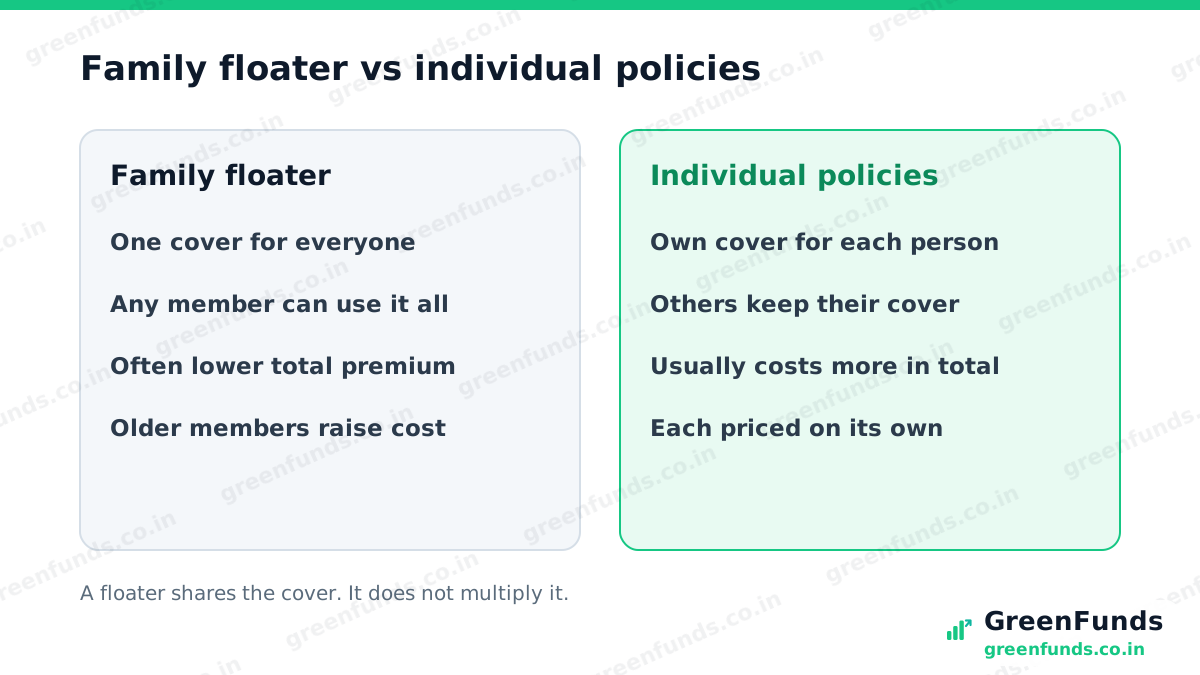
In a floater, every member sits under a single sum insured. IRDAI, the insurance regulator, describes it simply: the limit can be used by any or all members. There is no fixed share per person. One member can use the whole amount, and then nothing is left for the others until renewal.
With individual policies, each person has their own sum insured. One person’s claim never reduces another’s cover.
A rupee example
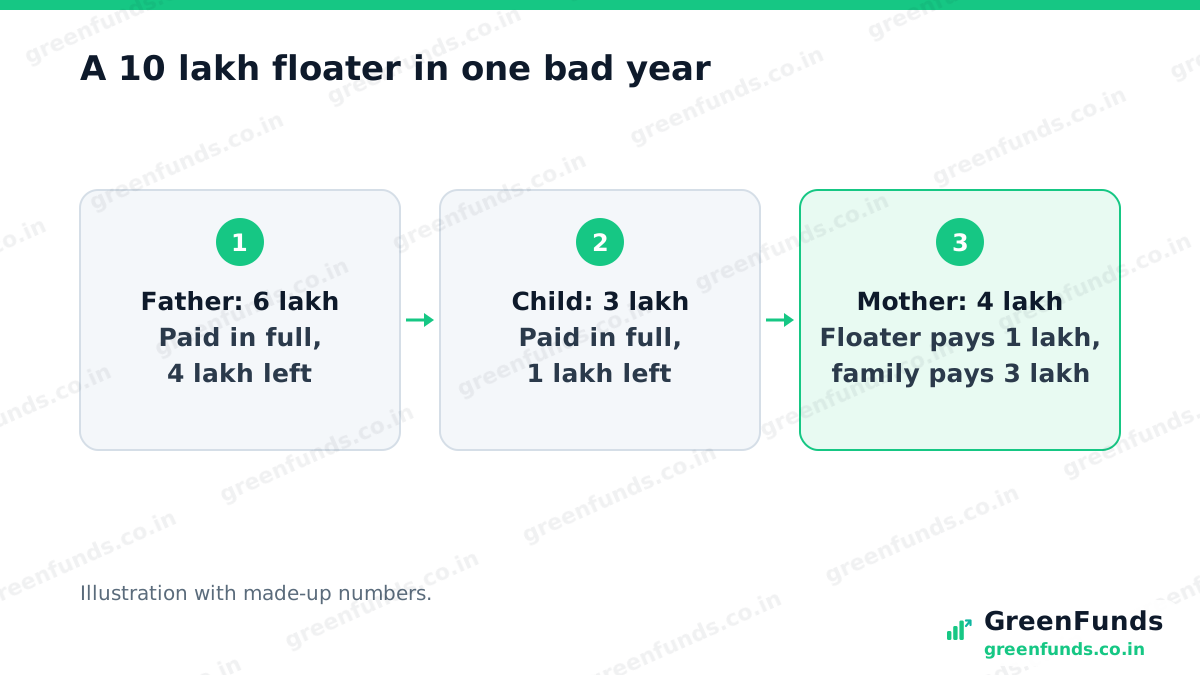
Say a family of four has a 10 lakh rupee floater. In one year (an illustration):
- The father has surgery costing 6 lakh. The floater pays it, leaving 4 lakh.
- A child is admitted for 3 lakh. The floater pays it, leaving 1 lakh.
- The mother then needs treatment costing 4 lakh. The floater pays the last 1 lakh, and the family pays 3 lakh.
Three claims in one year is unusual for a young family, which is why floaters are popular. But it shows the limit: the cover is shared, not multiplied.
When a floater suits you, and when it doesn’t
A floater tends to suit a young couple with small children. Everyone is at low risk, so one shared limit is usually enough, and the premium is lower than separate policies for each person.
It suits you less when:
- Older parents are in it. IRDAI lists age among the main pricing factors, so an older member weighs on the premium for the whole policy. Parents also tend to claim more, eating into the shared limit. See health insurance for parents for the separate-policy route.
- Someone has a long-term condition. Frequent claims by one person leave less for everyone else.
- The sum insured is small for your city. A shared 5 lakh can vanish in one stay. Our guide to how much health cover helps you size it.
Restore and recharge benefits
Some policies offer a restore, or recharge, benefit. It refills the sum insured after it is used up in a year. In the example above, a restore benefit might have covered the mother’s bill. But conditions vary: some apply only to a different illness or member, some only once a year. Read the wording rather than the brochure. A super top-up is another way to add a layer above a floater for less premium.
Did you know? A floater moves as one. IRDAI’s portability process asks you to port the entire policy, along with all the family members on it, and to apply at least 30 days before renewal.
Switching later
You are not locked in. You can migrate to another product with the same insurer, or port your health policy to a new insurer. Under IRDAI’s rules, your waiting period credits carry over, to the extent of the earlier sum insured. If a claim is ever cut, here is what to do when a health claim is rejected.
The takeaway. A floater is shared cover: good value for a young family, weaker when parents or frequent claimants join it. Size the sum insured for a bad year, not an average one.
More to read: the health insurance guide, super top-up health insurance, and health insurance basics.
Questions people ask
What is a family floater health insurance policy?
It is a single health policy that covers several family members under one sum insured. IRDAI describes it as a policy where all members share a single sum insured limit, which any or all of them can use. If one member's claim uses most of it, less is left for the others that year.
Is a family floater better than individual policies?
Neither is better for everyone. A floater is often cheaper for a young, healthy family, because it is unlikely that several members will need big hospital bills in the same year. Individual policies give each person their own cover, which matters more when members are older or have health conditions.
Should I include my parents in a family floater?
Often it is better not to. Age is a key factor insurers use in pricing, so older members can raise the premium for the whole floater, and a parent's large claim can use up cover your children rely on. Many families buy parents a separate policy instead. Compare quotes both ways.
What is a restore or recharge benefit?
It is a feature in some policies that refills the sum insured, fully or partly, after it is used up during the year. Conditions vary a lot: some apply it only to a different illness or a different member, and some only once a year. Read the exact wording in the policy document.
Can I move from a floater to individual policies later?
Yes. You can migrate to another product with the same insurer or port to a new insurer, usually at renewal. Under IRDAI's rules the credits you have built, such as waiting periods served, carry over to the extent of the earlier sum insured.
Source: IRDAI Health Department FAQs, irdai.gov.in/health-dept (page updated 26 October 2026), FAQ 8 (family floater), FAQ 16 (pricing factors), FAQ 36 to 39 (portability, migration, moratorium); IRDAI (Insurance Products) Regulations, 2024, Schedule III, in force 1 April 2024; IRDAI Master Circular on Health Insurance Business, 29 May 2024.
Found this useful? You can buy us a coffee. It keeps GreenFunds free.Flag a possible issue
Was this helpful?
Thanks for the signal.
Comments
Share your experience or a question. Be kind, stay on topic. This is reader discussion, not financial advice.
No comments yet. Be the first to share.