Health insurance basics
Cover for big hospital bills
One hospital stay can cost more than a year of savings. Health insurance is the thing that stands between a medical emergency and your money. Get the basics right and you are covered for the cost that scares people most.
Why it matters
A serious illness or accident can easily run into several lakh rupees of hospital bills. Without cover, that comes straight out of your savings, or your family’s. Health insurance turns a huge, unpredictable bill into a small, predictable yearly premium. And it is cheapest when you are young and healthy, before any condition shows up to raise the price or get excluded.
How much cover you need
The sum insured is the most the policy pays in a year. Too little, and a big bill still hurts.
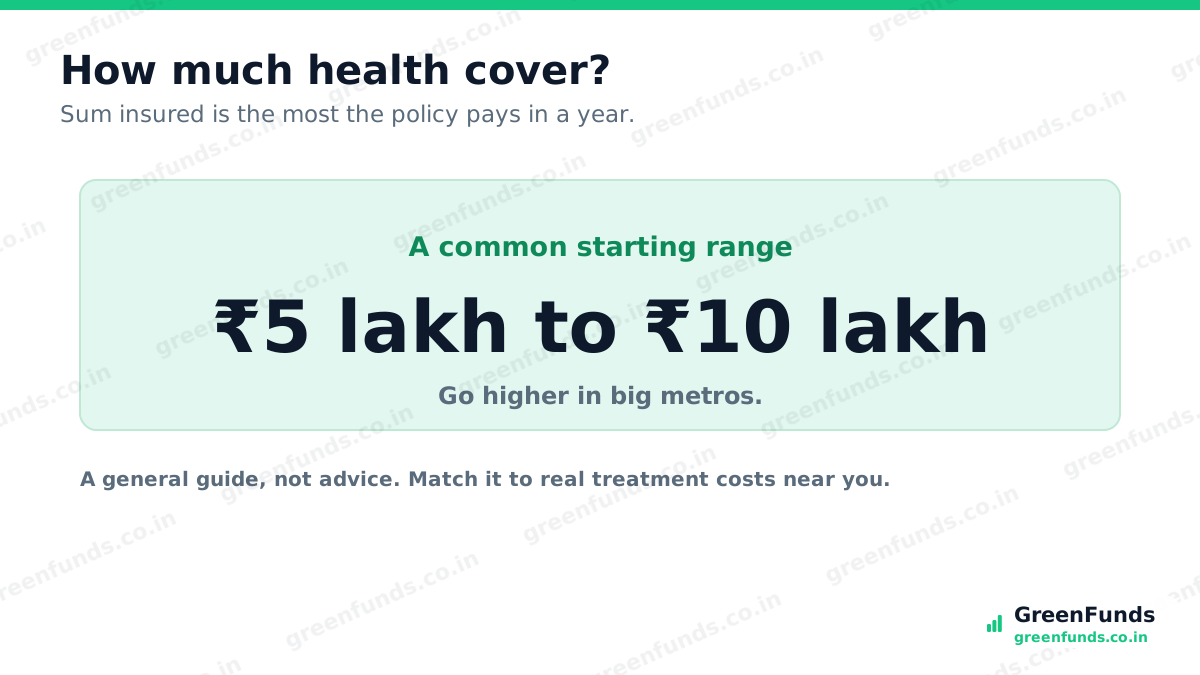
As a rough guide, many people start with ₹5 lakh to ₹10 lakh for themselves or their family, and go higher in big metros where treatment costs more. Look at what a serious hospitalisation actually costs near you and cover for that.
The terms that actually matter
The price is not the whole story. These terms decide whether a policy actually pays when you need it.
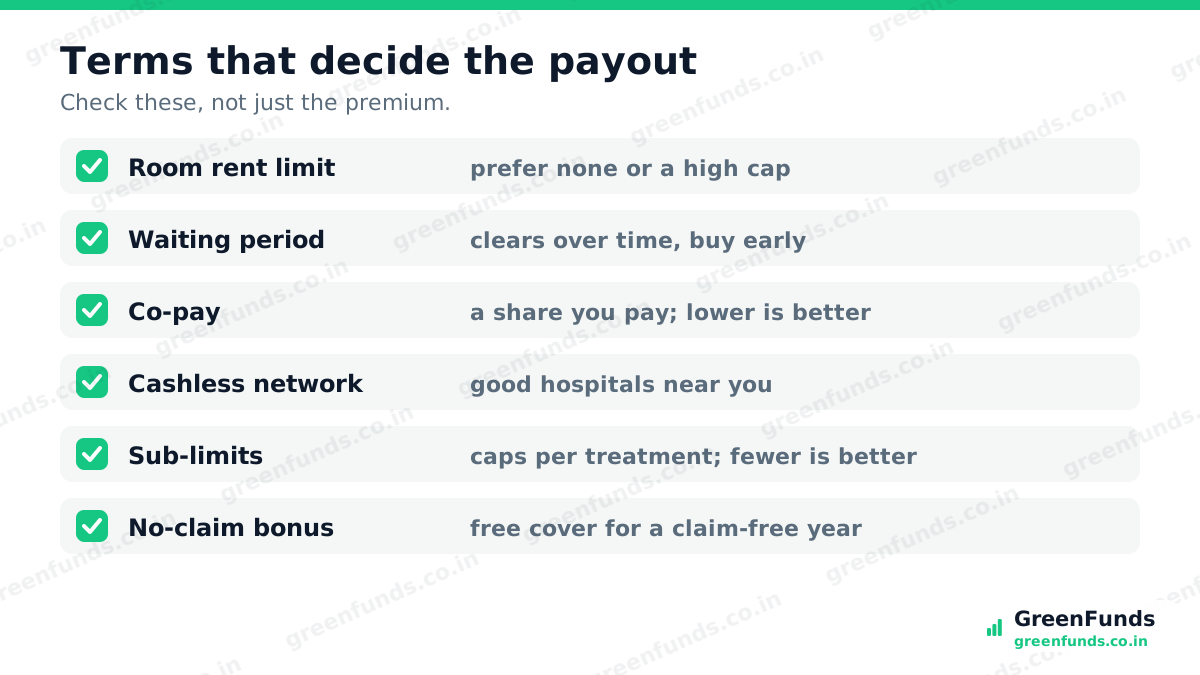
- Room rent limit: a cap on the daily room charge. If your room costs more, you pay the gap, and often the rest of the bill is scaled down too. Prefer no limit, or a high one.
- Waiting period: the gap before certain claims start. Pre-existing conditions and some illnesses have longer ones. Buy early to clear these sooner.
- Co-pay: a share of every claim you pay yourself. A 10% co-pay means you pay 10% of each bill. Lower is better.
- Cashless and network: with cashless, the insurer pays the hospital directly. Check that good hospitals near you are in the network.
- Sub-limits: caps on specific treatments, like cataract or knee surgery. Fewer sub-limits is better.
- No-claim bonus: extra cover added free for every year you do not claim. A nice reward for staying healthy.
Your employer’s cover is not enough
A job policy helps, but it usually has a low sum insured and it vanishes the day you leave or lose the job, which can be exactly when you need it. Keep your own personal policy alongside it, so your cover never depends on your employer.
How to choose
- Start young. Cheaper premiums, and waiting periods clear sooner.
- Pick a real sum insured. Match it to treatment costs in your city.
- Read the terms, not just the price. Room rent, co-pay and sub-limits decide the real payout.
- Check the network and claim record. Good nearby hospitals, and an insurer that pays claims smoothly.
Common mistakes
- Buying only for the tax break. Cover is the point; the deduction is a bonus.
- Choosing on premium alone. The cheapest policy often has the meanest limits.
- Relying only on the office policy. It ends when the job does.
- Hiding a health condition. Non-disclosure can get a future claim rejected. Always declare honestly.
Health insurance is not an investment and does not need to be. It is protection, and it quietly does the one job that matters: keeping a medical bill from becoming a money disaster.
Next, see why term insurance protects your family’s income, or start with the emergency fund.
Questions people ask
Why do I need health insurance if I am young and healthy?
Because a single accident or illness can cost several lakh rupees, enough to wipe out years of savings. Cover is also cheapest and easiest to get when you are young and healthy, before any condition appears.
How much health cover (sum insured) do I need?
Enough to handle a serious hospitalisation in your city. As a general guide many people start at 5 lakh to 10 lakh rupees, higher in big metros where treatment costs more. Match it to real costs around you.
What is a waiting period?
A gap after you buy the policy before certain claims are allowed. New policies have a short initial waiting period, and pre-existing conditions and some specific illnesses have longer ones. Buying early gets these waiting periods out of the way sooner.
What is cashless hospitalisation?
When the insurer settles the bill directly with a network hospital, so you do not pay upfront and claim later. It only works at hospitals in the insurer's network, so check that good hospitals near you are on the list.
What is a room rent limit and why does it matter?
A cap on the room charge the policy will pay per day. If your room costs more, you pay the difference, and in many policies the rest of the bill is then scaled down too. Prefer a policy with no room rent limit, or a high one.
Is my employer's health cover enough?
Usually not on its own. It often has a low sum insured, and it ends when you leave or lose the job, exactly when you may need it. A personal policy that stays with you is worth having alongside it.
Sources
- IRDAI (Insurance Regulatory and Development Authority of India), irdai.gov.in Policy terms, waiting periods and rules vary by insurer and change over time; read the policy document and confirm current details.