Critical illness insurance: a lump sum on diagnosis, not a hospital bill
Cover that pays you a fixed amount when you are diagnosed with a listed serious illness
Critical illness insurance pays you a fixed lump sum when you’re diagnosed with a serious illness on its list. It doesn’t look at your hospital bill. If the policy is for 10 lakh, a valid claim pays 10 lakh, and the money is yours to use.
How it differs from health cover. Regular health insurance pays the hospital, up to the actual bill and your sum insured. Critical illness cover pays you. Insurers call this a benefit based policy: the payout is fixed in advance, not matched to costs.
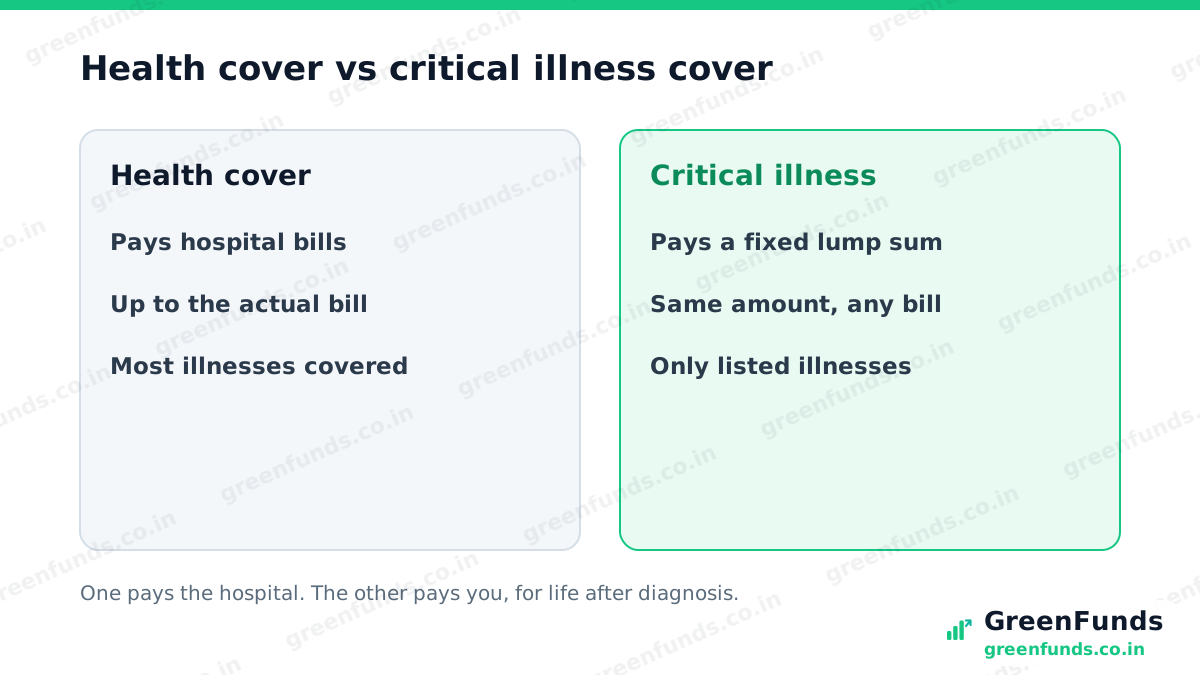
Why that matters. A serious illness costs more than the hospital. You might stop working for months. You might need home care, travel for treatment, or help with EMIs. A health policy won’t pay for any of that. A lump sum can.
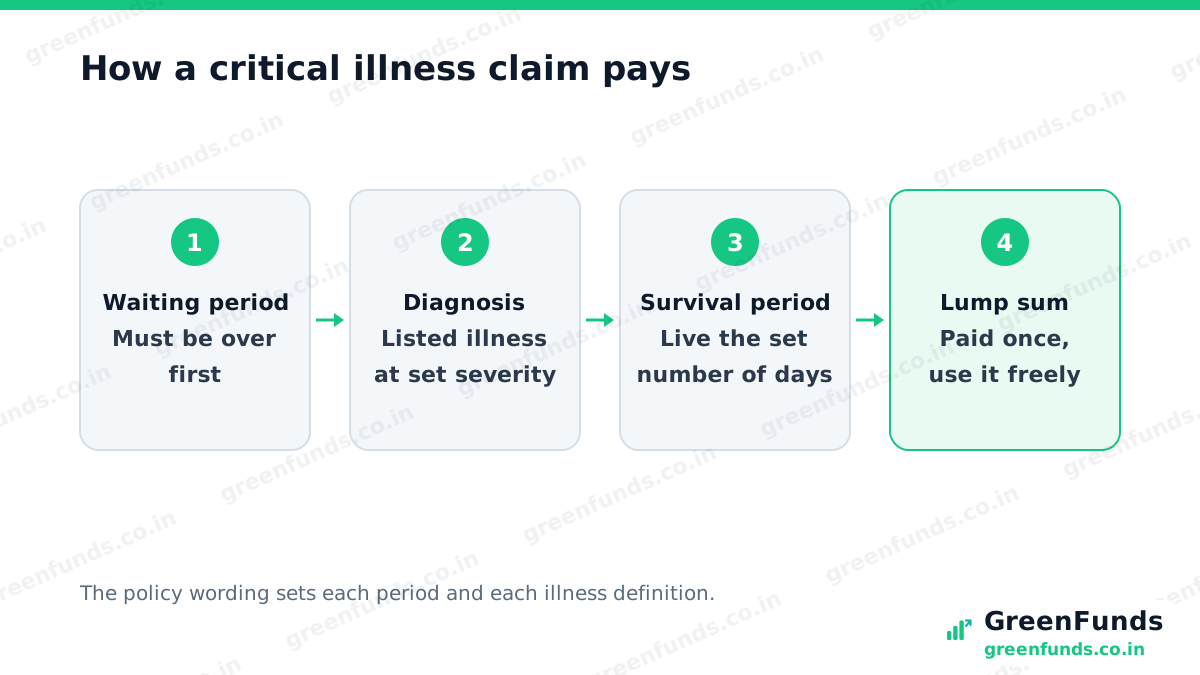
What has to happen for a claim. Four things, in order.
- The waiting period is over. Most policies won’t pay for an illness diagnosed in the first stretch after you buy. The wording sets the length.
- The illness is on the list, at the stated severity. Each illness has a strict definition, often by stage. An early stage of a condition may not qualify, unless the policy says so.
- You survive the survival period. You must live a set number of days after diagnosis, as stated in the policy schedule.
- The lump sum is paid. The wording says whether cover continues after a full payout.
A rupee illustration. Say Arjun, 40, has a 10 lakh family health policy and a separate 15 lakh critical illness cover (illustrative numbers). He’s diagnosed with a listed illness. Treatment costs 8 lakh. His health policy pays the 8 lakh bill to the hospital. After the survival period, the critical illness policy pays him 15 lakh. He’s off work for a year, and that 15 lakh covers his family’s living costs and home loan EMIs.
Two policies, two payouts. Under IRDAI’s 2024 master circular, benefit based policies pay out under every policy you hold when the event happens. A bill-paying policy works differently: several policies share one bill.
Before you buy, check:
- Which illnesses are listed, and how each is defined?
- How long are the waiting and survival periods?
- Does the policy end after one claim?
- Is it a standalone policy or a rider on life cover?
The takeaway. Critical illness cover isn’t a replacement for health insurance. It’s a separate cheque for the life costs a bill-paying policy ignores. Read the illness definitions before you buy, since they decide every claim.
More to read: our health insurance guide, how much health cover, and how much term cover, the cover for your family if the worst happens.
Questions people ask
What is critical illness insurance?
It is a policy that pays you a fixed lump sum if you are diagnosed with one of the serious illnesses it lists, at the severity it defines. The amount doesn't depend on your hospital bill, and you can use it for anything.
What is the survival period in critical illness insurance?
It is the number of days you must live after the diagnosis or surgery for the claim to be paid. The policy schedule sets it. If the person dies within it, the lump sum is usually not paid, so read this line carefully.
Is critical illness insurance the same as health insurance?
No. Health insurance pays hospital bills, up to the actual cost. Critical illness cover pays a fixed amount on diagnosis of a listed illness. Many people see it as a layer on top of health cover, not a replacement for it.
Can I claim from two critical illness policies for the same illness?
Yes. IRDAI's 2024 master circular says that for benefit based policies, you can claim from all insurers under all policies when the insured event happens. That's different from bill-paying health policies, which share one bill between them.
Source: Critical illness policy wordings filed with IRDAI (irdai.gov.in): survival period and waiting periods set in the policy schedule; IRDAI Master Circular on Health Insurance Business, 29 May 2024 (benefit based policies). Terms vary by product; check the policy wording.
Found this useful? You can buy us a coffee. It keeps GreenFunds free.Flag a possible issue
Was this helpful?
Thanks for the signal.
Comments
Share your experience or a question. Be kind, stay on topic. This is reader discussion, not financial advice.
No comments yet. Be the first to share.