Term insurance riders: types, IRDAI limits and when to skip them
A rider is an optional add-on to a term plan that pays an extra benefit for an extra premium
A rider is an add-on to your term insurance plan. You pay a bit more premium, and the policy pays an extra benefit when a listed event happens. A rider can’t be bought on its own. It’s attached to the base plan and ends with it.
Common types of riders
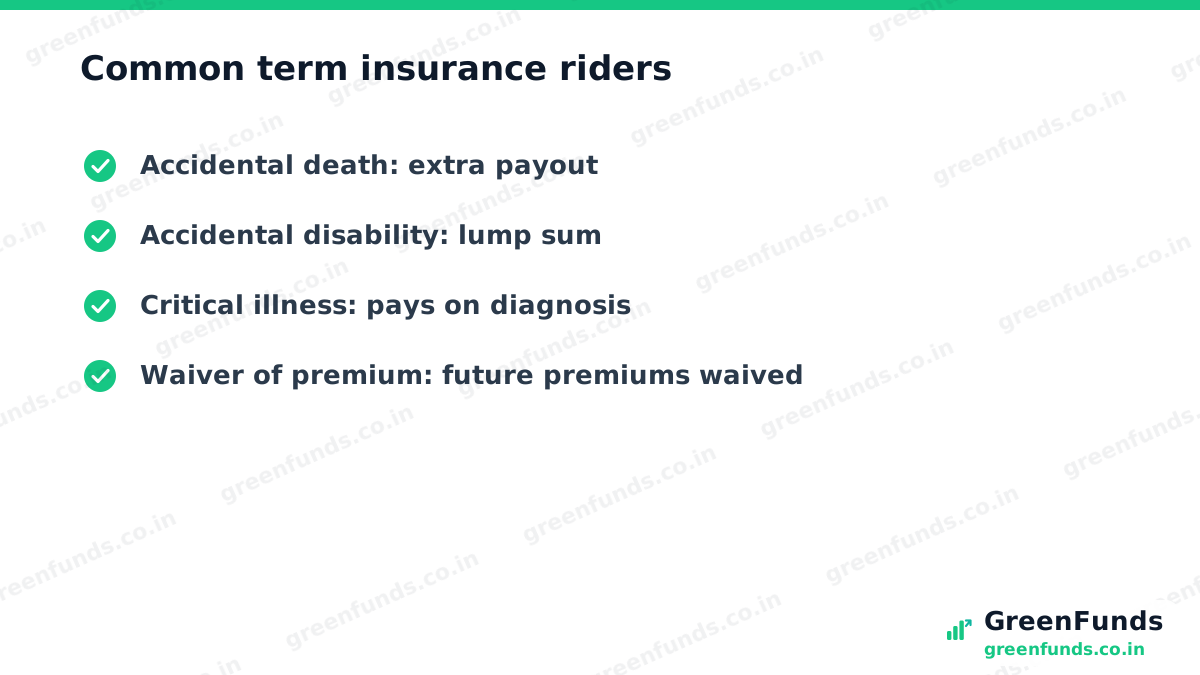
IRDAI’s Master Circular on Life Insurance Products, dated 12 June 2024, lists the riders insurers can file. It says the list isn’t exhaustive, and each insurer chooses which to offer. The ones you’ll usually see on a term plan:
- Accidental death benefit. An extra payout if death is caused by an accident, on top of the base cover.
- Accidental disability. A lump sum, or income in some designs, if an accident causes permanent total or partial disability.
- Critical illness. A lump sum on diagnosis of a listed serious illness. Some versions are “accelerated”: the payout comes out of the death benefit, so the life cover shrinks. Others pay on top. The rider wording says which.
- Waiver of premium. If a listed event happens, such as disability or a critical illness, the remaining premiums are waived and the cover carries on.
- Terminal illness. Pays an amount early if you’re diagnosed with a terminal illness, as the rider wording sets out.
The rules IRDAI sets on riders
The 2024 master circular, issued under the IRDAI (Insurance Products) Regulations, 2024, puts three limits on riders:
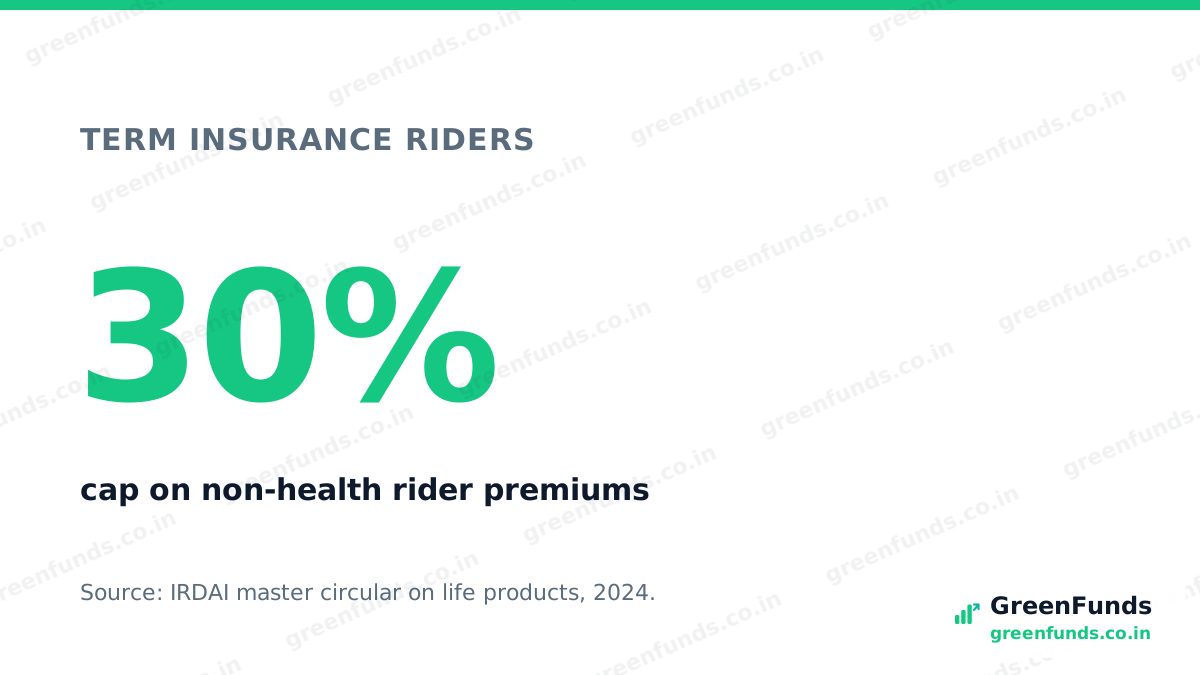
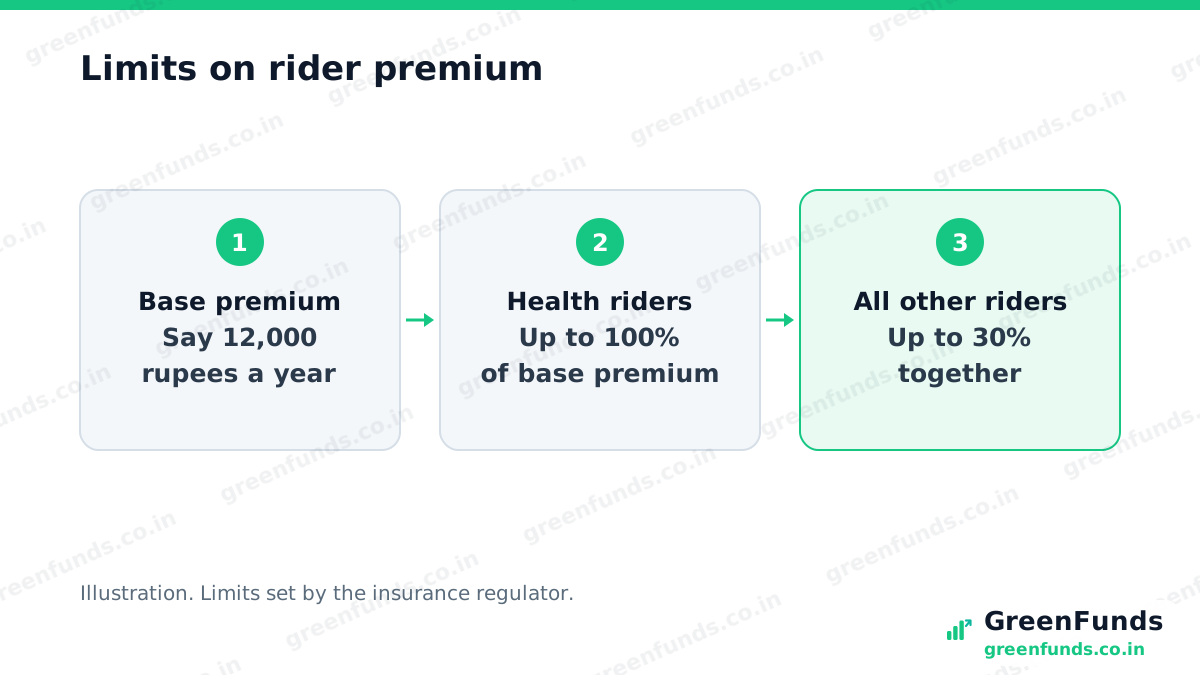
- Premium caps. Premiums for health related or critical illness riders can’t exceed 100% of the base policy premium. All other riders together can’t exceed 30% of it.
- Benefit caps. Each rider’s benefit can’t exceed the base plan’s sum assured. The one exception: an accidental death benefit rider can go up to three times the base sum assured.
- Term. When a rider is added to an existing policy, its term can’t run past what’s left of the base policy’s term.
An illustration. Say your term plan is for 1 crore rupees with a premium of 12,000 rupees a year (made-up numbers). Your accidental death, disability and waiver riders together could cost at most 3,600 rupees a year (30% of 12,000). A critical illness rider could cost up to 12,000 rupees on its own. Its payout couldn’t exceed 1 crore, while an accidental death rider could pay up to 3 crore.
The 30-day free look period applies to the policy, so read the rider wording in that window too.
When a separate policy may fit better
Riders are convenient: one policy, one premium date. But they have three built-in limits. The cover is capped by the base plan. It stops when the base plan stops. And if you switch term plans later, the riders don’t come with you.
A separate policy avoids all three:
- Accident cover. A standalone personal accident insurance policy, such as IRDAI’s standard Saral Suraksha Bima, can add weekly pay while you’re off work, which most accidental death riders don’t.
- Critical illness. A standalone critical illness policy can have its own sum and term, not tied to your life cover.
The waiver of premium rider is the one that has no direct standalone version. It keeps the term plan alive if you can’t pay, which is why many buyers look at it first.
Did you know? Every rider has its own ten-character Unique Identification Number (UIN) from IRDAI, separate from the base plan’s, and it must appear on your policy papers. The fourth character tells you what it is: A marks a linked rider and B a non-linked one. If an add-on has no rider UIN, it isn’t a filed rider.
Riders are one way to protect a family; for a non-earning spouse, see term insurance for homemakers.
The takeaway. Riders are a cheap way to plug a few gaps, within limits IRDAI sets. Decide first how much life cover you need, then add only the riders that cover a real risk you can’t cover better elsewhere.
More to read: how much term cover you need, term vs endowment, the real cost, and the term insurance lesson.
Questions people ask
What is a rider in term insurance?
A rider is an optional add-on you attach to a term plan for an extra premium. It pays a benefit the base plan doesn't, such as an extra sum if death is caused by an accident, or a lump sum on diagnosis of a listed critical illness. It can't be bought on its own and ends with the base policy.
What are the types of riders in term insurance?
IRDAI's 2024 master circular lists term riders, accidental death benefit riders, accidental total or partial permanent disability riders, waiver of premium riders, critical illness riders and terminal illness riders, and says the list isn't exhaustive. Each insurer decides which ones it offers.
Is there a limit on rider premium?
Yes. Under IRDAI's master circular of 12 June 2024, premiums for health related or critical illness riders can't exceed 100% of the base policy premium. Premiums for all other riders put together can't exceed 30% of it.
Can a rider pay more than the term plan's sum assured?
Usually not. The master circular says each rider's benefit can't exceed the base policy's sum assured. The exception is the accidental death benefit rider, where the rider sum assured can be up to three times the base sum assured.
Is a rider better than a separate policy?
It depends. A rider is convenient and often cheap, but its cover is capped by the base plan and it ends when the base plan ends. A separate critical illness or personal accident policy can have its own amount and term, and stays if you change or drop the term plan.
Source: IRDAI, Master Circular on Life Insurance Products, Ref IRDAI/ACTL/MSTCIR/MISC/89/6/2024, 12 June 2024 (paras 7.17, 63.8, 87.8; free look period, Section I), issued under the IRDAI (Insurance Products) Regulations, 2024 (irdai.gov.in); IRDAI, Guidelines on Standard Personal Accident Insurance Product, 25 February 2021. Rupee examples are illustrations.
Found this useful? You can buy us a coffee. It keeps GreenFunds free.Flag a possible issue
Was this helpful?
Thanks for the signal.
Comments
Share your experience or a question. Be kind, stay on topic. This is reader discussion, not financial advice.
No comments yet. Be the first to share.