Term insurance for homemakers: why it matters and how much cover
A homemaker's unpaid work has a cost to replace, so life cover can be sized on that cost
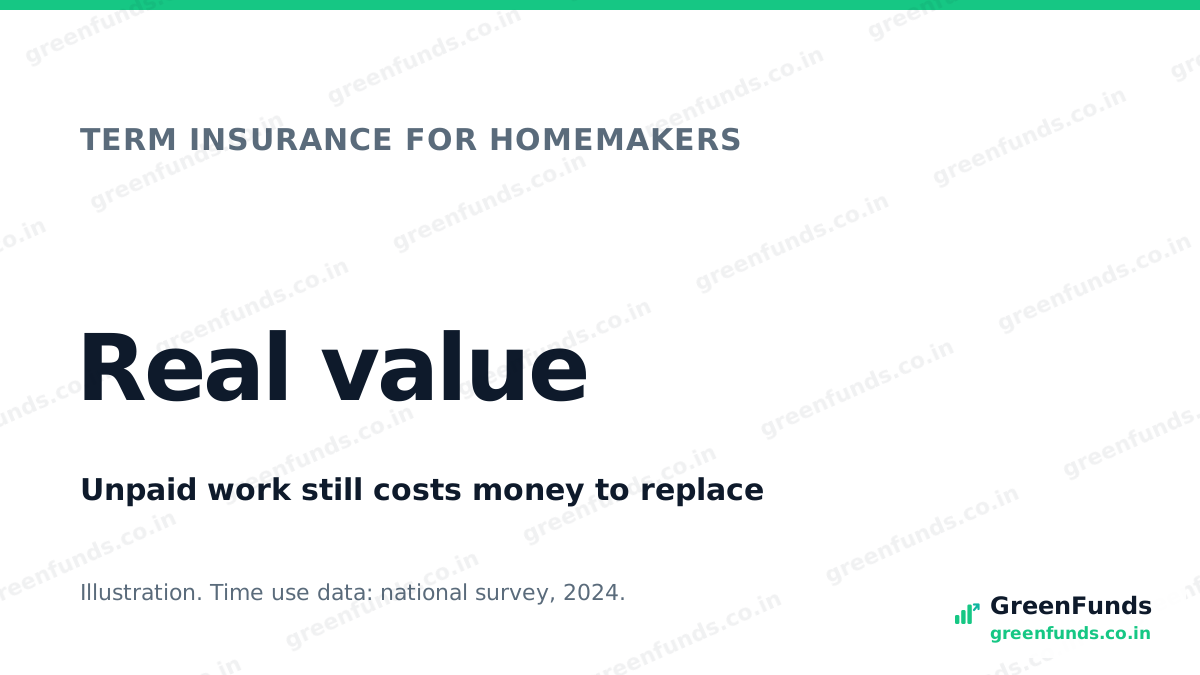
A homemaker has no salary slip, so it’s easy to think she doesn’t need life cover. But if she died, someone would still have to cook, clean, look after the children and care for older family members. That work would either cost money or cost the earning spouse working hours. Term insurance is one way to pay for that gap.
Unpaid work still has a price
The numbers are large. India’s Time Use Survey for 2024, released by the statistics ministry in February 2025, found that women aged 15 to 59 who did unpaid domestic work spent about 305 minutes a day on it, roughly five hours. Women who cared for family members spent about 140 minutes a day on caregiving, against 74 minutes for men.
Courts recognise this value too. In Kirti v Oriental Insurance (January 2021), a motor accident case, the Supreme Court said courts should fix a notional income for a homemaker when deciding compensation, rather than treat her work as worth nothing.
How insurers usually treat homemaker cover
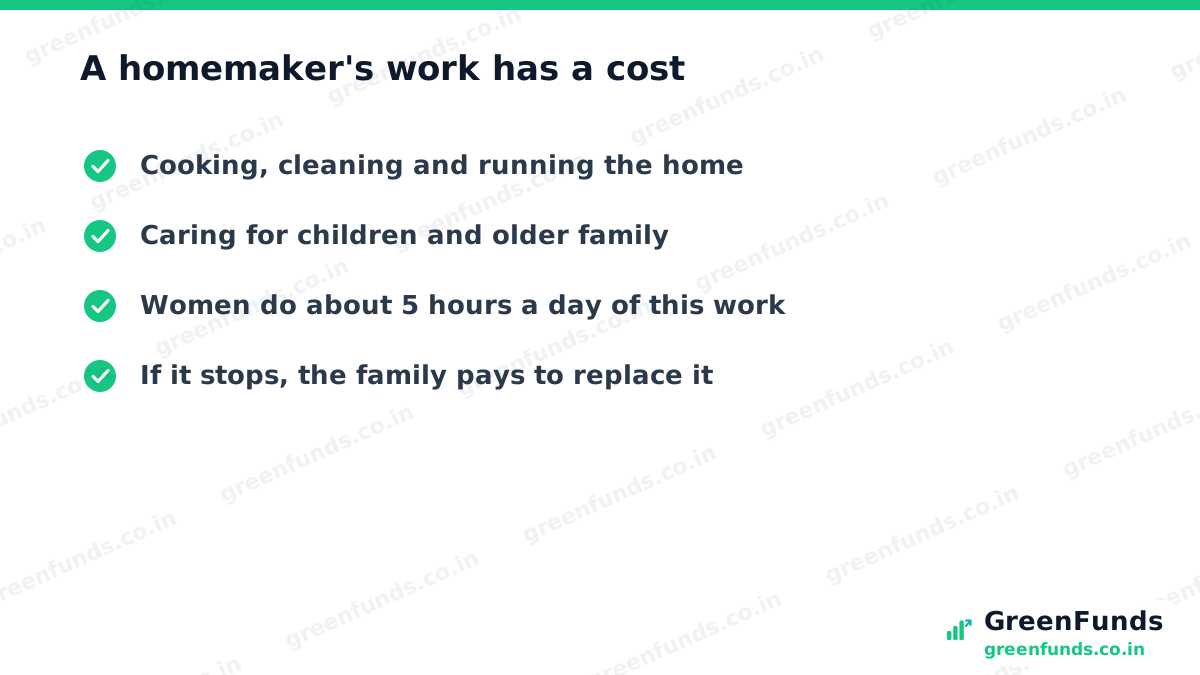
Life insurers size cover mostly on income, and a homemaker has none of her own. So the common pattern is to link her cover to the earning spouse: insurers often look at the spouse’s income or the spouse’s own term cover, may limit her cover to a part of it, and may ask that the spouse be insured as well. Some look at total household income instead.
The exact limits aren’t set by a regulator. They come from each insurer’s board approved underwriting policy, so they differ from one insurer to the next. IRDAI’s 2024 master circular does ask life insurers to offer products for all ages, regions and occupational categories, as per people’s needs and affordability. If one insurer declines or offers too little, another may treat the same case differently.
How much cover makes sense
Price the work, as you would a salary. The method is the same needs-based approach as in how much term cover, with the cost of her work in place of income.
An illustration. Say the family would need paid help for cooking, cleaning and childcare at about 25,000 rupees a month, or 3 lakh rupees a year (made-up numbers). The youngest child is 5, so the help is needed for about 15 years: 3 lakh times 15 is 45 lakh. Add 10 lakh towards a child’s education. Subtract 5 lakh the family has already saved for these costs. That gives 45 + 10 minus 5 = 50 lakh rupees of cover.
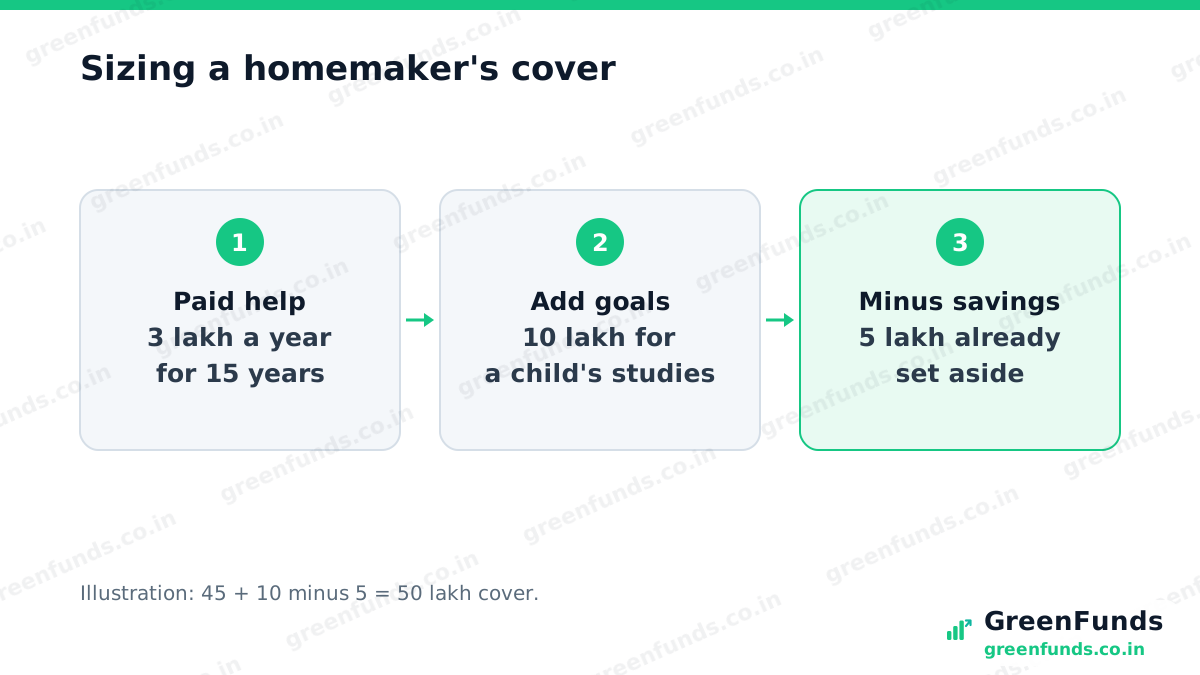
This simple sum ignores inflation, which would push the cost of help up each year, and the interest the payout could earn, which would offset some of it. It’s a starting point, not a final answer.
Alternatives and add-ons
- The earning spouse’s cover. Some families add the cost of replacing the homemaker’s work to the earner’s own cover. That doesn’t protect against her death, so it isn’t a substitute, but it shows the gap clearly.
- Accident cover. Under IRDAI’s standard personal accident insurance product, Saral Suraksha Bima, a family cover gives each member the full chosen sum separately. The government’s PMSBY offers 2 lakh rupees of accident cover for 20 rupees a year. Both cover accidents only.
- Riders. A rider adds benefits to a term plan, within IRDAI’s limits. See term insurance riders.
- Health cover. A family floater health insurance policy pays her hospital bills, which life cover doesn’t.
Did you know? The 2024 Time Use Survey found that on a given day, 81.5% of women and girls aged 6 and above did unpaid domestic work for their household, against 27.1% of men and boys. In most homes, this is the work a term plan for a homemaker is really insuring.
The takeaway. A homemaker’s work is unpaid, but it isn’t free. Price what it would cost to replace, check how each insurer links her cover to the earning spouse, and fill any gap with accident cover and a clear nominee on every policy.
More to read: term vs endowment, the real cost, the health insurance guide, and the term insurance lesson.
Questions people ask
Can a housewife buy term insurance?
Yes, many insurers offer term cover to a homemaker, who has no income of her own. Because insurers usually size cover on income, they commonly decide a homemaker's cover by looking at the spouse's income or the spouse's own life cover, and some ask that the spouse also be insured. The exact rule is set in each insurer's underwriting policy, so it varies.
Why does a homemaker need term insurance?
Because her work would cost money to replace. Cooking, cleaning, childcare and caring for older family members would need paid help or lost working hours if she died. India's 2024 Time Use Survey found women aged 15 to 59 who did unpaid domestic work spent about 305 minutes a day on it.
How much term cover does a homemaker need?
One way is to price the work. Estimate what paid help would cost each year, multiply by the years it would be needed, add big goals such as a child's education, and subtract savings already set aside. In one illustration, help at 3 lakh rupees a year for 15 years, plus 10 lakh for studies, minus 5 lakh saved, gives 50 lakh rupees.
What can a homemaker do if a term plan isn't available?
Other options include a personal accident policy, which under IRDAI's standard product can cover each family member for the full chosen sum, the government's PMSBY accident cover for 20 rupees a year, or raising the earning spouse's own term cover to include the cost of replacing her work.
Source: MoSPI Time Use Survey, January to December 2024, PIB release of 25 February 2025 (pib.gov.in); Supreme Court of India, Kirti and Anr v Oriental Insurance Co Ltd, Civil Appeal Nos 19 to 20 of 2021, judgment of 5 January 2021; IRDAI Master Circular on Life Insurance Products, 12 June 2024 (Section I, para 1); IRDAI Guidelines on Standard Personal Accident Insurance Product, 25 February 2021 (irdai.gov.in). Rupee figures are illustrations.
Found this useful? You can buy us a coffee. It keeps GreenFunds free.Flag a possible issue
Was this helpful?
Thanks for the signal.
Comments
Share your experience or a question. Be kind, stay on topic. This is reader discussion, not financial advice.
No comments yet. Be the first to share.