Credit card EMI: the real cost of converting a bill into EMIs
A credit card EMI is far cheaper than revolving the bill, but interest, fees and GST still add up
Most credit cards let you turn a big purchase, or part of a bill, into fixed monthly instalments. It’s a useful escape from card interest, but it’s still a loan with a price tag. Here’s what you actually pay.
Two ways to convert
- A purchase. At checkout, or within a window after it, you convert one transaction into an EMI plan of a few months.
- Your bill or outstanding balance. You convert part or all of a statement into EMIs, instead of paying it at once.
Either way, the converted amount drops out of what you must pay this month and comes back in instalments on each later statement.
What a card EMI costs
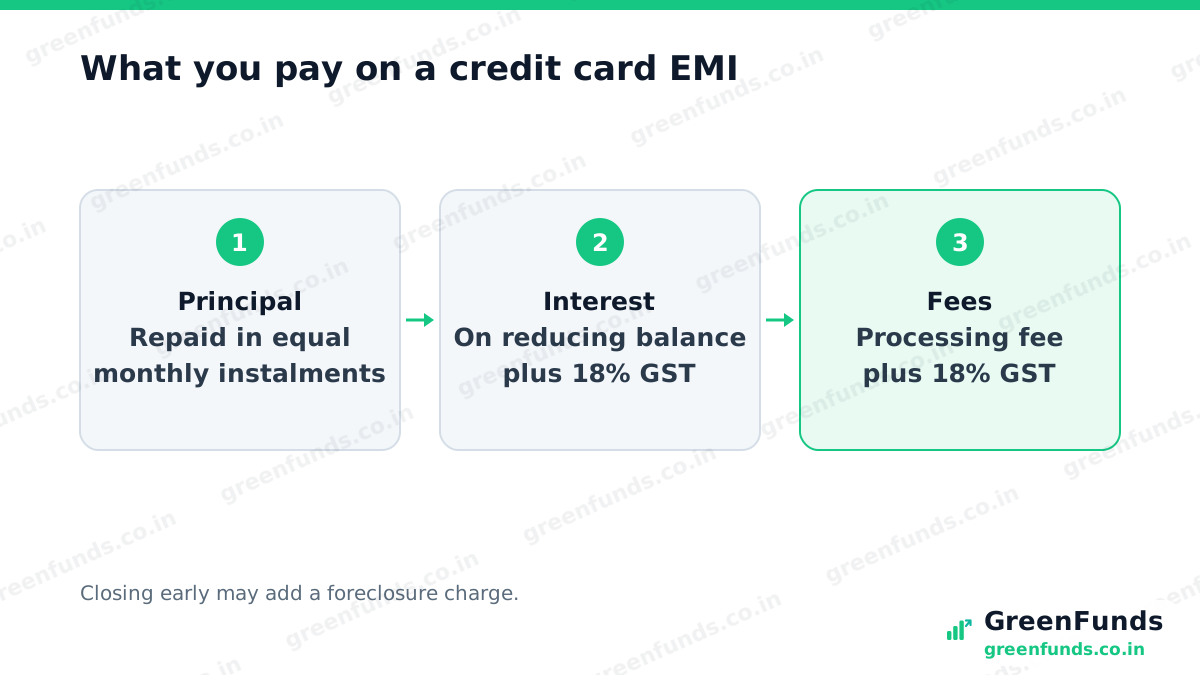
- Interest, charged on the reducing balance at the rate the issuer quotes for that plan.
- A processing fee, often charged once, upfront. See processing fee.
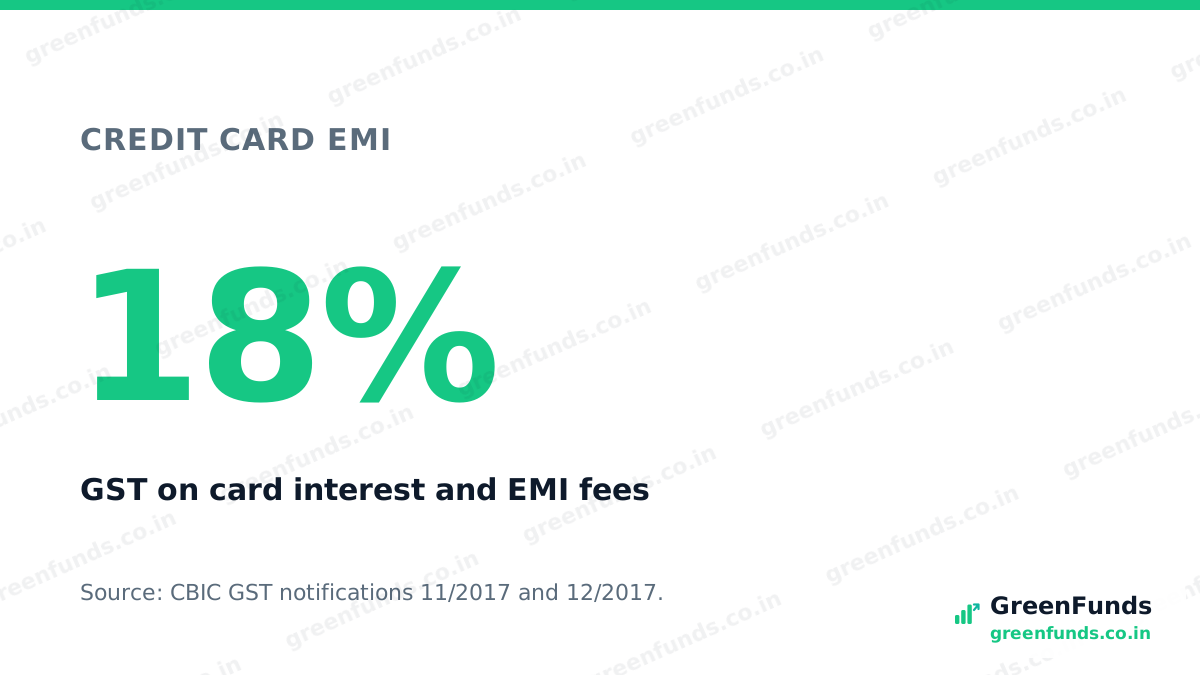
- GST at 18% on both. GST law exempts ordinary loan interest, but the exemption leaves out interest involved in credit card services. Fees aren’t interest, so GST applies to them as well.
- A foreclosure charge if you close the plan early, as per the issuer’s terms. The rules on that are in loan foreclosure charges.
What RBI makes the card issuer show you
RBI’s 2025 credit card directions, which replaced its 2022 Master Direction, set these rules for banks:
- Before converting, the issuer must clearly show the principal, interest and any upfront discount that makes it no-cost. The same must appear separately on your bill.
- An EMI with interest can’t be passed off as zero-interest or no-cost.
- A one-page Key Fact Statement with the card application must show the interest rate and charges.
- No charge can be levied that wasn’t shown to you when the card was issued, other than taxes. Changes in charges need at least one month’s notice.
A no-cost EMI usually means the merchant or issuer gives an upfront discount equal to the interest. You may still pay a processing fee and GST. Read is no-cost EMI really free and the no-cost EMI entry.
Your credit limit while the EMI runs
The converted amount usually stays blocked against your credit limit, and frees up as each EMI repays principal. Convert 60,000 rupees on a 1 lakh rupee limit, and you may have only about 40,000 rupees to spend at first. A high share of your limit in use can also weigh on your credit score.
A worked comparison
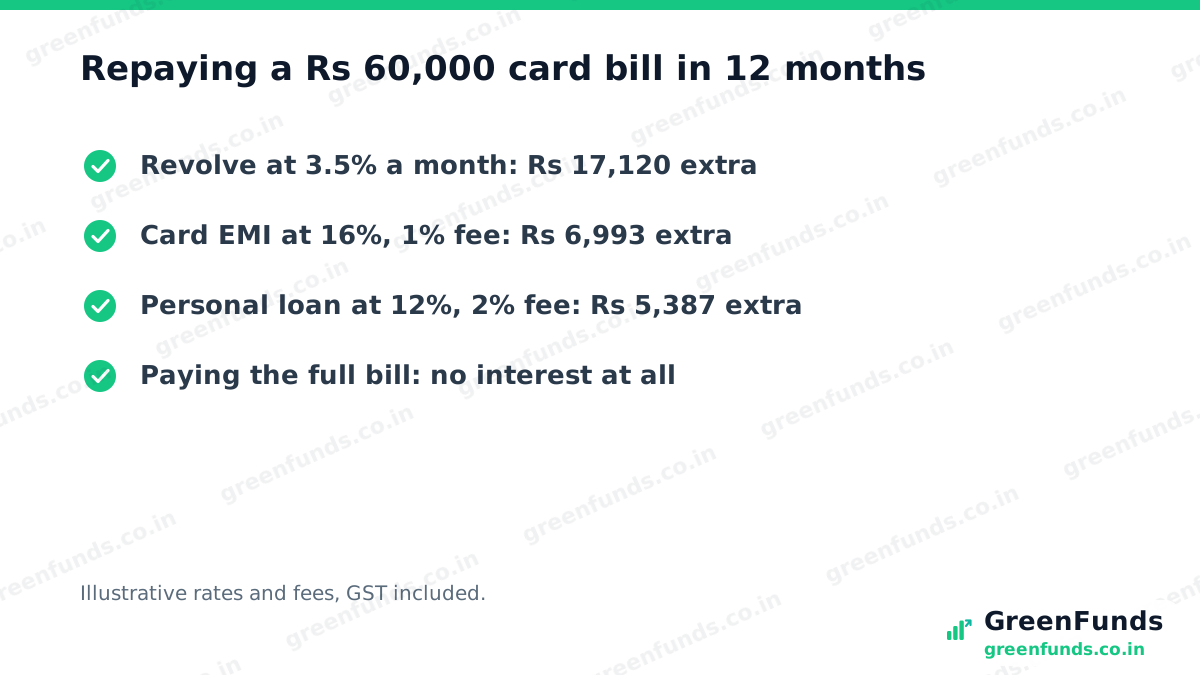
Say you have a 60,000 rupee card bill and need 12 months to clear it. Compare three routes, with rates and fees that are made up for illustration:
| Route | Rate (illustration) | Monthly payment | Interest | Fees and GST | Total extra cost |
|---|---|---|---|---|---|
| Revolve the bill | 3.5% a month | ₹6,209 | ₹14,508 | ₹2,612 GST | ₹17,120 |
| Card EMI | 16% a year, 1% fee | ₹5,444 | ₹5,326 | ₹1,667 | ₹6,993 |
| Personal loan | 12% a year, 2% fee | ₹5,331 | ₹3,971 | ₹1,416 | ₹5,387 |
The revolving line is simplified: real card interest runs daily from each purchase date, and while any balance is unpaid you lose the interest-free period on new spending. Personal loan interest carries no GST, but its processing fee does. Run your own numbers on the EMI calculator.
Paying a loan EMI with a credit card
Some lenders and apps let you pay a loan EMI with a card. That just moves the debt onto your card. Unless you pay the card’s total amount due in full, you end up paying card interest to service a cheaper loan. Any convenience fee adds to the cost.
Did you know? RBI’s card rules require every statement to warn that paying only the minimum amount due stretches repayment over months or years, with compounded interest. Converting to an EMI on purpose is far cheaper than drifting on the minimum due.
The takeaway. A card EMI beats revolving a bill by a wide margin, but add the interest, fee and GST before you say yes, and check what it does to your limit. If a personal loan is cheaper all-in, it can be the better route. For a bigger debt clean-up, see how to get out of credit card debt, and for long loans, home loan balance transfer.
More to read: personal loan vs credit card, credit card minimum due, and is no-cost EMI really free.
Questions people ask
How does a credit card EMI work?
The card issuer turns a purchase or part of your bill into a small loan repaid in fixed monthly instalments, added to each card statement. You pay interest on the reducing balance, often a one-time processing fee, and GST on both. The converted amount is taken out of the bill you have to pay that month.
Is GST charged on credit card EMI?
Yes. GST law exempts ordinary loan interest but specifically leaves out interest involved in credit card services, so card interest attracts GST at 18% (9% central plus 9% state). The processing fee is a fee, not interest, so GST applies to it too.
Is converting a credit card bill into EMI better than paying the minimum due?
Usually, yes. Card interest on a revolving balance is high, and while any balance is unpaid you also lose the interest-free period on new purchases. An EMI at a lower rate, repaid on schedule, costs far less. Paying the full bill is still the cheapest option.
Does a credit card EMI reduce my credit limit?
Typically, yes. The amount you convert stays blocked against your credit limit and is released as you pay off the principal with each EMI. Check your issuer's terms, since a big EMI can leave little room for daily spending.
What does RBI require for credit card EMIs?
Under RBI's credit card directions, the issuer must clearly show the principal, interest and any upfront discount before converting a transaction into EMIs, and show them separately on the bill. An EMI that carries interest cannot be presented as zero-interest or no-cost EMI.
Source: RBI (Commercial Banks - Credit Cards and Debit Cards: Issuance and Conduct) Directions, 2025, DOR.AUT.REC.No.74/24-01-041/2025-26, 28 November 2025, updated as on 1 October 2026, which replaced the earlier credit card Master Direction (rbi.org.in); CBIC Notification 12/2017-Central Tax (Rate), 28 June 2017, entry 27 (loan interest exemption excludes interest involved in credit card services), Notification 11/2017-Central Tax (Rate), heading 9971 (financial services at 9% central tax plus 9% state tax), and Circular 102/21/2019-GST on loan fees (cbic-gst.gov.in). Worked example computed with the standard reducing-balance EMI formula, with illustrative rates.
Found this useful? You can buy us a coffee. It keeps GreenFunds free.Flag a possible issue
Was this helpful?
Thanks for the signal.
Comments
Share your experience or a question. Be kind, stay on topic. This is reader discussion, not financial advice.
No comments yet. Be the first to share.