Loan foreclosure charges: RBI rules on prepaying a loan from 2026
Floating-rate loans to individuals for personal use carry no prepayment charge; fixed-rate loans follow the loan agreement
Paying off a loan early, called foreclosure, saves you the interest on the months you skip. Paying a lump sum without closing the loan is part-prepayment. Whether the lender can charge you for either depends on two things: the type of interest rate, and why you borrowed.
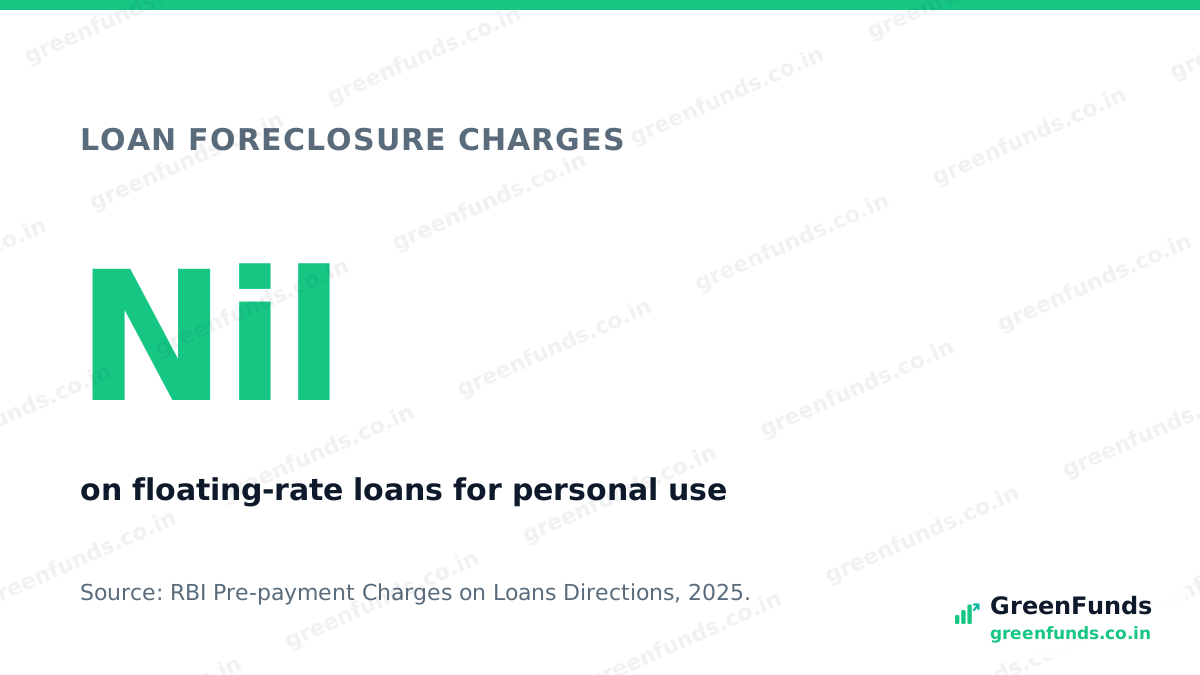
The main rule: floating rate, personal use, no charge
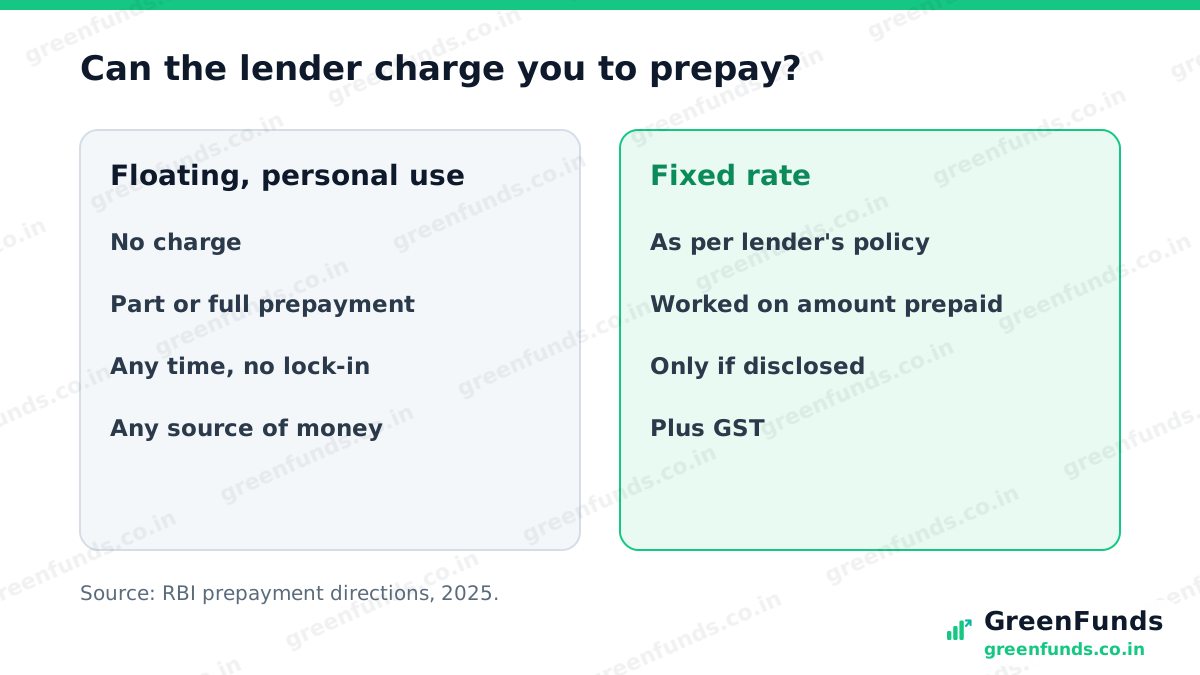
If your loan has a floating rate and you took it as an individual for a non-business purpose, no regulated lender can charge you for prepaying it. That covers floating-rate home, car and education loans taken for personal use.
- For loans sanctioned or renewed up to 31 December 2025, older RBI rules already barred charges on such floating-rate term loans.
- For loans sanctioned or renewed from 1 January 2026, the RBI (Pre-payment Charges on Loans) Directions, 2025, dated 2 July 2025, apply. They cover commercial banks (other than payments banks), co-operative banks, NBFCs and All India Financial Institutions.
The ban applies to part and full prepayment, whatever the source of the money, and with no minimum lock-in period. It holds even with a co-borrower. For a loan that mixes fixed and floating periods, what counts is whether it’s on a floating rate when you prepay.
Business loans to individuals and small firms
The 2025 directions go further for floating-rate loans taken for business by individuals and micro and small enterprises (MSEs):
- No charge at all at commercial banks (other than small finance, regional rural and local area banks), Tier 4 urban co-operative banks, upper-layer NBFCs and All India Financial Institutions.
- No charge up to a sanctioned amount of 50 lakh rupees at small finance banks, regional rural banks, Tier 3 urban co-operative banks, state and central co-operative banks and middle-layer NBFCs.
RBI said it acted because lenders followed divergent practices on MSE loans and some used loan clauses to stop borrowers from switching to a cheaper lender.
Fixed-rate loans, such as many personal loans
Outside these cases, prepayment charges follow the lender’s own approved policy. That’s why personal loan foreclosure charges vary. RBI still sets limits:
- For term loans, any charge must be worked out on the amount you prepay.
- It must be shown in the sanction letter, the loan agreement and the Key Fact Statement. An undisclosed charge can’t be levied.
- A lender can’t bring back, at prepayment, a fee it waived earlier.
- There’s no charge when the lender itself asks you to prepay.
GST is added to any charge, because a fee on a loan isn’t treated as exempt interest. RBI’s microfinance rules separately bar prepayment charges on microfinance loans.
A worked example
Say you took a fixed-rate personal loan of 5 lakh rupees at 14% for 3 years (made-up numbers). The EMI is ₹17,089.
| Close the loan after | You still owe | Interest you save |
|---|---|---|
| 12 months | ₹3,55,921 | ₹54,210 |
| 24 months | ₹1,90,326 | ₹14,740 |
After 12 months, closing the loan stays worthwhile unless the charge, before 18% GST, is above about 12.9% of the amount you prepay. After 24 months, that break-even falls to about 6.6%, because less interest is left to save. So check the KFS for the charge and do this sum before you close a loan late in its tenure.
Did you know? On cash credit and overdraft accounts, the 2025 directions also say there’s no prepayment charge if you tell the lender, within the time set in the agreement, that you won’t renew the facility, and it closes on its due date.
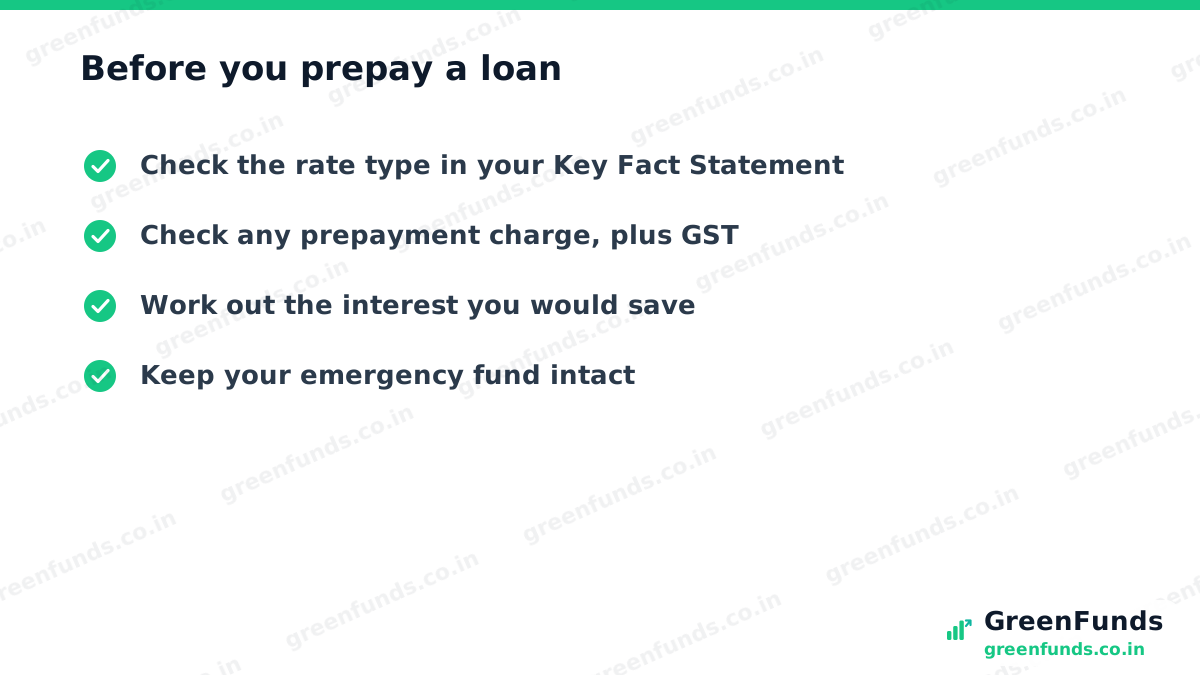
The takeaway. Check two lines in your Key Fact Statement: the interest rate type and the prepayment charge. On a floating-rate loan for personal use, prepaying is free. On a fixed-rate loan, compare the charge with the interest you’d save. To decide whether to prepay at all, read should you prepay a loan. To move a home loan instead, see home loan balance transfer, and for card debt, the real cost of a credit card EMI.
More to read: personal loan vs credit card, car loan basics, and home loan basics.
Questions people ask
Can a bank charge for foreclosing a floating-rate loan?
Not if you took the loan as an individual for a purpose other than business. RBI rules bar prepayment and foreclosure charges on such floating-rate loans, for part or full prepayment, whatever the source of the money and with no minimum lock-in period. This covers banks, co-operative banks and NBFCs.
What are personal loan foreclosure charges?
Many personal loans carry a fixed interest rate, and RBI lets lenders set prepayment charges on fixed-rate loans under their own approved policy. The charge must be disclosed in the sanction letter, loan agreement and Key Fact Statement, and for term loans it must be worked out on the amount you prepay. A charge that was not disclosed cannot be levied.
What changed on 1 January 2026?
RBI's Pre-payment Charges on Loans Directions, 2025 apply to loans sanctioned or renewed from 1 January 2026. Besides the personal-use rule, they bar prepayment charges on floating-rate business loans to individuals and micro and small enterprises at most commercial banks and large NBFCs, and up to a sanctioned amount of 50 lakh rupees at small finance banks, regional rural banks, some co-operative banks and mid-sized NBFCs.
Is GST charged on a loan foreclosure charge?
Yes, where a charge applies. GST law exempts loan interest, but a fee or charge on a loan does not count as interest, according to CBIC Circular 102/21/2019-GST, so GST is added to it.
Does closing a loan early always save money?
It saves the interest you would have paid on the remaining months, which is largest early in the loan. Weigh that against any charge, plus GST, and against keeping an emergency fund. Paying off very late in the tenure saves little interest.
Source: RBI (Pre-payment Charges on Loans) Directions, 2025, RBI/2025-26/64, DoR.MCS.REC.38/01.01.001/2025-26, 2 July 2025, applicable to loans sanctioned or renewed on or after 1 January 2026; RBI (Non-Banking Financial Companies - Responsible Business Conduct) Directions, 2025, 28 November 2025, updated as on 1 July 2026, paragraphs 29, 33, 34 and 81 (rbi.org.in); CBIC Circular 102/21/2019-GST on fees charged on loans (cbic-gst.gov.in). Worked example computed with the standard reducing-balance EMI formula.
Found this useful? You can buy us a coffee. It keeps GreenFunds free.Flag a possible issue
Was this helpful?
Thanks for the signal.
Comments
Share your experience or a question. Be kind, stay on topic. This is reader discussion, not financial advice.
No comments yet. Be the first to share.