Home loan balance transfer and top-up: how it works, costs and documents
Move your home loan to a cheaper lender only if the interest saved beats the switching costs
A home loan runs for 15 to 25 years, and rates move a lot in that time. If another lender offers a clearly lower rate, you can move your loan there. That’s a balance transfer. Many people also borrow a little more on the same house while switching, called a top-up loan.
How a balance transfer works
The new lender checks your income, your repayment record and the property, then sanctions a loan for the amount you still owe. It pays your old lender directly. The old lender closes your account and hands over your original property papers, and the new lender registers its own mortgage on the house.
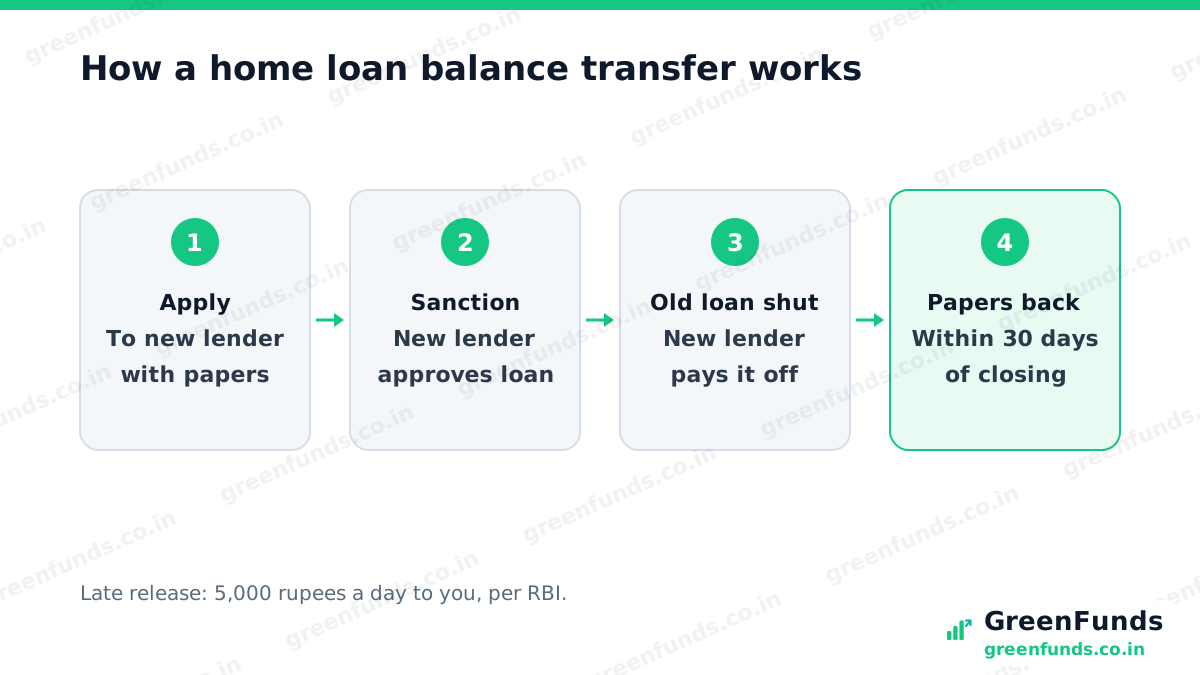
RBI rules protect you at the hand-off. Your old lender must release all original property documents within 30 days of full repayment. If the delay is its fault, it must pay you 5,000 rupees for each day of delay, under RBI’s September 2023 circular.
What it costs
There’s no fixed price list. Each lender sets its own charges, and they’re shown in the Key Fact Statement (KFS). Expect some of these:
- Processing fee at the new lender, plus GST. See processing fee.
- Legal and valuation fees for checking the title and value of the house.
- Stamp duty and registration on the new mortgage papers, set by your state.
- No foreclosure charge at the old lender on a floating-rate home loan taken by an individual. RBI has barred it for years, and its 2025 directions keep the ban for loans sanctioned or renewed from 1 January 2026. Read loan foreclosure charges for the full rule.
A worked example
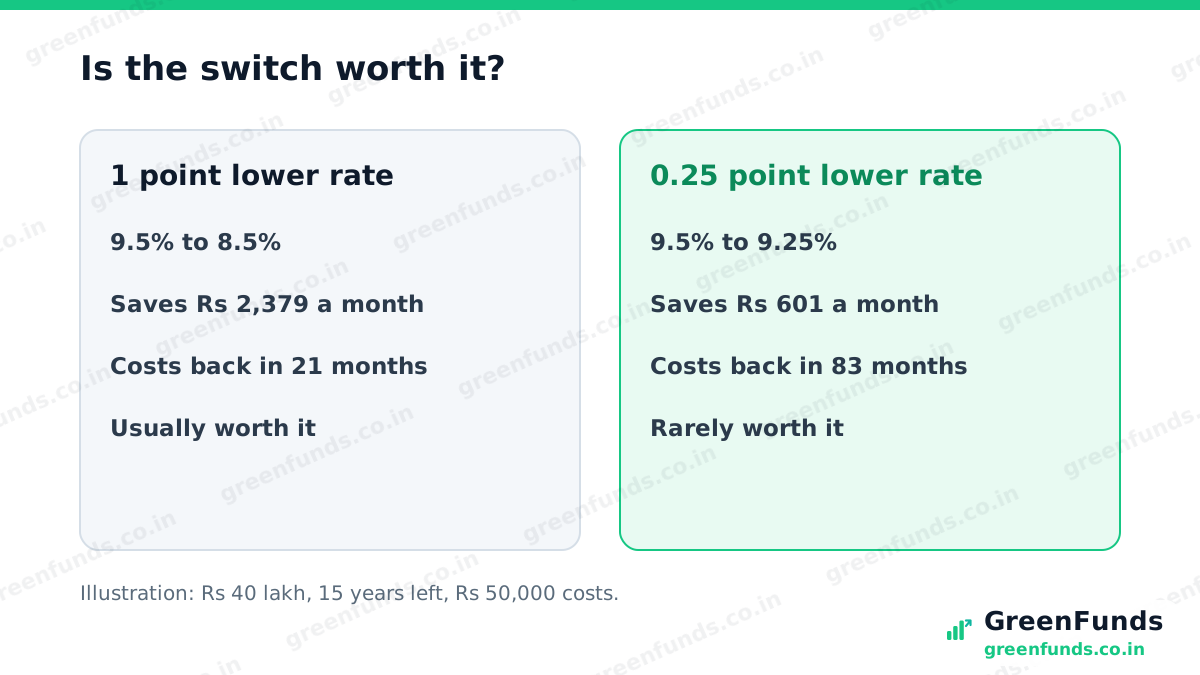
Say you owe 40 lakh rupees with 15 years left, at 9.5% a year, and a new lender offers 8.5%. Assume total switching costs of 50,000 rupees. These are made-up numbers for illustration, and the rates are assumed to stay flat.
| Current lender | New lender | |
|---|---|---|
| Rate | 9.5% | 8.5% |
| Monthly EMI | ₹41,769 | ₹39,390 |
| Interest over 15 years | ₹35,18,418 | ₹30,90,125 |
You save ₹2,379 a month, or ₹4,28,293 over the tenure. After the 50,000 rupees of costs, you’re ahead by ₹3,78,293, and you earn back the costs in about 21 months.
Now shrink the gap to a quarter of a percentage point (9.5% to 9.25%). The saving drops to ₹601 a month, and the same 50,000 rupees takes about 83 months, nearly seven years, to recover. A small gap rarely justifies a switch. Try your own numbers on the home loan EMI calculator.
Ask your lender first, and know your reset rights
Before you switch, ask your current lender for a lower rate. Under RBI’s 2025 directions on interest rates, a bank may lower parts of the spread on a loan category earlier than three years to keep customers. Some lenders charge a fee for this. Compare it with the switching costs above.
Floating rates also follow RBI’s rules on resets. A loan linked to an external benchmark such as the repo rate must be reset at least once in three months. Under RBI’s August 2023 circular on EMI-based personal loans, which include home loans:
- At sanction, the lender must explain how a rate change can affect your EMI, tenure or both, and tell you immediately when either goes up.
- At a reset, you can choose a higher EMI, a longer tenure, or a mix, and you can prepay in part or in full.
- A switch to a fixed rate is offered at the lender’s option since 1 October 2025, as per its policy. Any switching charges must be in your sanction letter.
- You get a statement every quarter showing principal and interest paid, EMIs left and the annual rate.
Did you know? When a lender stretches your tenure after a rate rise, RBI’s rules say it must not lead to negative amortisation. That means your EMI must always cover at least the month’s interest, so your loan can’t quietly grow.
The takeaway. A balance transfer works when the rate gap is large, many years are left, and the costs are small enough to recover quickly. Get every charge in writing, ask your current lender for a match first, and treat a top-up as a new loan with its own price. If you’re paying off high-interest debt instead, see the real cost of a credit card EMI.
More to read: home loan basics, should you prepay a loan, and what a repo rate change does to your EMI.
-
Compare the rate gap and the costs
Ask the new lender for its rate, processing fee and other charges in writing, and use an EMI calculator to work out how much interest you would save over the remaining tenure.
-
Ask your current lender first
Request a lower rate from your existing lender. Banks may cut part of the spread on external benchmark loans earlier than three years to keep customers, so a reset may cost less than a switch.
-
Apply and get a sanction
Apply to the new lender with your KYC, income proof, loan statement and property papers. Read its Key Fact Statement before you accept the offer.
-
Let the new lender close the old loan
Get a foreclosure letter from your current lender. The new lender pays the outstanding amount directly, and the old lender must release your original property documents within 30 days of full repayment.
Questions people ask
What is a home loan balance transfer?
It is moving your outstanding home loan from your current lender to a new lender, usually to get a lower interest rate. The new lender pays off the old loan and you start paying EMIs to the new lender for the remaining amount and tenure.
What is a top-up loan with a balance transfer?
A top-up loan is an extra loan on the same property, over and above the outstanding home loan. Many lenders offer it along with a balance transfer, so you move the old loan and borrow more in one go. It is priced separately, so check its rate and charges in the Key Fact Statement.
What are the charges for a home loan balance transfer?
The new lender usually charges a processing fee and may charge legal and valuation fees for checking the property. Registering the new mortgage can attract stamp duty, which depends on your state. Your current lender cannot charge a foreclosure fee if yours is a floating-rate home loan taken as an individual.
Which documents are needed for a home loan balance transfer?
Lenders usually ask for KYC documents such as PAN and address proof, income proof such as salary slips, Form 16 or income tax returns and bank statements, a statement of your current loan account, the list of property documents held by your current lender, and copies of the property papers. The exact list varies by lender.
Can my bank lower my home loan rate instead?
You can ask. Under RBI's 2025 directions on interest rates, a bank may reduce some parts of the spread on a loan category earlier than the usual three years to retain customers, in a fair and non-discriminatory way. Some lenders charge a fee for this, so compare it with the cost of switching.
Source: RBI (Pre-payment Charges on Loans) Directions, 2025, RBI/2025-26/64, 2 July 2025 (loans sanctioned or renewed from 1 January 2026), carried into RBI's Responsible Business Conduct Directions of 28 November 2025 (for example the NBFC directions, updated as on 1 July 2026); RBI circular 'Reset of Floating Interest Rate on Equated Monthly Instalments (EMI) based Personal Loans', DOR.MCS.REC.32/01.01.003/2023-24, 18 August 2023, updated as on 1 October 2025; RBI (Commercial Banks - Interest Rates on Advances) Directions, 2025, 28 November 2025, paragraphs 33 and 38; RBI circular on release of property documents, DoR.MCS.REC.38/01.01.001/2023-24, 13 September 2023 (rbi.org.in). Worked example computed with the standard reducing-balance EMI formula.
Found this useful? You can buy us a coffee. It keeps GreenFunds free.Flag a possible issue
Was this helpful?
Thanks for the signal.
Comments
Share your experience or a question. Be kind, stay on topic. This is reader discussion, not financial advice.
No comments yet. Be the first to share.