Is no-cost EMI really free? The charges it hides
No-cost EMI is not free, the interest just moves
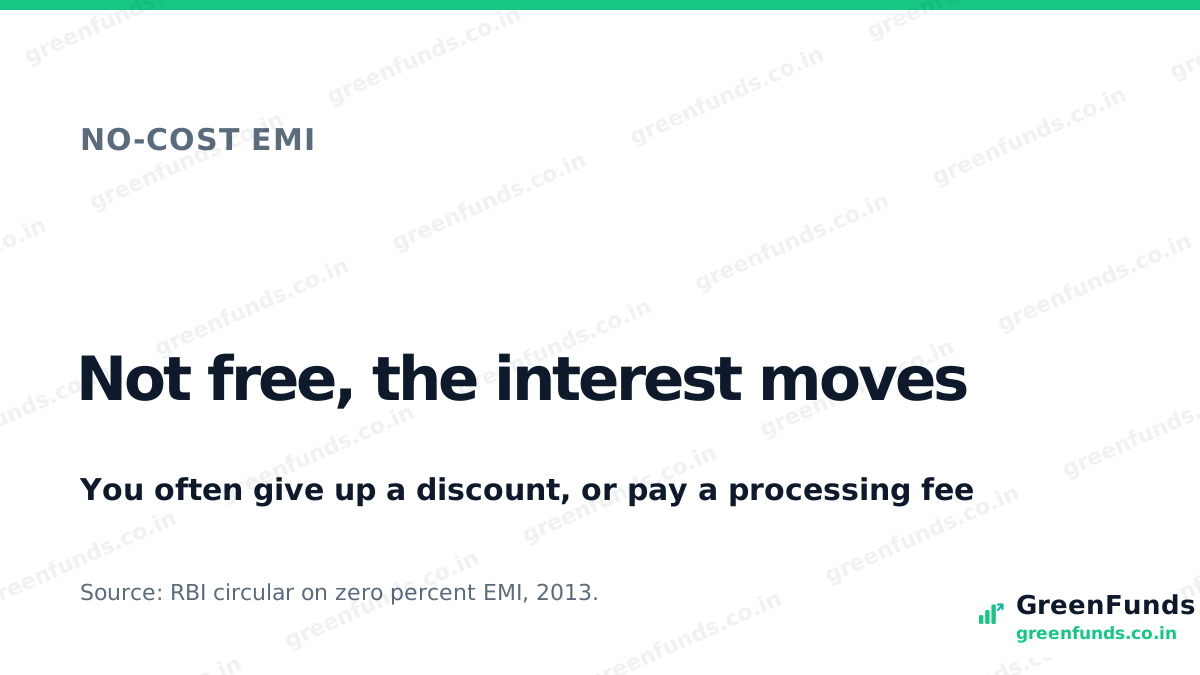
No-cost EMI sounds like the best of both: pay over a few months, with no extra cost. It rarely works out that way. The interest does not vanish. It just moves somewhere you are less likely to look. The Reserve Bank of India put it bluntly in a 2013 circular: the concept of zero percent interest is non-existent.
Where the interest actually goes. A lender does not lend for free. In a no-cost EMI, the interest is usually recovered in one of two ways: you give up a discount you would have got for paying upfront, so you pay the full price instead of a lower one, or it is folded into a processing fee. RBI’s own words are that the interest element is often camouflaged and passed on as a processing fee or through adjusted pricing.
The three charges to look for. This matches the pattern: a charge at the start, interest in the middle, a charge if you stop early.
- A processing fee charged at the start, which some lenders add even on a no-cost EMI.
- The interest itself, hidden as the discount you gave up by not paying upfront.
- A foreclosure fee if you want to close the EMI early. GST can also apply on the interest part. These vary by lender and retailer, so check the invoice and the loan terms.
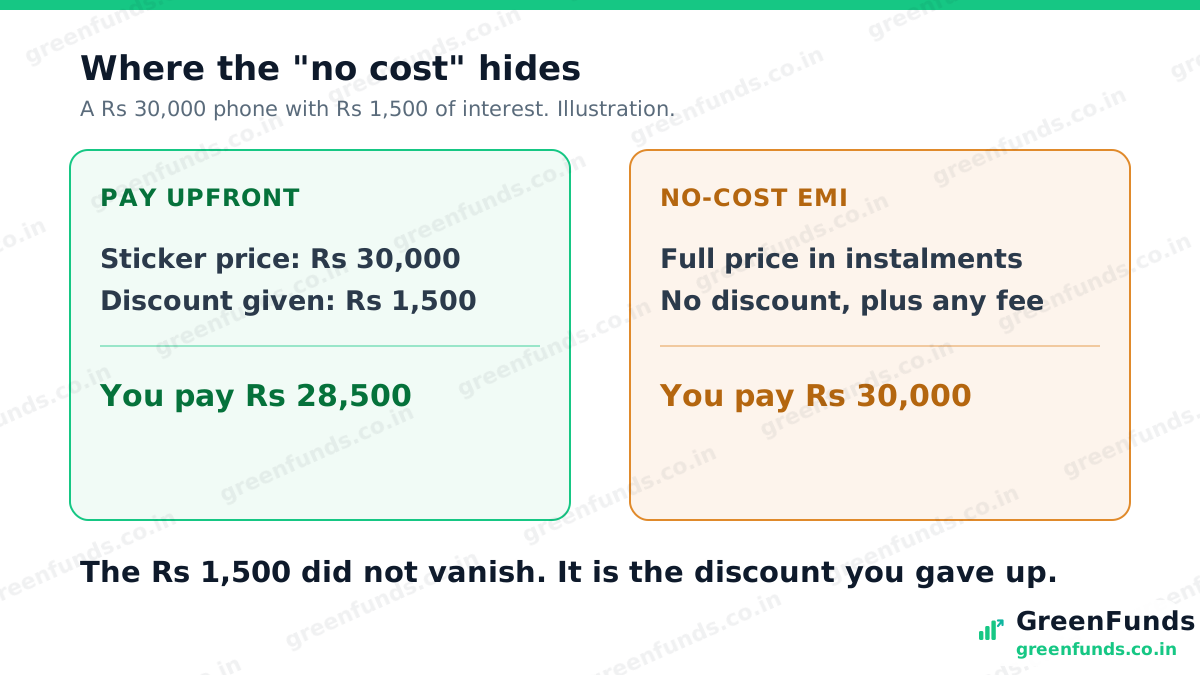
A rupee example. Say a phone is listed at Rs 30,000, with Rs 1,500 of interest built into a no-cost EMI (an illustration). Pay upfront and the shop may knock off Rs 1,500 as a discount, so you pay Rs 28,500. Choose the no-cost EMI and you pay the full Rs 30,000, just spread over months. The Rs 1,500 did not disappear. You paid it as the discount you let go. Add any processing fee, and the no-cost option costs more than cash.
When it is still fine to use. The problem is not splitting a payment. If the EMI price is the same as the upfront price, there is no processing fee, and you are comfortable paying each instalment on time, a no-cost EMI can be a convenient way to spread a cost. The trap is paying more than the sticker price without noticing.
Did you know? The quickest check is to ask for the cash price and the no-cost EMI price side by side, including any processing fee. If the EMI total is higher, that gap is the real cost of the “no cost”. A small extra may be fine for the convenience, as long as you choose it with eyes open.
The takeaway. No-cost EMI is not a scam, but it is rarely free. Before you tap it, compare the total you will pay, fees included, with the plain cash price. If you are not comfortable paying a little extra, or paying every instalment on time, it is better skipped.
More in this series: your first credit card bill, and the principle underneath borrowing, good debt versus bad debt.
Questions people ask
Is no-cost EMI really free?
Rarely. The interest does not disappear, it moves. Often you give up a discount you would have got for paying upfront, so you pay the full price instead of a lower one. Some lenders also charge a processing fee. RBI has said the idea of zero percent interest is non-existent.
What are the hidden charges in a no-cost EMI?
Three things to look for: a processing fee charged at the start, the discount you forgo by not paying upfront, and a foreclosure fee if you close the EMI early. GST can also apply on the interest part. These vary by lender and retailer, so check the invoice and loan terms.
What did RBI say about zero percent EMI?
In a 2013 circular, RBI said the concept of zero percent interest is non-existent, and that the interest element is often camouflaged and passed on to the buyer as a processing fee or through adjusted product pricing.
When is no-cost EMI still worth using?
When the EMI price matches the upfront price with no extra fee, and you are comfortable paying the instalments on time. The problem is not splitting a payment, it is paying more than the sticker price without realising. Compare the total outflow with the cash price first.
Source: RBI circular (2013) on zero percent EMI schemes, rbi.org.in. Exact fees and GST vary by lender and retailer, so check the invoice and loan terms.
Flag a possible issue
Was this helpful?
Thanks for the signal.
Comments
Share your experience or a question. Be kind, stay on topic. This is reader discussion, not financial advice.
No comments yet. Be the first to share.