Free, annual-fee or secured: which first credit card fits
A card's fee only pays off if you use the perks

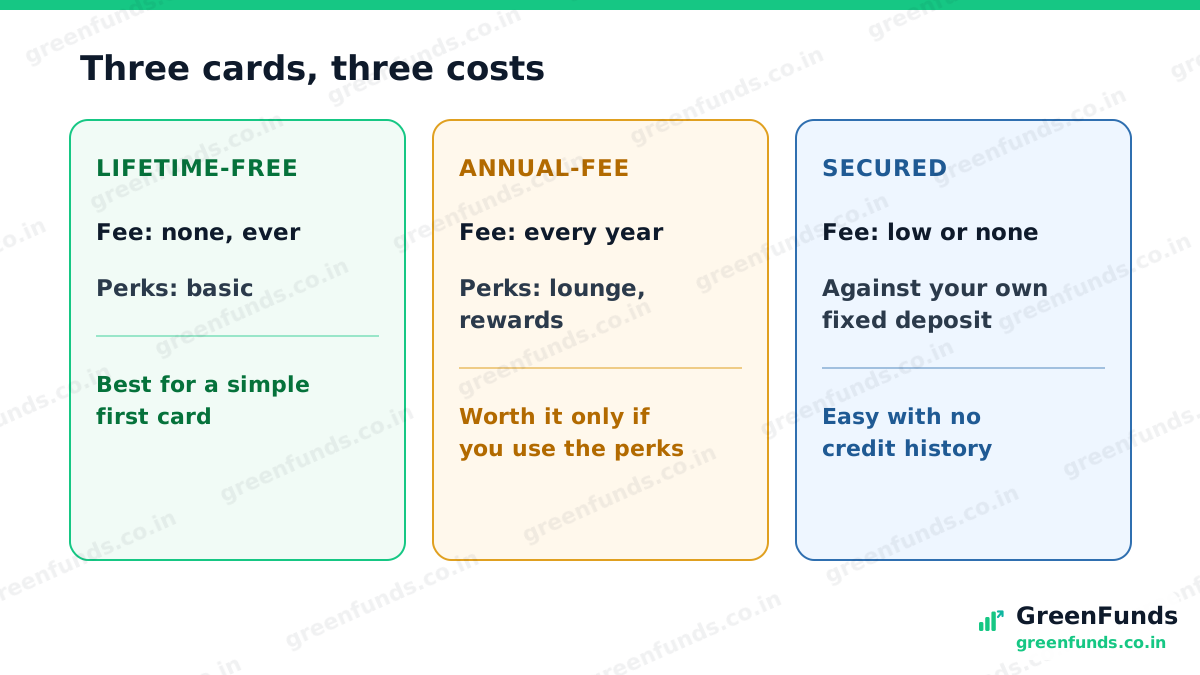
Credit cards are not one product. By cost, they fall into three broad types: lifetime-free, annual-fee, and secured against a deposit. Knowing which is which is the difference between a card that quietly helps you and one that charges you for perks you never use.
Lifetime-free cards. No joining fee, no annual fee, ever. The rewards are usually basic. For a first card, where the real goal is to build a credit history and a credit score without paying for the privilege, this is the plain, honest default.
Annual-fee cards. These charge a joining fee and a yearly fee, and in return offer perks: airport lounge visits, higher reward rates, milestone vouchers, a fuel-surcharge waiver. The perks are real, but so is the fee, every year.
Secured cards. A secured card is given against your own fixed deposit, usually with a limit close to the deposit. Because the bank holds your deposit as security, it is easy to get even with no credit history, and it builds your score like any other card. It is often the honest first-card answer for a new earner, and banks rarely push it because it earns them less than a regular card.
The fee-waiver trap. Many annual-fee cards waive the yearly fee if you spend above a threshold in the year. It sounds generous. The catch is that people spend more than they planned just to dodge a small fee. Chasing a waiver is how a Rs 500 fee turns into thousands in spending you did not need.
The one question that decides it. A perk only counts if you would actually use it. So add up the yearly value you would really use, then compare it to the fee.
Say a card charges Rs 500 a year (an illustration, fees vary) and offers four lounge visits and dining rewards. If you fly twice a year and eat out often on the card, the value may clear the fee. If you rarely fly and spend little on dining, you are paying Rs 500 for perks worth close to nothing, and a lifetime-free card would have served you better. The numbers here are an illustration, so check your own card’s fee and perks.
Did you know? A secured card, backed by a fixed deposit, lets someone with no credit history start building a score safely, because the deposit is the bank’s security. The Reserve Bank of India allows banks to issue credit cards against fixed deposits, which is what makes these cards a low-risk on-ramp. Confirm current rules on rbi.org.in.
The takeaway. Do not pick a card by its perks. Pick it by the perks you will genuinely use, set against the fee. For many first cards, that points to lifetime-free or secured, not the shiny fee card the bank leads with. This is how the choice works, not a recommendation of any one card.
Just got a card offer call? See what that “your card is ready” call really is. Already carrying a balance? See the minimum due trap.
Questions people ask
What is a lifetime-free credit card?
A card with no joining fee and no annual fee, ever. The rewards are usually basic, but it costs nothing to hold. For a first card where you mainly want to build a history and a score, it is the simplest choice.
Is an annual-fee credit card worth it?
Only if the perks you will actually use are worth more than the fee each year. Airport lounge access is worth nothing if you do not fly, and dining rewards are worth nothing if you do not spend on dining. Add up the value you would really use, then compare it to the fee.
What is a secured credit card?
A card given against your own fixed deposit, usually with a limit near the deposit amount. Because the bank holds your deposit as security, it is easy to get even with no credit history, and it builds your credit score like any other card. Banks rarely push it because it earns them less.
What does fee waived on spend mean?
Many annual-fee cards waive the yearly fee if you spend above a set amount in the year. The risk is spending more than you planned just to dodge a small fee, which defeats the point. Only count the waiver if you would have spent that much anyway.
Which credit card is best for a first-timer in India?
There is no single best card, and this is education, not a recommendation. For a first card, people often weigh a lifetime-free card (no cost, builds history) or a secured card (easy to get with no credit history). Match the card to how you will actually use it, and read the full fee schedule before you apply.
Source: Typical Indian credit card terms and RBI guidance on secured cards against fixed deposits. Fees and perks vary by card, so check the card's terms.
Flag a possible issue
Was this helpful?
Thanks for the signal.
Comments
Share your experience or a question. Be kind, stay on topic. This is reader discussion, not financial advice.
No comments yet. Be the first to share.