How a bank decides your credit card, and your limit
Your income and score decide the card and its limit
When you apply for a credit card, or accept a pre-approved offer, the bank decides two things at once: whether to give you the card, and how much you can spend on it, which is your credit limit.
What the bank checks. Three things, mostly: a steady income, how much you already owe on other loans and cards, and your credit score. A clean record and a reliable salary make approval easy. If you have no credit history yet, a regular card is often refused, because the bank has nothing to judge you on. That is exactly where a secured card against a fixed deposit comes in: easy to get, and it builds the history a regular card later wants.
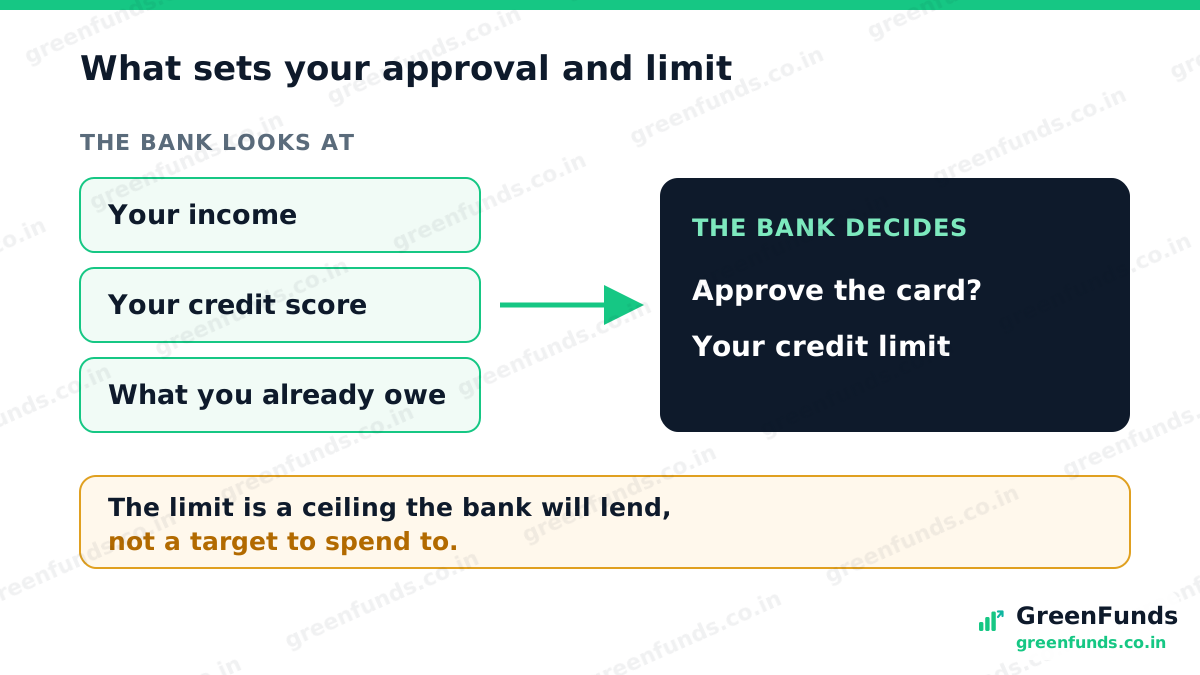
Your credit limit is a ceiling, not a target. The limit is the most the bank is willing to lend you on the card, set mostly from your income and score. A higher income and a cleaner record usually mean a higher limit. The common mistake is to treat the limit as money to spend. It is not. Spending a large share of your limit every month, called high credit utilisation, is widely seen as a negative signal and can weigh on your score. Keeping your usage well below the limit is the safer habit.
Say your limit is Rs 1,00,000 (an illustration). Spending Rs 70,000 most months is high utilisation. Keeping your spend low relative to the limit is gentler on your score. The exact effect is not published by the credit bureaus, so treat this as a guideline, not a formula.
The enquiry when you apply. Every card or loan application triggers a hard enquiry on your credit report, which can nudge your score down a little. One is minor and recovers. The trap is applying to several cards at once, hoping one says yes. Those enquiries stack, the dip is larger, and a burst of applications can itself look risky to lenders. Space applications out.
Did you know? A secured card, given against your own fixed deposit, is the Reserve Bank of India’s sanctioned route for someone with no credit history to start building a score, because the deposit is the bank’s security. That is why “no credit history” is rarely a dead end. Confirm current rules on rbi.org.in.
The takeaway. Approval and your limit come down to income, existing debt and your score. The limit is a cap the bank sets, not a spending goal, and a lower share used is better for your score. And do not scatter applications, because each one leaves a mark.
More in this series: what the “your card is ready” call really is and free, annual-fee or secured, which first card fits. To go deeper on the score itself, see how credit scores work.
Questions people ask
What do banks check before giving a credit card?
Mainly a steady income, your existing loans and card dues, and your credit score. A higher and cleaner income and score make approval easier and usually mean a higher limit. For someone with no credit history, a regular card is often refused and a secured card against a fixed deposit is the easy route.
How is a credit card limit decided?
The bank sets it mostly from your income and your credit score, plus how much you already owe elsewhere. More income and a cleaner record usually mean a higher limit. The limit is a ceiling the bank is willing to lend, not an amount you are meant to spend.
Does applying for a credit card lower your credit score?
Each application triggers a hard enquiry on your credit report, which can nudge your score down a little. One is minor. Several applications in a short time stack these nudges and can look risky to lenders, so it is better to space applications out.
Can I get a credit card with no credit history?
Often not a regular one, because the bank has nothing to judge you on. A secured card, given against your own fixed deposit, is the usual way in. It is easy to get and it builds the history that a regular card later needs.
Should I use my full credit limit?
Using a large share of your limit every month, called high credit utilisation, is widely seen as a negative signal and can weigh on your score. Keeping your usage well below the limit is the safer habit. The exact effect is not published by the bureaus.
Source: RBI master directions on credit cards and general lender practice. Exact approval rules and limits vary by bank, so check with yours.
Flag a possible issue
Was this helpful?
Thanks for the signal.
Comments
Share your experience or a question. Be kind, stay on topic. This is reader discussion, not financial advice.
No comments yet. Be the first to share.