Your first credit card bill, explained
Pay the full bill by the due date, or it gets costly
A credit card is free money for a few weeks, then the most expensive money you can borrow. The whole difference is one thing: whether you pay the full bill by the due date.
The billing cycle, in plain terms. Your card runs on a monthly cycle. On the statement date, the bank adds up everything you spent that cycle and generates a bill. The due date is the last day to pay it, usually about 15 to 20 days later. Everything you bought in the cycle is interest-free until that due date, as long as you pay the full bill.
Statement date is not the due date. The statement date is when the bill is made. The due date is when it must be paid. The gap between a purchase and the due date is your interest-free period, and it can stretch to around 45 to 50 days if you spend early in the cycle. That free period is the one real perk every card gives you, and it survives only if you pay in full.
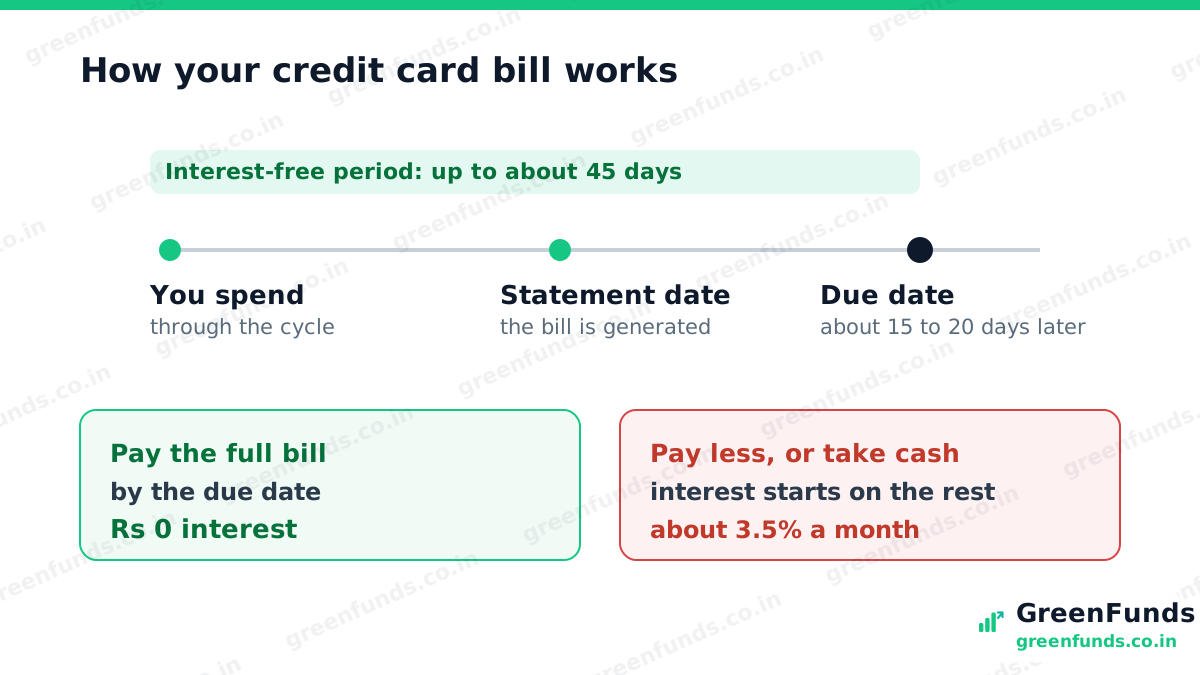
Pay in full, or pay a lot. Clear the full bill by the due date and you pay zero interest. Pay less, even the minimum due, and interest starts on the rest, usually about 3.5% a month, which is roughly 42% a year, and you also lose the interest-free period on new purchases until the whole thing is cleared.
Say your first bill is Rs 20,000 (an illustration). Pay it in full by the due date and the interest is zero. Pay only the minimum and carry about Rs 18,000, and at roughly 3.5% a month that is around Rs 630 in interest in the first month alone, growing from there. The numbers are an illustration, so check your card’s rate.
The ATM cash trap. Pulling cash from a credit card at an ATM, called a cash advance, breaks the one good rule. There is no interest-free period on it: interest runs from the day you withdraw, and there is usually a cash-advance fee on top, often around 2.5% to 3% of the amount with a minimum. That makes credit card cash one of the costliest ways to get money. Keep it for a genuine emergency, and check your card’s charges.
The real cost of carrying a balance. At about 3.5% a month, an unpaid card balance is one of the most expensive everyday ways to borrow, far above most other options. So the cost math is simple: if you can comfortably clear the full bill by the due date, the card is free to use. If you cannot, that balance is costly, and knowing its true rate helps you weigh cheaper ways to cover the gap. This is how the cost works, not a recommendation.
Did you know? The interest-free period is only on purchases, and only if you pay the full bill. A single cash withdrawal, or carrying any balance, switches interest on immediately. That is why “I pay the minimum every month” quietly becomes a trap, explained in full in the minimum due trap.
The takeaway. Treat the card as a 45-day interest-free convenience, not a loan. Pay the full bill by the due date, skip ATM cash, and the most expensive money you can borrow stays, for you, completely free.
More in this series: activating your card safely, and if a balance has already built up, how to get out of credit card debt.
Questions people ask
What is the difference between the statement date and the due date?
The statement date is when the bank generates your bill for the cycle. The due date is the last day to pay it, usually about 15 to 20 days later. Purchases made in the cycle are interest-free until the due date, but only if you pay the full bill.
What is the interest-free period on a credit card?
The gap between a purchase and the due date, during which you pay no interest, as long as you clear the full bill by that date. It can be up to around 45 to 50 days depending on where in the cycle you spend. Carry any balance and you lose this on new purchases.
Is taking cash from a credit card at an ATM a bad idea?
It is one of the costliest ways to get cash. A cash advance has no interest-free period, so interest runs from day one, and there is usually a cash-advance fee on top, often around 2.5% to 3% of the amount with a minimum. Check your card, and keep it for real emergencies.
How much does it cost to carry a credit card balance?
Unpaid card dues usually run interest of about 3.5% a month, which is roughly 42% a year. That makes a carried card balance one of the most expensive everyday ways to borrow. The only way to pay zero interest is to clear the full bill by the due date.
What happens if I only pay the minimum due?
The card stays active and you avoid a late fee, but interest starts on the rest of the bill, and you also lose the interest-free period on new purchases until you clear everything. Paying only the minimum is how small balances grow into large ones.
Source: Typical Indian credit card terms and RBI data on card interest. Rates and fees vary by card, so check your card's statement and schedule of charges.
Flag a possible issue
Was this helpful?
Thanks for the signal.
Comments
Share your experience or a question. Be kind, stay on topic. This is reader discussion, not financial advice.
No comments yet. Be the first to share.