Using your credit card abroad: the charges nobody mentions
A foreign swipe costs more than the price on the tag
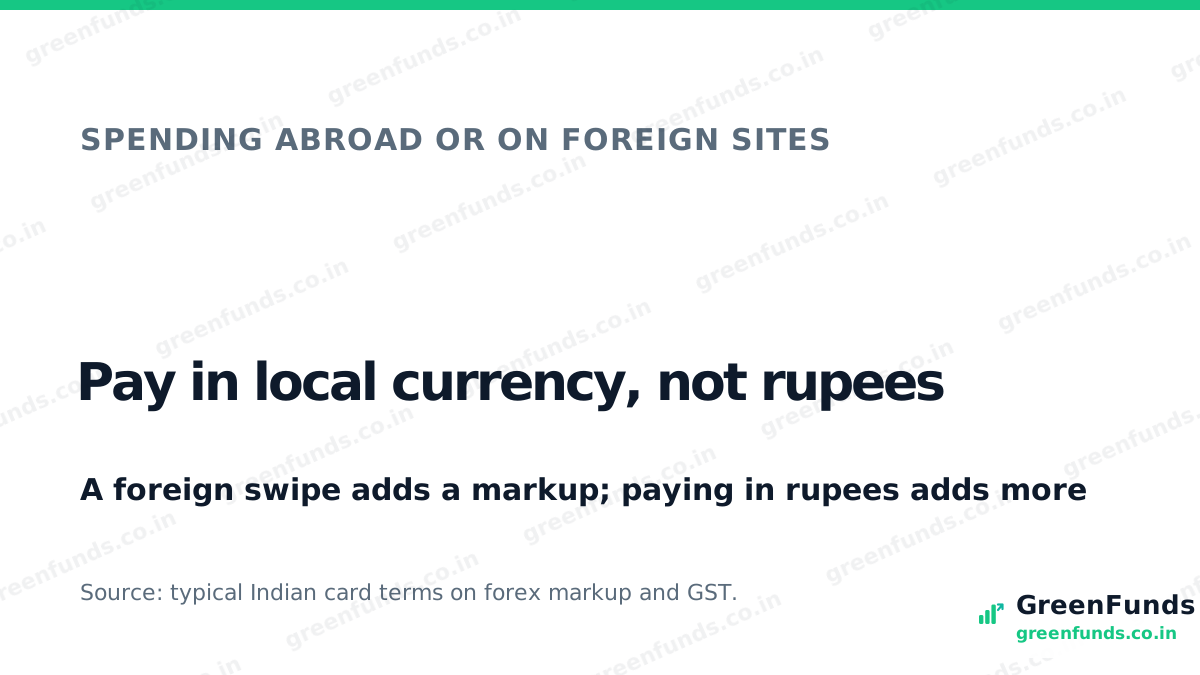
Spending on your credit card abroad, or on a foreign website from your sofa, costs more than the price on the tag. The extra is not hidden to trick you, but nobody spells it out either. Two charges almost always stack, and a third one appears only if you make the wrong choice at the counter.
Domestic card or international card. A domestic card works only in India and on Indian networks. An international card also works abroad and on foreign websites. Many cards are international by default. Most banks let you turn international use on or off in the app, so a good habit is to keep it off and switch it on only when you travel or shop abroad. That one toggle is also a strong protection against misuse.
Charge one: the forex markup. On any transaction in a foreign currency, the card adds a foreign-exchange markup, usually around 1% to 3.5% on Indian cards, and 18% GST applies on that markup, not on the whole spend. Some travel-focused cards charge a lower markup or none. This fee applies to foreign websites too, not just trips, so an overseas online order is an international spend.
Say you spend the equivalent of Rs 50,000 on a foreign website (an illustration). A 3.5% markup is Rs 1,750, and 18% GST on that markup is about Rs 315, so roughly Rs 2,065 extra. Your card’s markup may be lower, so check it, but the shape is the same: a few percent, every foreign swipe.
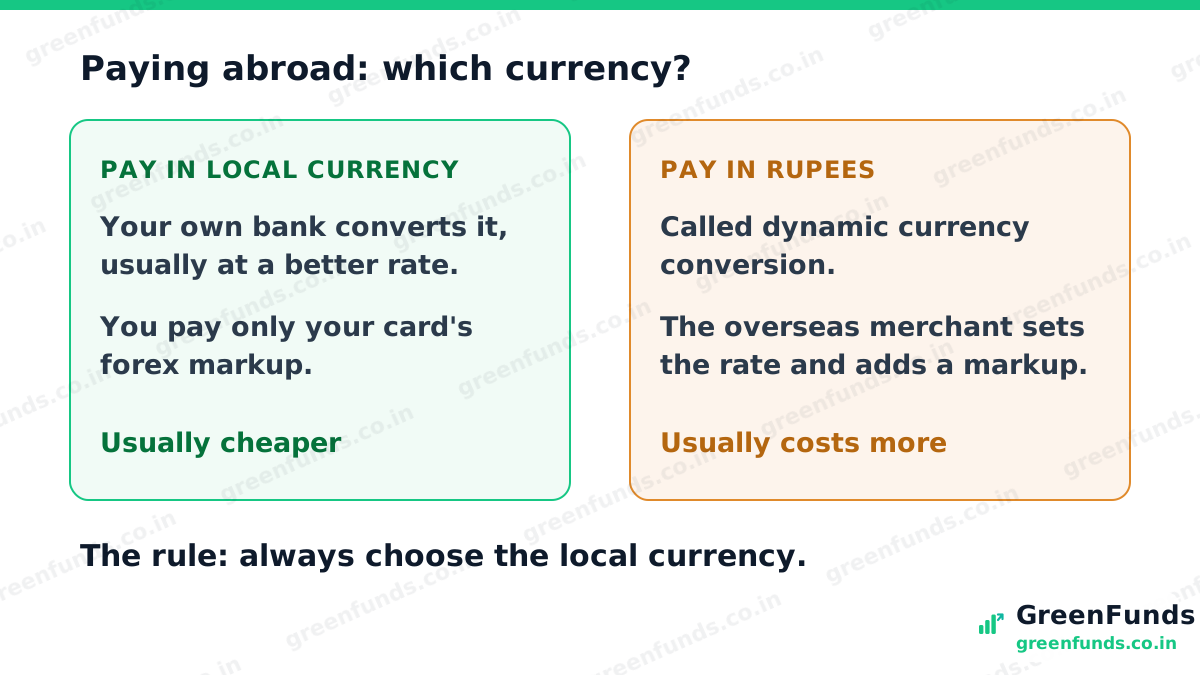
Charge two: the wrong-currency trap. At a foreign shop, terminal or website, you may be asked whether to pay in the local currency or in rupees. Paying in rupees sounds friendlier, but it is usually the costlier choice. This is called dynamic currency conversion: the overseas merchant does the conversion and sets the rate, and it typically adds its own markup on top. Choosing the local currency lets your own bank convert it, usually at a better rate, with only your card’s markup to pay.
A note on tax. On top of card charges, some foreign spending falls under the Liberalised Remittance Scheme, where a tax collected at source can apply above a yearly limit. This area has changed more than once, including which cards it covers and the threshold, so there is no point memorising a number. Before a large foreign spend, check the current rule on incometax.gov.in or with your bank.
The one choice that saves the most. You cannot avoid the forex markup on a foreign-currency spend, but you can avoid making it worse. Always pay in the local currency, never in rupees, when a machine or website abroad gives you the choice. That single habit sidesteps the costliest layer.
The takeaway. A foreign swipe is the price, plus a markup of a few percent, plus GST on that markup. Pay in the local currency, keep international use switched off until you need it, and check your card’s exact markup so nothing on the statement is a surprise.
More in this series: your first credit card bill and free, annual-fee or secured, which first card fits.
Questions people ask
What is the forex markup fee on a credit card?
A fee the card charges on every transaction in a foreign currency, including on foreign websites. On Indian cards it is usually around 1% to 3.5% of the amount, and 18% GST applies on the fee itself, not the whole spend. Some travel-focused cards charge a lower markup or none, so check your card.
Should I pay in local currency or in rupees when abroad?
Usually the local currency. When a shop or website offers to charge you in rupees, that is dynamic currency conversion, and the overseas merchant sets the exchange rate and adds its own markup, which is often worse. Choosing the local currency lets your own card do the conversion, usually at a better rate.
Does the forex markup apply to online shopping on foreign websites?
Yes. If the merchant is overseas and the charge is in a foreign currency, the markup applies even though you shopped from home. A charge shown in rupees can still be treated as international if the merchant is abroad, so the fee can still apply.
Is there tax (TCS) on international credit card spends?
There can be tax collected at source on some foreign spending under the Liberalised Remittance Scheme. The rules here have changed more than once, including which cards they cover and the yearly threshold, so check the current position on incometax.gov.in or with your bank before a large foreign spend.
What is the difference between a domestic and an international credit card?
A domestic card works only in India and on Indian networks. An international card also works abroad and on foreign websites. Many cards are international by default, and most banks let you switch international use on or off in the app, which is a useful safety control.
Source: Typical Indian card terms on forex markup and GST; RBI on international card controls; Income Tax Department (incometax.gov.in) for TCS. Rates vary by card and rules change, so check the current ones.
Flag a possible issue
Was this helpful?
Thanks for the signal.
Comments
Share your experience or a question. Be kind, stay on topic. This is reader discussion, not financial advice.
No comments yet. Be the first to share.