Couples financial planning: joint finances for married couples in India
A couple's money plan is a few shared decisions: how to split costs, what to save for, and how to protect each other

Couples financial planning isn’t one big plan. It’s a handful of decisions you make together and revisit every year. Here is a simple order to work through.
1. Talk about money first
Share the basics: what each of you earns, what you owe (loans, credit card balances), what you already save, and what you each want in five and twenty years. It’s awkward once, and it saves years of guessing. Debts matter most, because one partner’s missed payments can affect plans you make together.
2. Joint account, separate accounts, or both
A joint account is a bank account held in two or more names. How it can be run depends on the mode you choose when opening it. RBI’s 2025 directions on settling claims of deceased customers list the common survivorship styles: “either or survivor”, “former or survivor” and similar. With “either or survivor”, either of you can operate the account, and if one of you dies, the bank can pay the balance to the survivor.
Many couples use a mix: each keeps a personal savings account, and both pay into one joint account for shared bills.
3. Split shared costs fairly
An illustration. Partner A takes home 1,20,000 rupees a month, partner B 80,000. Shared costs are 60,000.
- Equal split: 30,000 each. That’s 25% of A’s pay but 37.5% of B’s. A is left with 90,000, B with 50,000.
- Proportional split: A earns 60% of the household income, so pays 36,000; B pays 24,000. That’s 30% of each partner’s pay, leaving 84,000 and 56,000.
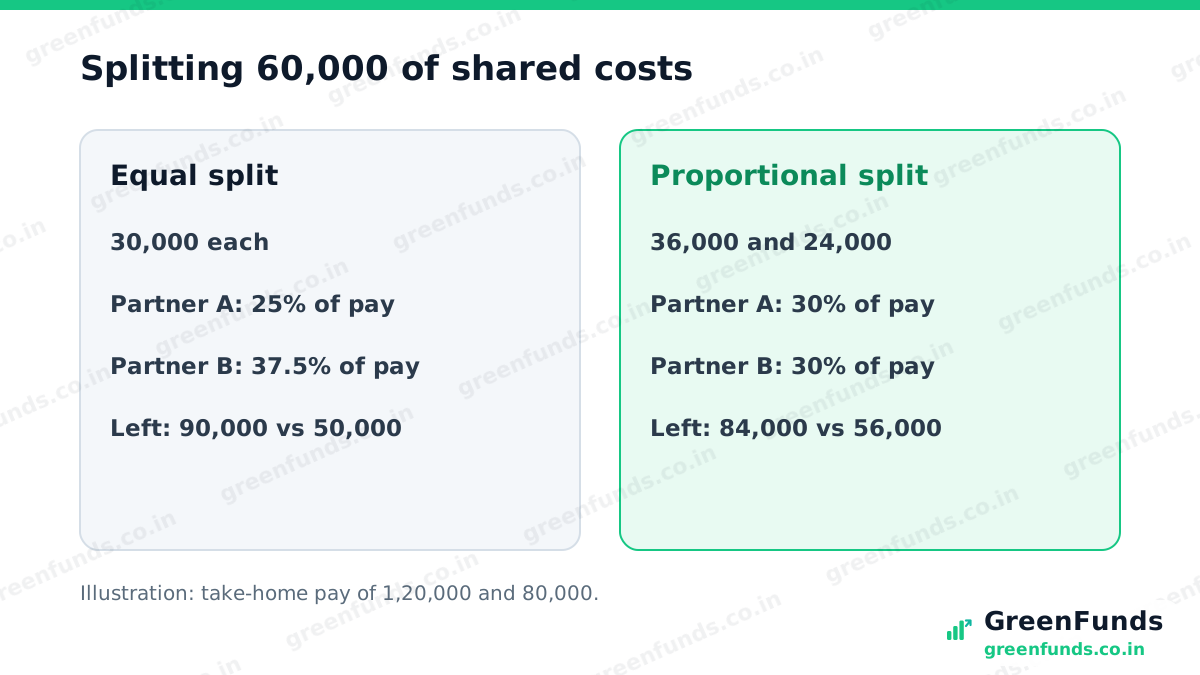
Neither is “correct”. Pick one, write it down, and revisit it when incomes change. A budget such as the 50-30-20 rule can sit on top.
4. Shared goals and an emergency fund
List your joint goals (a home, a child’s education, retirement) and give each a rough amount and date. Before investing, build an emergency fund. The emergency fund lesson suggests three to six months of essential expenses. If all 60,000 rupees of shared costs above are essentials, that’s 1.8 lakh to 3.6 lakh rupees.
5. Insure both partners
- Life cover. Term insurance covers one life, so each partner the family depends on needs a policy. That includes a partner who runs the home: see term insurance for homemakers and how much term cover you need.
- Health cover. A family floater covers both of you under one sum insured. Compare it in family floater vs individual health insurance.
6. Nominees and wills
Name each other, or others, as nominee on every account and policy. From 1 November 2025, bank deposit accounts allow up to four nominees, according to a Ministry of Finance release. For a joint account, RBI’s directions say the nominee’s right arises only after all the joint holders have died. A nominee receives money as a trustee for the legal heirs, so each of you should also write a will. The nomination lesson explains the difference.

7. Tax: you are still two taxpayers
There’s no joint tax return in India. Each spouse files their own ITR and picks their own tax regime.
A gift between spouses isn’t taxed, since a spouse is a “relative” under the Income-tax Act, 2025 (see tax on gifts). But under section 99 of the Act, income from money or assets you give your spouse without adequate consideration is added to your income. This is clubbing of income. If you gift your spouse 5 lakh rupees for a fixed deposit, the interest is taxed as yours.
Did you know? Shared bills can affect your credit too. If you pay joint costs on one partner’s card, that partner’s credit utilisation rises. Read how a credit card limit increase works before either of you accepts a higher limit to cover them.
The takeaway. Talk openly, agree how to split costs, build one emergency fund, insure both lives, and keep nominees and wills current. Then review it all once a year.
More to read: health insurance for parents, how to build wealth, setting money goals, and old vs new tax regime.
Questions people ask
Should a married couple have a joint bank account?
It depends on how you like to manage money. Many couples keep their own accounts and add one joint account for shared costs such as rent, groceries and bills. A joint account styled 'either or survivor' lets either partner operate it, and on the death of one, the survivor can be paid the balance. Separate accounts keep personal spending private.
How should couples split expenses when incomes differ?
Two common ways are an equal split and a proportional split. With take-home pay of 1,20,000 and 80,000 rupees and 60,000 rupees of shared costs, an equal split is 30,000 each, which takes 25% of one partner's pay and 37.5% of the other's. A proportional split is 36,000 and 24,000, which is 30% of each partner's pay. Neither is right for everyone; agree on one together.
Can a husband and wife file a joint income tax return in India?
No. Indian income tax has no joint return for couples. Each spouse is a separate taxpayer who files their own return on their own income, and each chooses their own tax regime.
Is money gifted to a spouse taxed?
The gift itself is not taxed, because a spouse counts as a relative under the Income-tax Act, 2025. But income earned on the gifted money, such as fixed deposit interest, is added to the income of the spouse who gave it, under section 99 of the Act. This is called clubbing of income.
Does each partner need separate term insurance?
Term insurance covers one life, so each partner whose income or unpaid work the family relies on needs their own policy. Health insurance is different: a family floater can cover both partners under one shared sum insured.
Source: Income-tax Act, 2025 (No. 30 of 2025), Gazette of India, 21 August 2025, in force from 1 April 2026: section 99(1)(a)(ii) (income from assets transferred to a spouse without adequate consideration included in the transferor's income), section 92(3)(a) and the definition of 'relative' (gifts from a relative, including a spouse, not taxed), section 2(77) (an individual is a separate 'person'); PIB, Ministry of Finance, 'Key Provisions relating to Nomination under the Banking Laws (Amendment) Act, 2025 to come into effect from 1st November 2025', 23 October 2025; Reserve Bank of India (Settlement of Claims in respect of Deceased Customers of Banks) Directions, 2025, RBI/2025-26/82, 26 September 2025, paragraphs 7 and 8 (rbi.org.in). Expense split computed, with illustrative numbers.
Found this useful? You can buy us a coffee. It keeps GreenFunds free.Flag a possible issue
Was this helpful?
Thanks for the signal.
Comments
Share your experience or a question. Be kind, stay on topic. This is reader discussion, not financial advice.
No comments yet. Be the first to share.