Is a gift taxable in India? The relatives rule and the 50,000 limit
Gifts from relatives, on your wedding or by inheritance are tax-free; others are taxed once they cross 50,000 rupees in a year

A gift is money or property you get without paying for it. In India, most family gifts are tax-free. The tax only kicks in on gifts from people outside the family, and only once they add up to more than 50,000 rupees in a year.
The three tax-free routes. The Income Tax Department lists three situations where a gift is not taxed, whatever the amount: it comes from a relative, it’s received on the occasion of your marriage, or it comes through a will or inheritance.
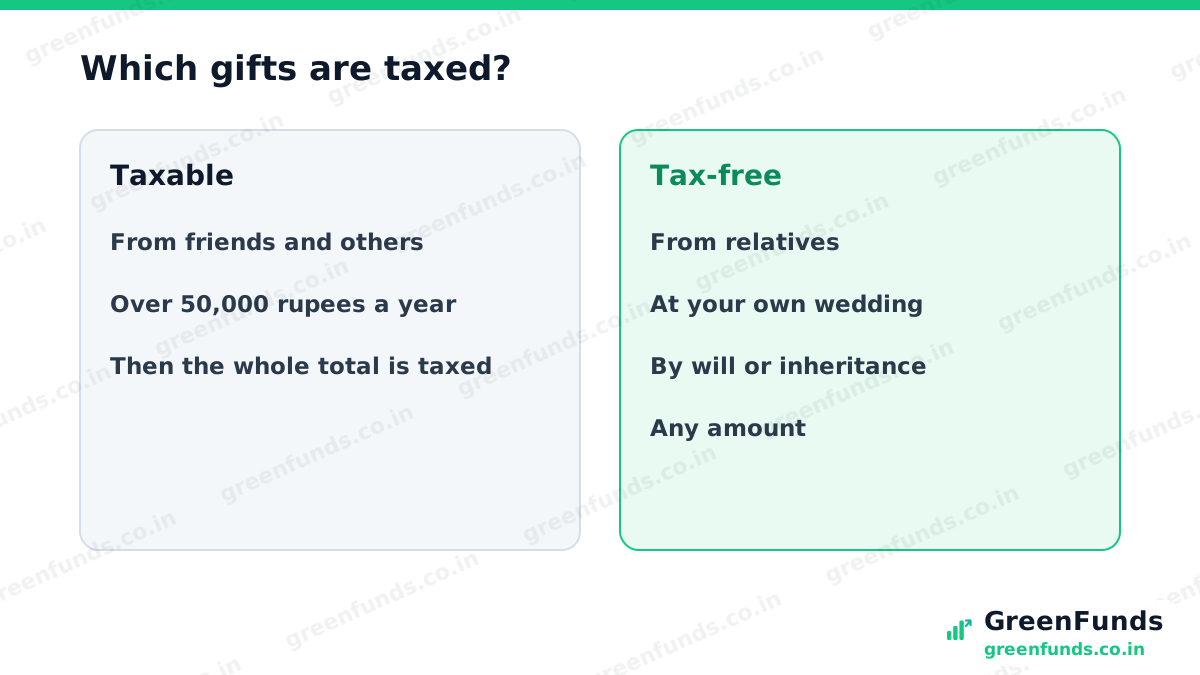
Who counts as a relative. Tax law has its own list. It includes your spouse, your parents and grandparents, your children and grandchildren, your spouse’s parents and grandparents, your brothers and sisters, your spouse’s brothers and sisters, your parents’ brothers and sisters, and the spouses of these people. A friend, a cousin or a colleague is not on it, so gifts from them don’t get the relatives exemption. Check the full list on the Income Tax Department’s site if you’re unsure.
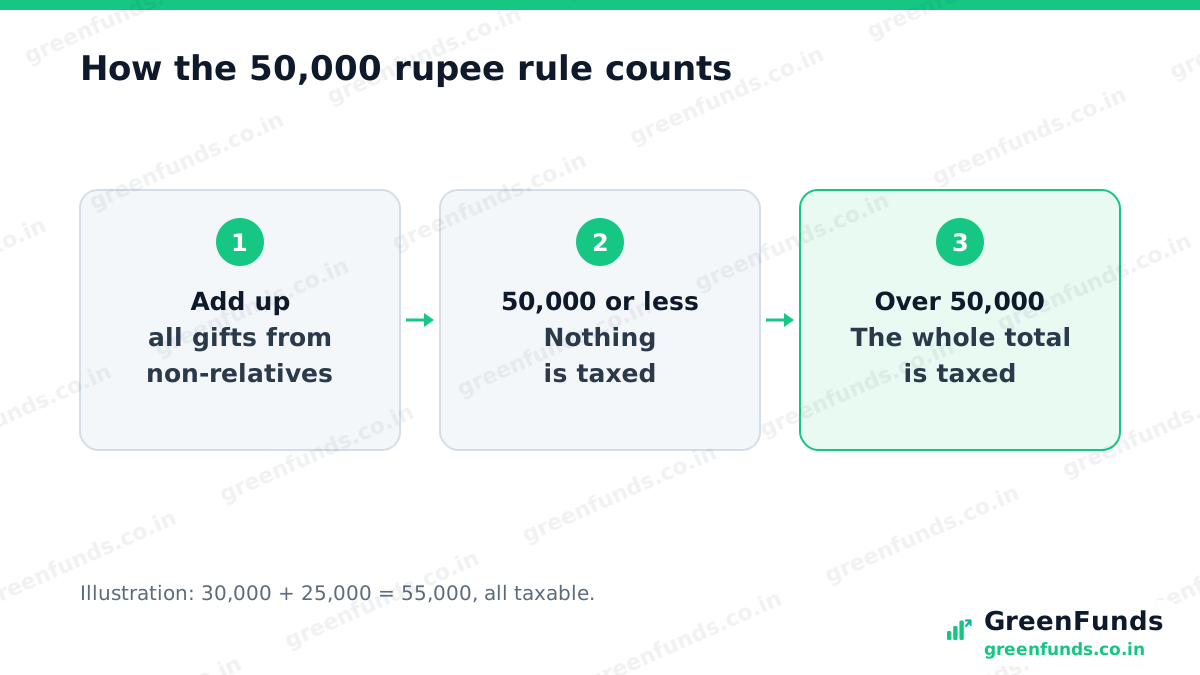
The 50,000 rule, and its catch. Gifts from non-relatives become taxable once they total more than 50,000 rupees in the year. Here’s the catch: once you cross the line, the whole amount is taxed, not just the part above 50,000. It’s added to your income and taxed at your slab rate.
An example. Say friends give you 30,000 rupees and 25,000 rupees in one year (an illustration). That’s 55,000, which is over the limit, so the full 55,000 is taxable. Had the second gift been 15,000, the total of 45,000 would be tax-free.
Did you know? The rule isn’t only about cash. The Income Tax Department’s guidance also covers gifts of property, jewellery and shares from non-relatives, valued in set ways. And gifts from abroad follow the same rule as gifts from within India.
Where it shows up. Large money movements can appear in your AIS, so keep a simple record of big gifts: who gave it, how much, and the relationship. If a gift is taxable, you show it under income from other sources when you file, and it may push up your advance tax for the year.
One more thing. Even a tax-free gift can earn taxable income later. If your parents gift you money and you put it in an FD, the interest is your income. Gifts between spouses have their own rules on whose income that interest counts as, so check before you rely on it.
The takeaway. Family gifts, wedding gifts and inheritances are tax-free. Gifts from friends and others are fine up to 50,000 rupees in a year, but cross that and the whole amount is taxed. Rules change, so check the current rules on incometax.gov.in.
More to read: income from other sources, old vs new tax regime, and the new Income-tax Act, 2025.
Questions people ask
Is a gift from my parents taxable?
No. Money or property you receive as a gift from a relative, as defined in tax law, is not taxed, whatever the amount. Parents, grandparents, children, your spouse and your siblings are all relatives under the rule.
Is a gift from a friend taxable?
It can be. A friend is not a relative under tax law. If gifts from friends and other non-relatives add up to more than 50,000 rupees in a year, the whole amount is taxed as your income, not just the part above 50,000, per the Income Tax Department.
Are wedding gifts taxable?
Gifts you receive on the occasion of your own marriage are not taxed, whoever gives them. Keep a simple record of who gave what, in case you are asked.
Is inheritance taxed in India?
Money or property you receive through a will or by inheritance is not taxed as a gift. Any income it later earns, such as interest or rent, is taxed in your hands as usual.
Source: Income Tax Department, FAQs on gifts received by an individual or HUF and meaning of relatives (incometaxindia.gov.in). Rules change, check the current rules on incometax.gov.in.
Found this useful? You can buy us a coffee. It keeps GreenFunds free.Flag a possible issue
Was this helpful?
Thanks for the signal.
Comments
Share your experience or a question. Be kind, stay on topic. This is reader discussion, not financial advice.
No comments yet. Be the first to share.