Credit card limit increase: how it works and when to say no
A higher credit card limit needs your explicit consent, and it only helps if your spending stays the same
A credit limit is the most you can owe on a credit card at any time. RBI defines it as the maximum revolving credit the bank sets and tells you about. It’s set when the card is issued, as covered in how banks decide your card and limit, but it can change later. Here is how a credit card limit increase works.
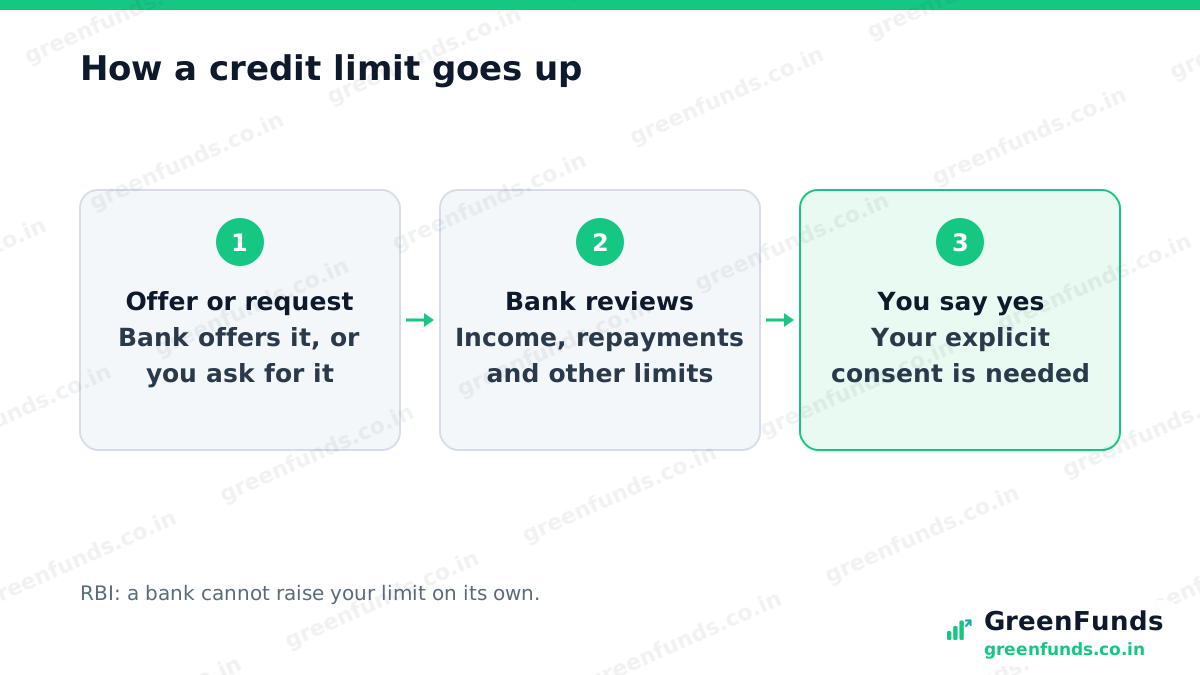
Two ways a limit goes up
- The bank offers it. After a period of steady use and on-time payments, many banks show a pre-approved higher limit in the app or by SMS.
- You ask for it. You request an increase, often with fresh proof of income.
Either way, the rule is the same. Under RBI’s credit card directions of November 2025, updated as on 1 October 2026, card issuers “shall not unilaterally upgrade credit cards and enhance credit limits”. Your explicit consent is needed. The directions even count a higher credit limit as an “upgradation” of the card. A cut in your limit is different: the bank only has to inform you.
What the bank looks at
Each bank uses its own policy and does not publish a fixed formula. Broadly, it weighs:
- Your income, and whether it has grown since the card was issued.
- Your repayment record on this card: paying in full and on time, versus paying late or only the minimum.
- Your credit score and report from a credit bureau, which show your other loans and cards.
- Limits you hold elsewhere. RBI’s directions tell issuers to assess your limit taking into account all the limits you enjoy from other lenders.
Your request may lead to a credit check. See how credit scores work for why repeated checks matter.
What it does to your credit utilisation
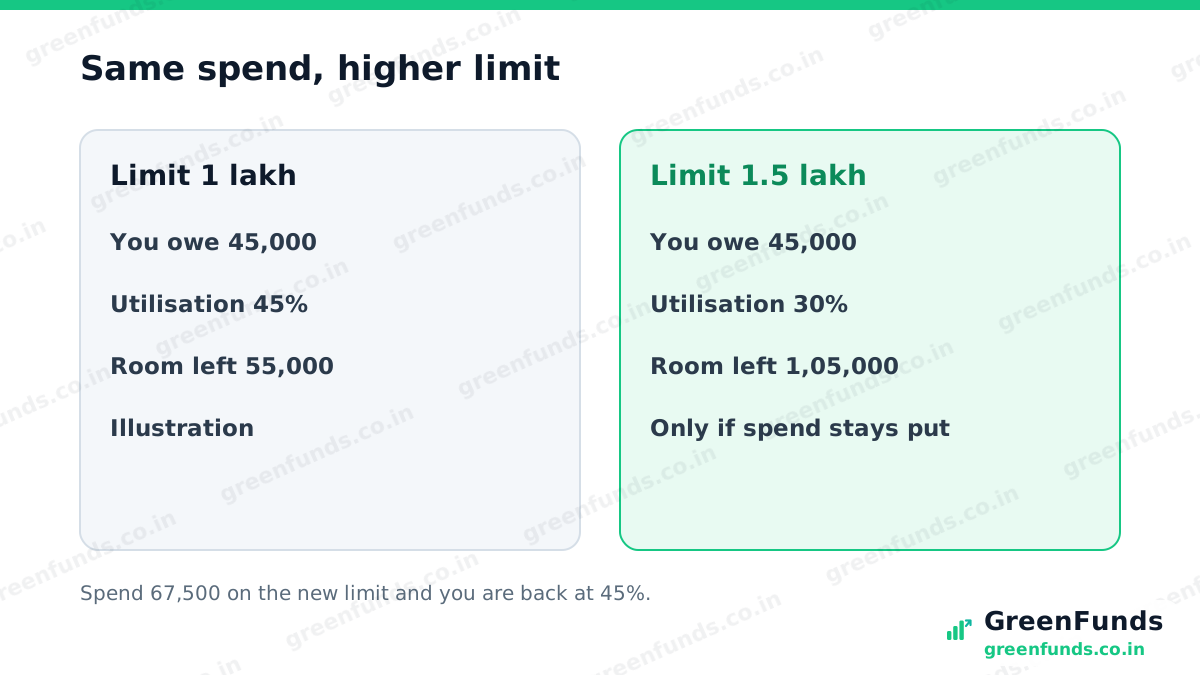
Credit utilisation is the share of your limit you are using. A higher limit lowers it, but only if you don’t spend more.
An illustration. You owe 45,000 rupees on a 1 lakh rupee limit: utilisation is 45%. The limit rises to 1.5 lakh rupees and you still owe 45,000: utilisation falls to 30%. But if your spending creeps up to 67,500 rupees, you are back at 45%, now with a bigger bill.
Low utilisation is widely seen as a good sign for your score, but the bureaus don’t publish the exact effect.
Did you know? Interest and charges don’t eat into your limit. RBI’s directions say interest, charges and fees shall not be factored in when computing your credit limit usage or levying overlimit charges. Say your limit is 1 lakh rupees, you have spent 99,000, and 1,500 rupees of interest and fees are added (an illustration). Your bill is 1,00,500 rupees, but your limit usage is 99,000. Going over the limit at all needs your prior explicit consent, which you can switch on or off.
When a higher limit is a bad idea
- You already carry a balance. If you pay only the minimum due, a higher limit is room to borrow more at card interest. Work on getting out of credit card debt first.
- More credit means more spending for you. Be honest about this one.
- You plan big EMI conversions. These block part of your limit, as the real cost of credit card EMIs explains, and a bigger limit makes large ones easy.
Couples who share cards or bills should agree on limits together, as part of couples financial planning.
The takeaway. A limit increase never happens without your yes. It helps your utilisation only if your spending stays put. If you already carry a balance, say no and clear it first.
More to read: how banks set your first limit, how to improve your credit score, your first credit card bill, and credit cards, the lesson.
-
Check where you stand
Look at your last few statements. Have you paid on time, and how much of your limit do you usually use? Note any rise in income since the card was issued.
-
Look for an offer first
Many banks show a pre-approved limit increase in the card's app or net banking. Accepting one of these is usually the simplest route.
-
Ask for an increase
If there is no offer, request one through the app, net banking or customer care. The bank may ask for recent salary slips, income tax returns or bank statements.
-
Read the terms and decide
Check the new limit and any change in terms before you agree. The increase applies only once you give your explicit consent.
Questions people ask
Can a bank increase my credit card limit without asking me?
No. RBI's credit card directions say card issuers shall not unilaterally upgrade credit cards and enhance credit limits, and must take your explicit consent whenever terms change. A bank can offer you a higher limit, but it applies only if you say yes. A reduction is different: the bank only has to inform you.
How do I increase my credit card limit?
Check the card's app or net banking for a pre-approved offer and accept it if it suits you. If there is none, request an increase through the app, net banking or customer care. The bank may ask for proof of income such as salary slips or income tax returns, and it decides based on your income, repayment record and other credit.
Does a credit limit increase improve my credit score?
It can lower your credit utilisation, the share of your limit you use, but only if your spending stays the same. If you owe 45,000 rupees on a 1 lakh limit, utilisation is 45%. On a 1.5 lakh limit it falls to 30%. Credit bureaus do not publish exact weights, so treat this as a direction, not a guaranteed jump.
Do interest and charges count towards my credit limit?
Not for working out how much of your limit you have used. RBI's directions say interest, charges and fees on the card shall not be factored in when computing credit limit usage or levying overlimit charges. They still appear on your bill and must be paid.
When is a higher credit card limit a bad idea?
When you already carry a balance from month to month, pay only the minimum due, or tend to spend more when more credit is available. Then a higher limit mostly means room to borrow more at card interest rates. Clear the debt first.
Source: Reserve Bank of India (Commercial Banks - Credit Cards and Debit Cards: Issuance and Conduct) Directions, 2025, RBI/DOR/2025-26/155, DOR.AUT.REC.No.74/24-01-041/2025-26, 28 November 2025, updated as on 1 October 2026: definitions of credit limit and upgradation, paragraph 12 (underwriting standards, overlimit consent, charges not counted towards limit usage), paragraphs 33 and 34 (no unsolicited facilities, no unilateral limit increase, notice of a reduction) (rbi.org.in). Utilisation example computed, with illustrative numbers.
Found this useful? You can buy us a coffee. It keeps GreenFunds free.Flag a possible issue
Was this helpful?
Thanks for the signal.
Comments
Share your experience or a question. Be kind, stay on topic. This is reader discussion, not financial advice.
No comments yet. Be the first to share.