Credit cards in India: a complete beginner's guide
A short loan you repay every month
Figures checked 2026-10-23
A credit card is one of the most useful and most misunderstood tools in personal finance. Used one way, it is free short-term credit and a quiet way to build your credit score. Used another way, it is the most expensive loan most people will ever take. The difference comes down to a handful of things this guide walks through. This page is the hub: it covers the essentials and links out to deeper pieces on each.
On this page: How it works · Pay in full or pay interest · The minimum-due trap · What a card costs · Your credit score · Already in card debt · Using one well · Myths
Go deeper: The credit card trap · Total vs Minimum Amount Due · Your credit score explained · How to get out of card debt
How a credit card actually works
A credit card is not your money. When you tap it, the bank pays the shop for you and notes it down as a short loan. Once a month it adds up everything you spent and sends you a bill, called the statement. You then have until a due date to pay it back.
Two numbers on that statement decide everything:
- The Total Amount Due: everything you spent this cycle. Pay this and your slate is clean.
- The Minimum Amount Due: a small slice, often about 5% of the balance. Pay only this and the card stays active, but interest begins. More on that trap below.
Did you know? Indians now hold more than 11 crore credit cards (Reserve Bank of India data, 2025). That is a lot of short monthly loans running at once, which is exactly why knowing how the bill works matters more than which card has the flashiest rewards.
The billing cycle and the interest-free period
Spending is grouped into a monthly billing cycle, and the gap between your statement and its due date is the grace period. Because a purchase early in the cycle is billed only at month-end and paid only on the due date, you can get roughly 20 to 50 days of interest-free credit, as long as you clear the full bill. That free window vanishes the moment you carry a balance.
Pay in full or pay interest
This is the single rule that separates a credit card as a tool from a credit card as a trap.
Pay the Total Amount Due in full, on time, and your purchases cost you nothing in interest. You used the bank’s money for a few weeks for free. This is the only way to use a credit card that makes sense for most people.
Carry any balance and interest starts, and credit card interest is brutal.
Did you know? Credit card interest in India is often around 3% to 3.75% a month, which works out to roughly 40% or more a year. That is far above a personal loan, a car loan or a home loan. Borrowing on a card and only slowly paying it back is one of the most expensive things an ordinary person can do with money. The exact rate sits on your card’s schedule of charges.
The minimum-due trap
The scariest line on the statement is the friendliest looking one. The Minimum Amount Due is designed to feel manageable: pay this small amount and nothing bad happens today. What it hides is that once you pay only the minimum, interest applies to your entire balance, and every new purchase starts charging interest immediately too.
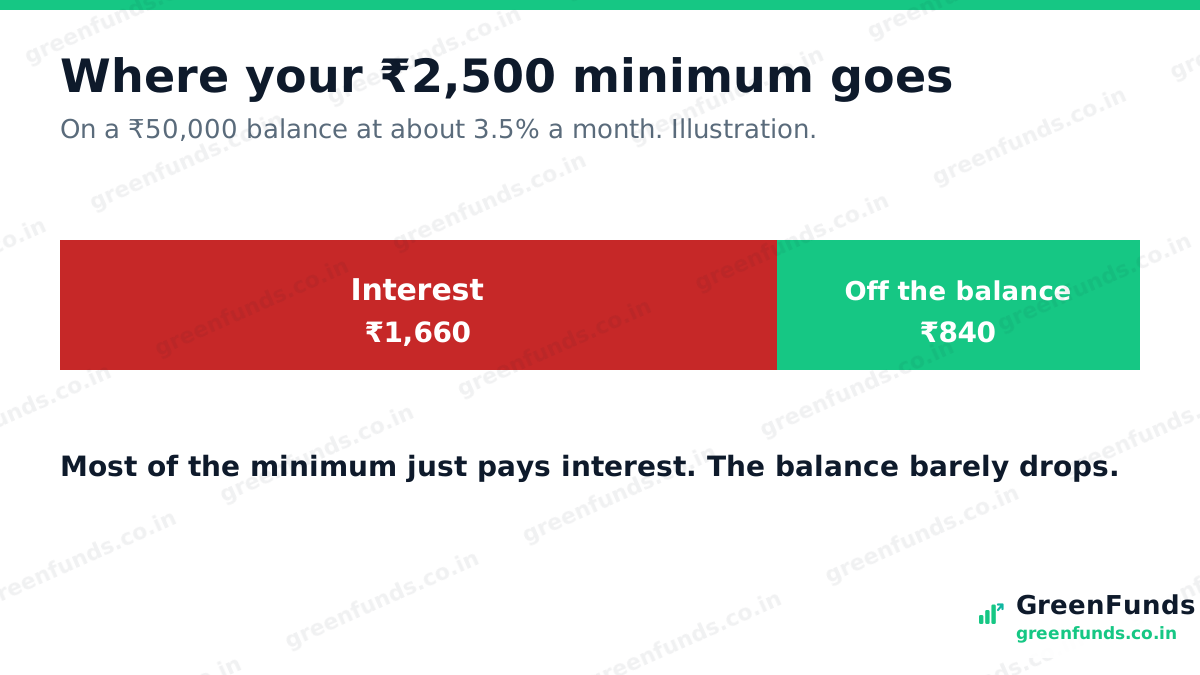
As the illustration shows, most of a minimum payment just covers interest, so the balance barely moves and the debt can drag on for years. The plain-words breakdown is in Total vs Minimum Amount Due, and the whole mechanism in the credit card trap.
What a card costs
Beyond interest, watch for these. None of them bites if you pay in full and use the card normally, but they are worth knowing:
- Annual fee. Many cards charge one; many waive it if you spend a set amount in a year. A free-forever card is fine for a beginner.
- Late payment fee. A flat charge if you miss the due date, on top of interest.
- Cash withdrawal. Taking cash on a credit card usually means interest from day one, with no interest-free period, plus a fee. Treat it as a last resort.
- Foreign currency markup. A percentage added to overseas or foreign-website spends.
- GST. Tax applies on the fees and charges above.
The costly items are interest and cash withdrawal. Avoid both and a credit card is close to free.
How a card shapes your credit score
Every card you hold and every payment you make is reported to the credit bureaus, who turn your record into a credit score.
Did you know? Your credit score runs from 300 to 900, and a score around 750 and above is generally treated as strong (TransUnion CIBIL). There is no official cutoff, each lender sets its own, but a higher score usually means easier approval and a lower interest rate on future loans.
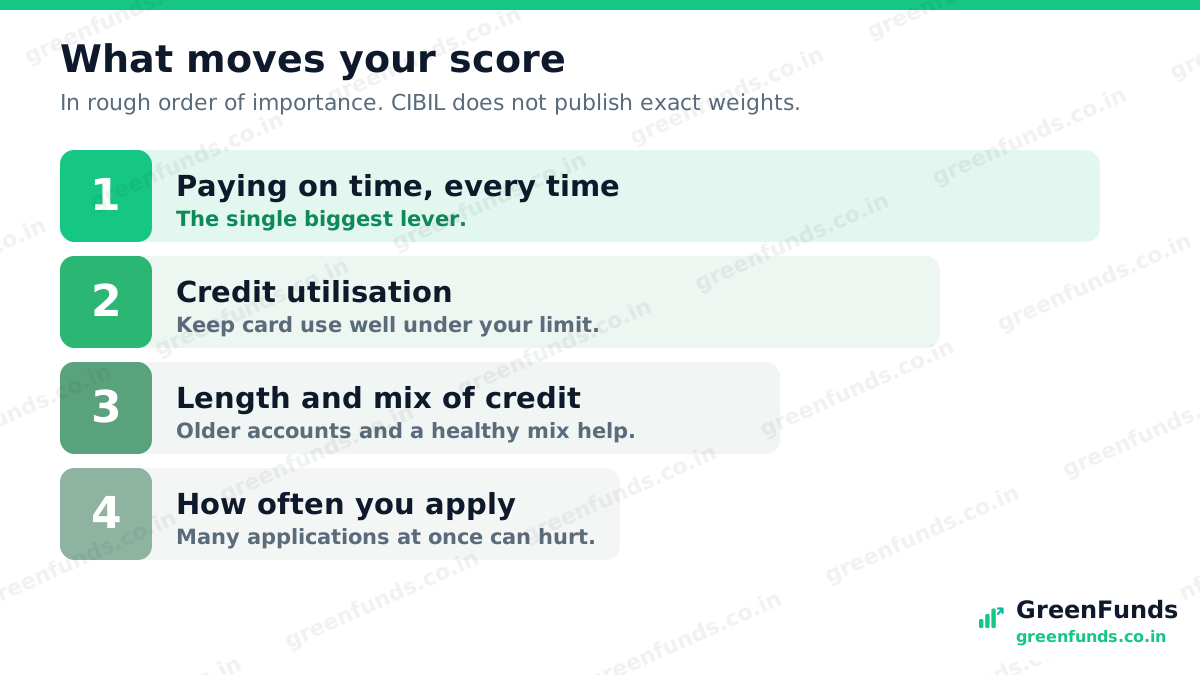
Used well, a credit card is one of the easiest ways to build that score:
- Pay on time, every time. This is the single biggest factor. One autopay for the full bill protects it.
- Keep your credit utilisation low. Using a small share of your limit, rather than running it near the top, tends to help.
- Keep old cards open. A longer history generally helps, so do not rush to close your first card.
The fuller version is in your credit score explained.
If you are already in card debt
If a balance has built up, the priority is simple: stop adding to it, and attack the costliest debt first. Two common methods are the debt avalanche (clear the highest-interest balance first, which saves the most money) and the debt snowball (clear the smallest balance first, for momentum). The step-by-step is in how to get out of card debt.
How to use a card well
The whole guide boils down to a few habits:
- Pay the Total Amount Due in full, by the due date. Set up autopay for the full amount, not the minimum.
- Never treat the limit as your money. Spend only what you could pay from your bank account today.
- Keep usage well under the limit, which also helps your score.
- Skip cash withdrawals on the card.
- Start with one card, learn the rhythm, and add another only if you have a clear reason.
A credit card rewards discipline and punishes drift. That is the entire game.
Myths and mistakes
- “A credit card is extra income.” No. It is a loan you repay every month.
- “Paying the minimum keeps me safe.” No. It starts interest on everything and stretches the debt for years.
- “Carrying a small balance helps my score.” No. Paying in full is what helps; carrying a balance just costs you interest.
- “More cards mean a better score.” No. More due dates to miss, not a free upgrade.
- “Cash on a card is like an ATM.” No. It is an expensive loan from the first day.
Putting it together
Treat a credit card as a short loan you clear in full every month, and it becomes a genuinely useful tool: free short-term credit, a safer way to pay, and a quiet builder of your credit score. Miss that one discipline and it becomes the most expensive borrowing in your life. The card is neutral; the habit is everything.
New to this? Start with good debt versus bad debt, or browse the money basics path.
Questions people ask
How does a credit card actually work?
The bank pays the shop on your behalf and bills you once a month. If you pay that bill in full by the due date, you borrowed the money free. If you do not, interest starts, and it is steep. A credit card is a short monthly loan, not extra income.
Is a credit card free if I pay the full bill?
Largely yes. Pay the Total Amount Due in full by the due date and you usually pay no interest on your purchases, thanks to the interest-free period. You may still pay an annual fee or specific charges, but the costly part, interest, is avoided.
What happens if I pay only the minimum due?
The card stays active and you avoid a late fee, but interest applies to the whole balance, not just the unpaid part, and the new purchases lose their interest-free period too. Paying only the minimum is how a small balance quietly becomes a large one.
How much interest do credit cards charge in India?
Often around 3% to 3.75% a month, which works out to roughly 40% or more a year, among the most expensive borrowing most people ever touch. The exact rate is on your card's statement and schedule of charges, so check yours.
Does using a credit card improve my credit score?
It can. Paying the full bill on time, every time, and keeping your usage well below your limit tends to build your score over months. Missing payments or running the card near its limit pulls it down. The bureau does not publish the exact formula.
How many credit cards should a beginner have?
One, used well, is plenty to start. The number of cards matters far less than the habit of paying in full and on time. More cards mean more due dates to miss, not automatically a better score.
Sources
- Reserve Bank of India, Payment System Indicators Number of credit cards in force and card spending. Figures change monthly; verify the latest here.
- TransUnion CIBIL Credit score range (300 to 900) and credit reports. One free full report a year is your right.
- RBI, credit card and debit card master directions Rules on billing, disclosures and customer rights. Confirm the current rules here.