Setting money goals by time horizon
The deadline decides where the money goes
Figures checked 2026-10-23
Every money goal has a hidden second number. The first is how much you need. The second, the one people skip, is when you need it. That deadline, more than any clever product, decides where your money should sit. Get it right and the rest of investing becomes simple.
Why the deadline matters
Two forces pull in opposite directions. Inflation slowly eats the value of money that is not growing. Market swings can cut the value of money that is growing, in the short run. Which one is your enemy depends entirely on your timeframe.
Did you know? The Reserve Bank of India aims to keep inflation around 4% a year, within a 2% to 6% band (its flexible inflation targeting framework; confirm the current target on rbi.org.in). That means money growing slower than about 4% is quietly losing buying power. For a goal years away, sitting in idle cash can cost you more than market ups and downs do.
So the question is never just “what gives the best return”. It is “what gives the best return for the time I have”. A short deadline means you cannot afford a fall, so safety wins. A long deadline means you can ride out the falls, so growth wins.
The three horizons
A simple way to sort any goal is by how far away it is.
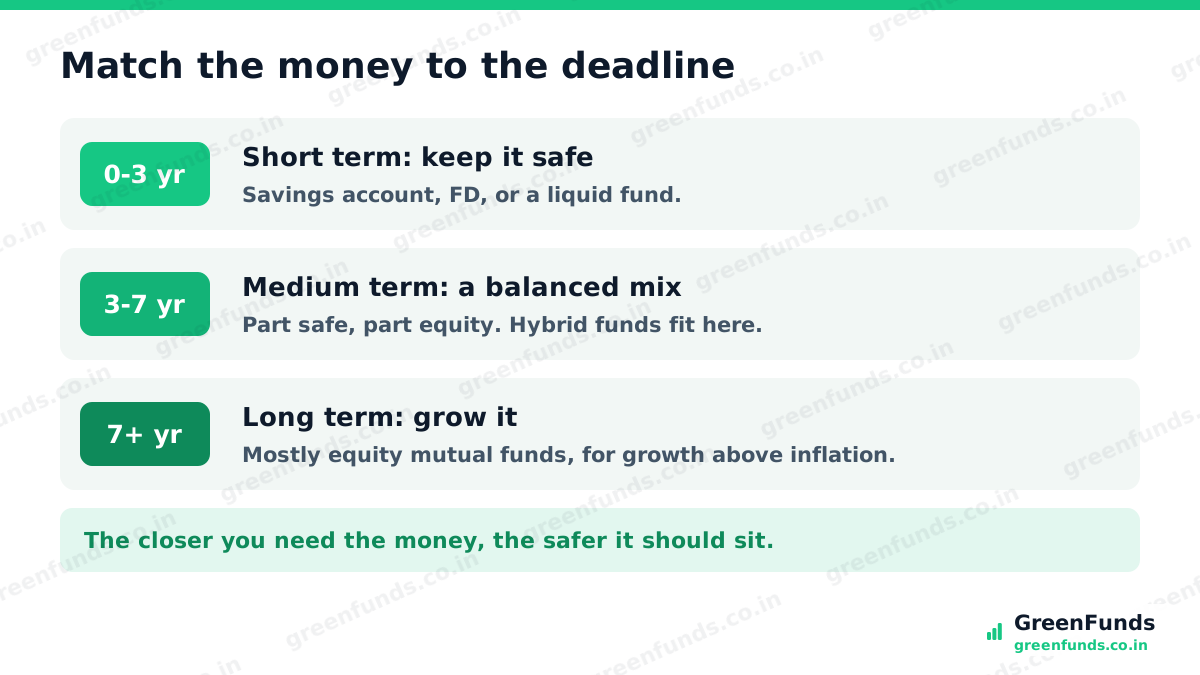
- Short term, 0 to 3 years. A trip, a gadget, an emergency fund, next year’s fees. The job here is to protect the money, so keep it in a savings account, a short fixed deposit, or a liquid fund. You are not trying to grow it, you are making sure it is there.
- Medium term, 3 to 7 years. A car, a house down-payment, a wedding. A balanced mix fits: part safe, part equity, often through hybrid funds, so you get some growth without betting it all on the market.
- Long term, 7 years or more. Your child’s education, your retirement. Here you want growth that beats inflation, which usually means mostly equity through mutual funds. The long runway is exactly what lets you sit through the rough patches.
The two costly mistakes
Almost every goal that goes wrong is a horizon mismatch: the right money in the wrong place for its deadline.
Did you know? The stock market can fall 30% or more in a bad year and take a while to recover. That is perfectly survivable for money you will not touch for a decade, and a disaster for money you need next year. The same investment can be wise or reckless, decided entirely by your time horizon.
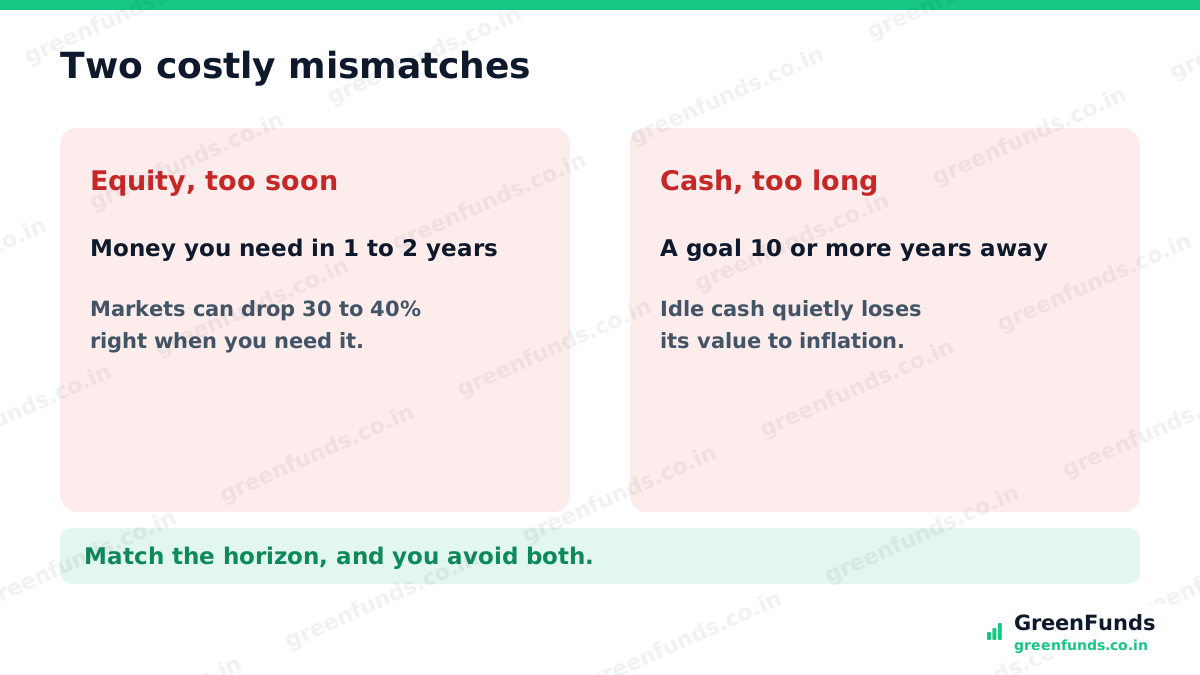
Equity, too soon. Putting money you need in a year or two into the stock market. If it falls right before your deadline, you are forced to sell at a loss. Cash, too long. Leaving a 15-year goal in a low-interest account, where inflation quietly shrinks it. Both feel safe in the moment. Both cost you.
How to actually set a goal
- Name it. “A ₹3 lakh car,” not “some savings.” A vague goal is easy to raid.
- Date it. Put a year on it. That single step tells you which bucket to use.
- Price it. A rough figure is enough to start. For a far-off goal, remember prices will be higher by then.
- Pick the bucket. Match the horizon to the table above.
- Automate it. Set up a monthly SIP or transfer on payday, so the goal funds itself. Try the SIP calculator to see what a monthly amount could become.
Keep each goal in its own place, so you always know what the money is for. Mixing your emergency fund with your holiday fund is how both disappear.
Putting it together
You do not need to predict the market to invest well. You need to know your deadlines. Short money stays safe, long money grows, and compounding does the heavy lifting over the years you give it. The single most useful question before you invest a rupee is simply: when do I need this back?
New here? Start with the money basics path, or your first salary slip, decoded.
Returns are never guaranteed and the figures here are illustrations. Inflation and interest rates change over time, so confirm current numbers on the official sources before planning around them.
Questions people ask
How should I decide where to invest for a goal?
Start with the deadline, not the product. Money you need within about three years should sit somewhere safe, like a savings account, FD or liquid fund. Money you will not touch for seven years or more can grow in equity. Match the risk to the timeframe.
Where should I keep money I need in one or two years?
Somewhere safe and easy to reach, such as a savings account, a short fixed deposit, or a liquid fund. The goal here is to protect the money, not to grow it, because there is no time to recover from a fall.
Is equity safe for short-term goals?
No. Equity can fall sharply in a bad year and take time to recover, which is fine for a far-off goal but risky for money you need soon. For short horizons, safety matters more than returns. This is general education, not financial advice.
Why does inflation matter for a long-term goal?
Over many years, rising prices quietly shrink the buying power of idle cash. For a goal a decade away, keeping everything in a low-interest account can cost you more than market swings would. That is why long-term money usually needs some growth.
How do I set a money goal?
Name it, date it, and price it: what, by when, and roughly how much. The deadline tells you which bucket to use, and a monthly SIP or transfer does the rest automatically.
Sources
- Reserve Bank of India, monetary policy framework The flexible inflation target (around 4%, within a 2% to 6% band). Reviewed periodically; confirm the current target here.