Your first salary slip, decoded
What every line on your payslip means
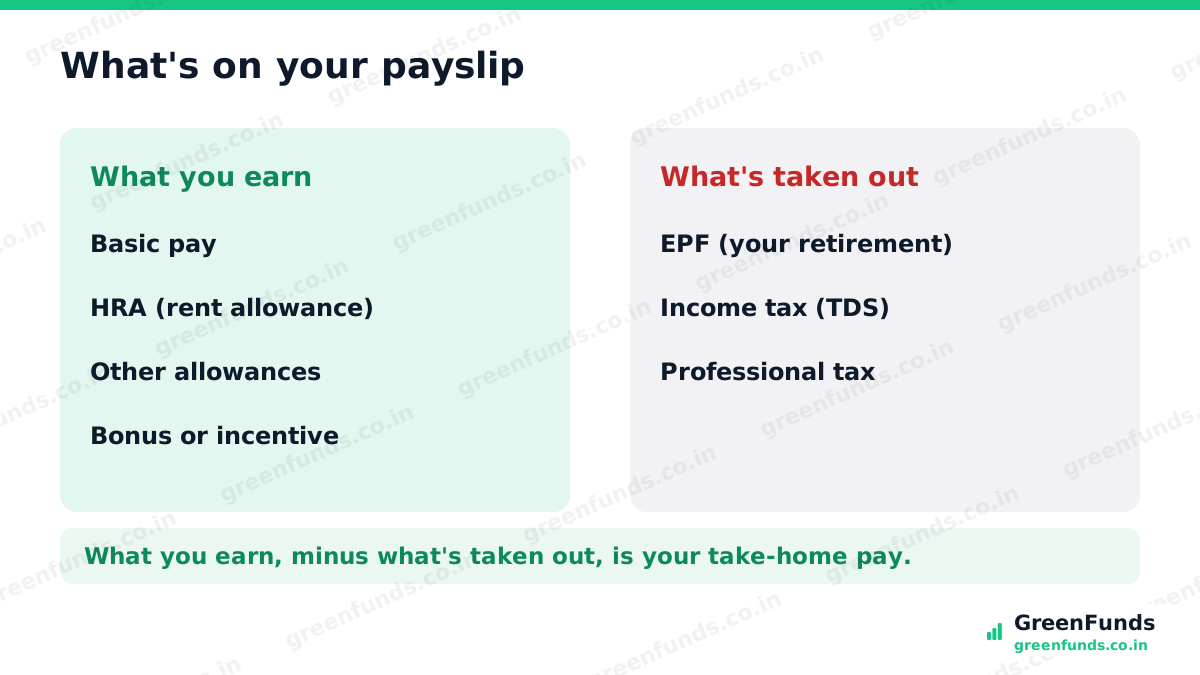
Your first salary slip looks simple until you notice the number at the bottom is smaller than the figure in your offer letter. That gap is not a mistake. A payslip has two halves: what you earn, and what is taken out before the money reaches you. Once you can read both, you know exactly where your salary goes.
What you earn
The top of the slip lists your earnings:
- Basic pay. The core of your salary. Many other numbers, like your EPF and HRA limits, are worked out from it.
- HRA, or House Rent Allowance. A part of pay meant for rent. If you actually pay rent, some of it can be tax-free under the old tax regime. See HRA.
- Allowances. Dearness allowance, special allowance, travel and other top-ups.
- Bonus or incentive, if any, in that month.
Add these up and you get your gross pay, the total before anything is deducted.
What is taken out
Below the earnings sit the deductions, the reason your take-home is smaller:
- EPF, the Employees’ Provident Fund. Your retirement savings. A fixed slice of your basic pay goes in every month. See EPF.
- Income tax (TDS). Tax Deducted at Source: your employer estimates your yearly tax and takes a slice each month, so you avoid one big bill.
- Professional tax. A small state tax on salaried people. Not every state charges it.
Did you know? The money shown as EPF is not lost, it is forced saving for your future. Around 12% of your basic pay goes in, and your employer adds a matching share on top that never even appears as a deduction on your slip (EPFO rules). It quietly earns interest, 8.25% for FY2024-25, every year. Activate your UAN to watch it grow, step by step.
Did you know? Professional tax has a hard ceiling. No state can charge you more than ₹2,500 in a whole year, because Article 276 of the Constitution caps it there. So this line, however annoying, is always small.
Why your take-home is less than your CTC
Your offer letter quotes a CTC, or Cost To Company: everything the company spends on you in a year, including parts you never see in your account, like the employer’s EPF share and gratuity. Your payslip then shows your gross pay (your earnings) and your take-home, after your own deductions.
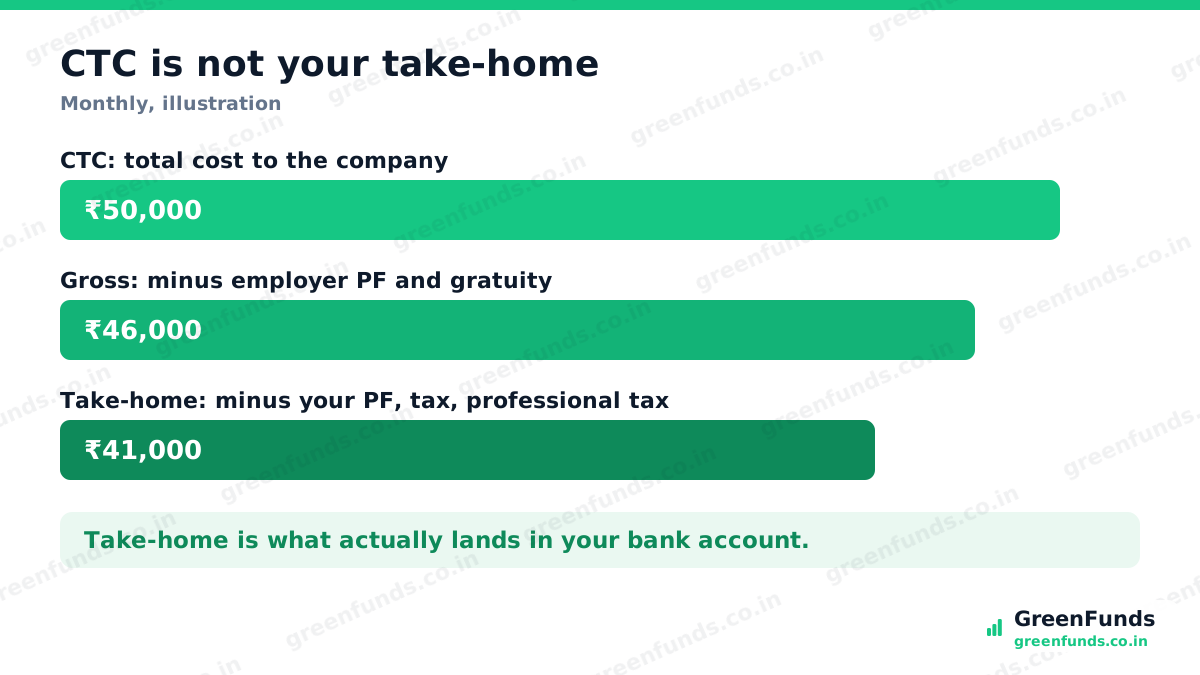
As the illustration shows, the number that matters for your monthly budget is take-home, not CTC. Plan your spending around what actually lands in your account.
What to do with your first payslip
- Budget on take-home, not CTC. A simple split like the 50-30-20 rule is a good start.
- Build an emergency fund before you take on big commitments.
- Check your tax regime. Pick the regime that taxes you less; the old one lets you claim HRA, 80C and more, the new one has lower rates.
- Start small on investing. Even a ₹500 monthly SIP begun now beats a big one begun later, and your EPF is already a head start on retirement.
Rates and rules, like the EPF rate, tax slabs and professional tax, change over time and vary by state, so confirm the current figures on the official sites (epfindia.gov.in and incometax.gov.in) for your own numbers.
Questions people ask
Why is my take-home less than my CTC?
CTC (Cost To Company) is everything the company spends on you in a year, including parts you never see, like the employer's EPF share and gratuity. Your take-home is after your own deductions (EPF, income tax, professional tax), so it is always lower than CTC.
What is the EPF deduction on my salary?
EPF is the Employees' Provident Fund, your retirement savings. Typically 12% of your basic pay is deducted and goes into it each month, and your employer adds a matching share on top. It earns interest set yearly by the government.
What is professional tax on a payslip?
A small tax some states charge on salaried people. It is capped at ₹2,500 a year across India, and not every state levies it, so the amount is always small or nil.
What is TDS on my salary slip?
TDS is Tax Deducted at Source, your income tax. Your employer estimates your yearly tax and deducts a slice each month, so you are not hit with one large bill at year end. The amount depends on your income, declarations and tax regime.
Should I choose the old or new tax regime?
The new regime has lower rates but few deductions; the old one has higher rates but lets you claim HRA, 80C and more. Which saves you more depends on your deductions, so compare both on your own numbers. Confirm the current slabs on incometax.gov.in.
Source: EPFO (epfindia.gov.in) for EPF rules and rate; the Income Tax Department (incometax.gov.in) for TDS and regimes; professional tax is capped by Article 276 of the Constitution. Figures change and vary by state; confirm the current ones.
Flag a possible issue
Was this helpful?
Thanks for the signal.
Comments
Share your experience or a question. Be kind, stay on topic. This is reader discussion, not financial advice.
No comments yet. Be the first to share.