What is an ETF, and how it differs from an index fund
An index fund that trades like a share
Figures checked 2026-10-23
An ETF is one of those three-letter terms that sounds complicated and turns out to be simple. It stands for Exchange Traded Fund, and it is really just an index fund that you buy and sell on the stock exchange, like a share. Once you see the small difference, you can decide whether it fits you or whether a plain index fund is easier.
What an ETF is
Like an index fund, an ETF holds the same companies as a market index, in the same weights, so its value tracks that index. Nobody picks stocks, which keeps the cost very low. The one thing that sets it apart is how you buy it: an ETF trades on the stock exchange during market hours, at a live price that moves through the day, and you need a demat account to hold it.
Did you know? If you earn a salary, you probably already own ETFs without realising it. Since 2015, the EPFO has invested a slice of your Provident Fund, within a 5% to 15% band, into equity through Nifty and Sensex ETFs (EPFO; the exact share is reviewed over time). ETFs are not exotic. They are already quietly part of many Indians’ retirement savings.
ETF versus index fund
This is the comparison that trips people up, so here it is side by side.
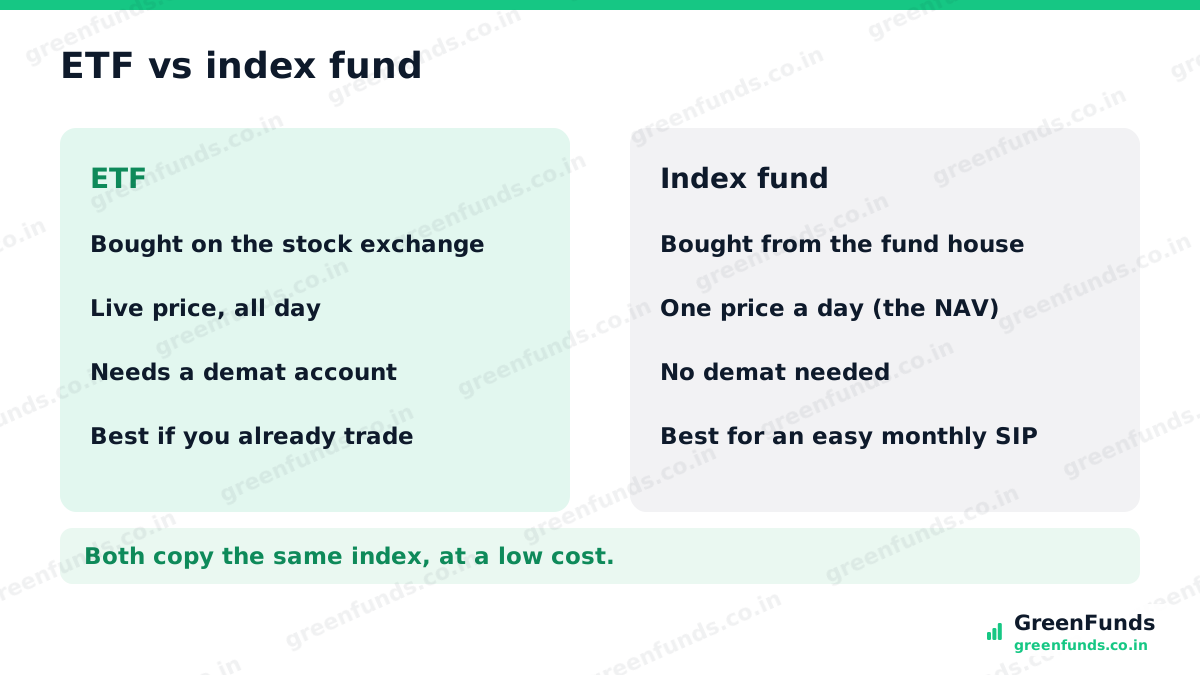
The holdings are the same idea. The difference is the wrapper:
- An ETF is bought on the exchange at a live price, and needs a demat account. Its market price can drift slightly above or below its true NAV during the day.
- An index fund is bought from the fund house at the day’s single NAV, needs no demat account, and takes an automatic monthly SIP easily.
What it costs
Both are cheap because no manager is picking stocks. The yearly fee, the expense ratio, is low for both, and sometimes lowest of all for an ETF.
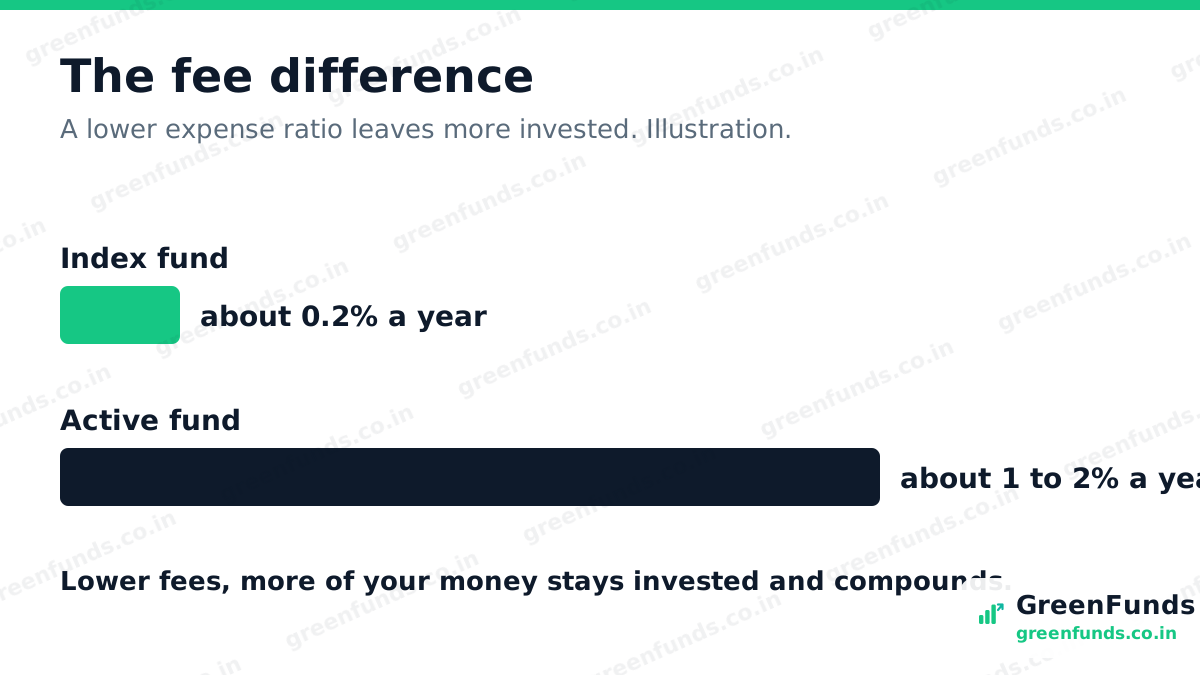
There is a catch with an ETF, though. Because you buy it on the exchange, you also pay brokerage on each trade, and a thinly traded ETF can have a wide gap between its buy and sell price. For small, regular investing, those frictions can quietly eat into the low expense ratio.
Which should a beginner pick?
Neither is “better”. They suit different people:
- A regular index fund is usually simpler for a first-timer who just wants to invest a fixed amount every month. No demat account, and the SIP runs on its own.
- An ETF suits you more if you already have a demat and trading account, you are comfortable placing an order, and you want the lowest possible cost.
Both are low-cost, passive ways to own the whole market, which is the part that actually matters. The deeper case for passive investing is in active versus passive.
Putting it together
An ETF is not a different world from an index fund. It is the same low-cost, index-tracking idea in a form that trades like a share. If that extra step (a demat account and placing trades) is worth it to you, an ETF is a fine choice. If you would rather set up a monthly SIP and forget it, an index fund does the same job with less fuss. Either way, you are doing the sensible thing: owning the market cheaply and letting compounding work.
New here? Start with what is an index fund, or the money basics path.
Returns are never guaranteed and the figures here are illustrations. Costs and rules change over time, so check each fund’s factsheet and the current rules before investing.
Questions people ask
What is an ETF?
An ETF, or Exchange Traded Fund, is a fund that tracks a market index at low cost, like an index fund, but you buy and sell it on the stock exchange during market hours, at a live price, through a demat account.
What is the difference between an ETF and an index fund?
Both track an index cheaply. An ETF trades on the stock exchange at a live price and needs a demat account. A regular index fund is bought from the fund house at the day's single NAV and needs no demat account. The holdings are otherwise the same idea.
Do I need a demat account to buy an ETF?
Yes. An ETF is bought and sold on the stock exchange, so it needs a demat and trading account. A regular index fund does not, which is why index funds are often simpler for a first-time investor.
Are ETFs good for beginners?
They can be, but for someone who just wants an automatic monthly SIP, a regular index fund is usually simpler: no demat account, and the SIP runs on its own. An ETF suits you more if you already trade and want the lowest cost. This is general education, not financial advice.
Is an ETF cheaper than an index fund?
ETFs often have very low expense ratios, sometimes lower than index funds. But you also pay brokerage on each trade and the market price can differ slightly from the NAV, so the true cost depends on how you use it.
Sources
- EPFO (Employees' Provident Fund Organisation) EPFO has invested part of the PF corpus in Nifty/Sensex ETFs since 2015, within a 5 to 15% band. The exact share is reviewed over time; confirm the current figure.
- SEBI / AMFI, mutual funds and ETFs Rules on ETFs, index funds and disclosures. Verify current rules here.