Expense ratio, explained
The yearly fee every fund charges
An expense ratio is the yearly fee a mutual fund charges to run itself, shown as a small percentage of the money you have invested. You never pay it as a separate bill. The fund quietly takes it out of its own value every day. It sounds tiny, but over years it adds up to real money.
How it actually works
Say a fund has a 1% expense ratio and you have ₹1 lakh in it. That is about ₹1,000 a year, taken a little at a time from the fund, not charged to your bank account.
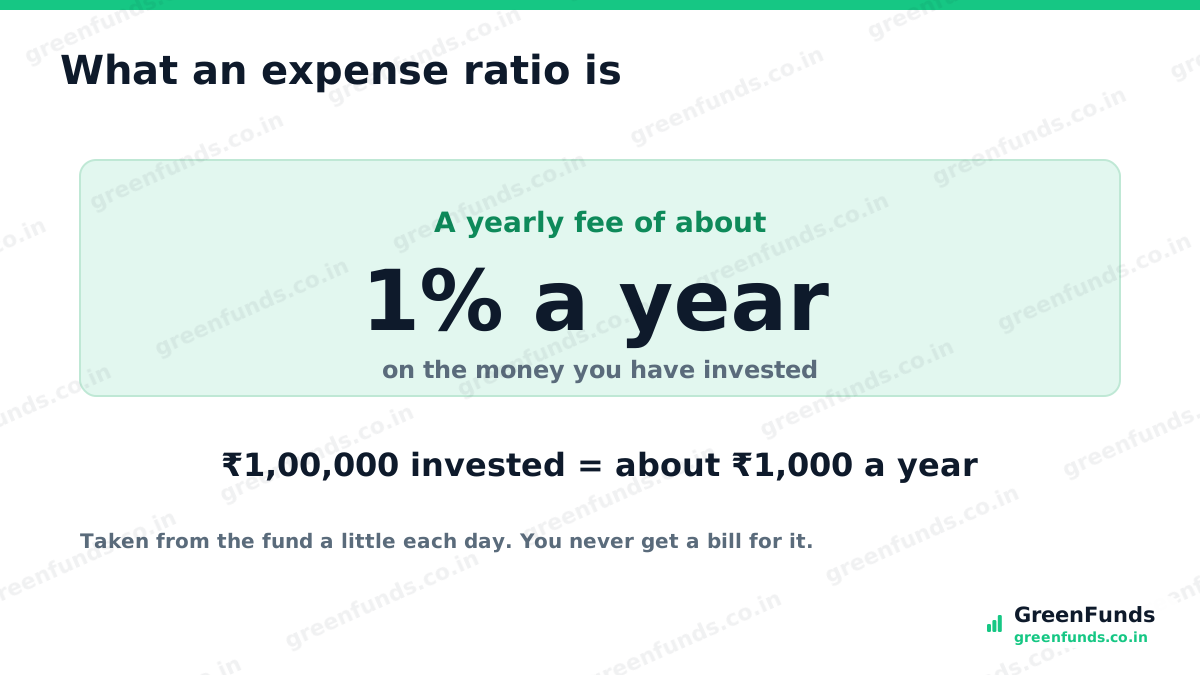
Because it is already baked into the NAV you see, you never feel it leave. That is what makes it so easy to overlook, and so important to check before you overlook it.
Why a small percentage is a big deal
A fee of 1% sounds harmless. Over one year it is. Over an investing lifetime, it is not, because that fee is skimmed off every single year while your money is trying to compound.
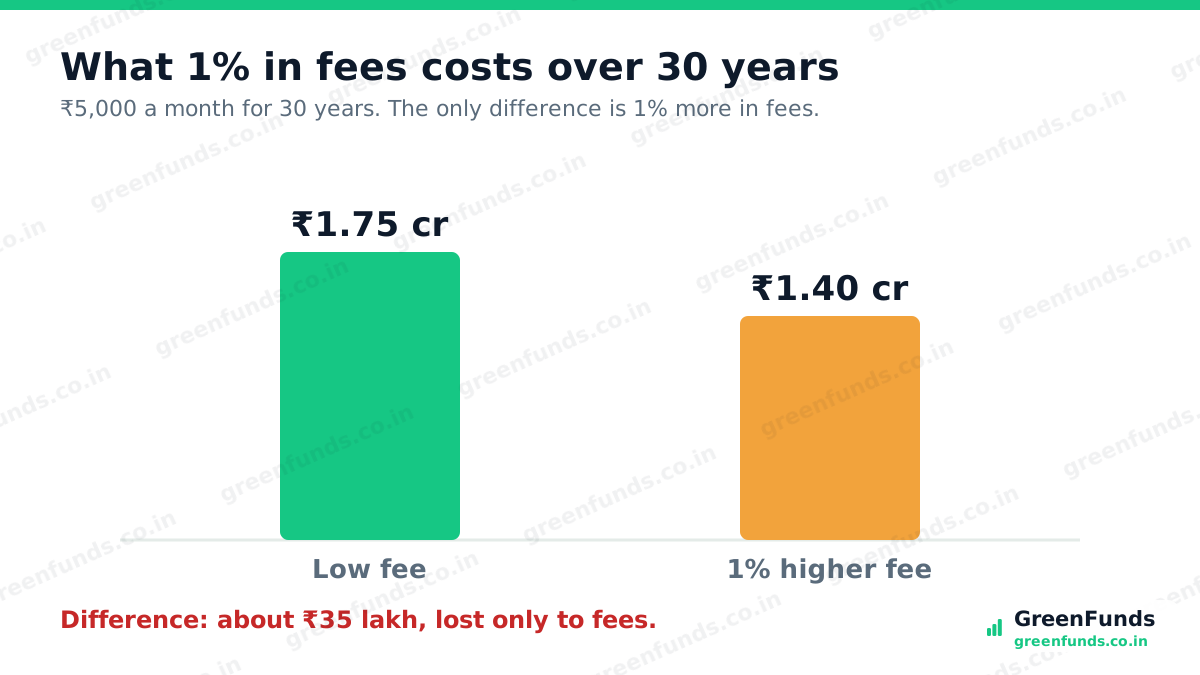
As the compounding lesson shows, ₹5,000 a month for 30 years at 12% grows to about ₹1.75 crore, but at 11% it is about ₹1.40 crore. That single 1% of fees costs roughly ₹35 lakh. This is an illustration using assumed returns, not what you will actually earn, but the lesson is real: fees compound against you exactly the way returns compound for you.
Index funds vs active funds
This is where the expense ratio matters most.
- Index funds simply hold a slice of every big company in the market, with no stock-picking, so they are cheap to run and charge very little. See what is an index fund.
- Active funds pay a manager and a research team to try to beat the market, so they charge more. The manager then has to beat the market by more than that extra fee just to leave you level.
SEBI caps how much funds can charge, but within the cap the gap between a cheap fund and a costly one is money straight out of your pocket.
How to use this
- Compare the expense ratio of funds doing the same job before you pick.
- Prefer the direct plan of any fund, which has a lower expense ratio than the regular plan.
- Do not chase a cheap fund alone. Cost is one factor; for active funds, a long track record matters too.
Common mistakes
- Ignoring the fee because it is invisible. Out of sight is not out of pocket.
- Paying active-fund fees for index-like results. If a fund just tracks its benchmark, you are overpaying.
- Forgetting the direct plan. Same fund, lower fee, more kept.
A low expense ratio will not make you rich on its own. But it is one of the very few things about investing you can control completely, so control it.
Next, see what is an index fund, or how one percent a year really adds up.
Questions people ask
What is an expense ratio?
It is the yearly fee a mutual fund charges to manage your money, shown as a percentage of the amount you have invested. A 1% expense ratio on 1 lakh rupees is about 1,000 rupees a year.
Do I pay the expense ratio separately?
No. You never get a bill for it. The fund takes it out of its own value a little each day, so it is already reflected in the NAV you see. That is exactly why it is easy to ignore.
Is a lower expense ratio always better?
For funds doing the same job, usually yes, because the fee is a cost you pay every year regardless of performance. Index funds have very low expense ratios; active funds charge more for trying to beat the market.
What is a good expense ratio?
There is no single number, and SEBI caps how much funds can charge. As a rough idea, index funds are often a fraction of a percent, while active equity funds commonly charge around 1% or more. Always check the fund's current factsheet.
Does the expense ratio affect my returns?
Yes, directly. Every rupee of fee is a rupee less compounding for you. Over decades even a 1% higher fee can cost lakhs, which is why low-cost funds have such an edge.
Sources
- SEBI mutual fund regulations on total expense ratio (TER) SEBI sets the maximum expense ratio by fund size and type; check a fund's current factsheet for its exact figure.