What is an index fund
Own the whole market at low cost
An index fund is a ready-made basket of shares that simply copies the whole market, instead of trying to beat it. You end up owning a small slice of many big companies at once, and because no expert is picking the shares, it costs very little to run. For most people, it is the easiest way to start investing.
What an index fund actually is
A market index is a basket. The Nifty 50 tracks India’s 50 largest listed companies. The Sensex tracks 30. An index fund buys those same companies in the same proportions, so its return closely follows the index itself.
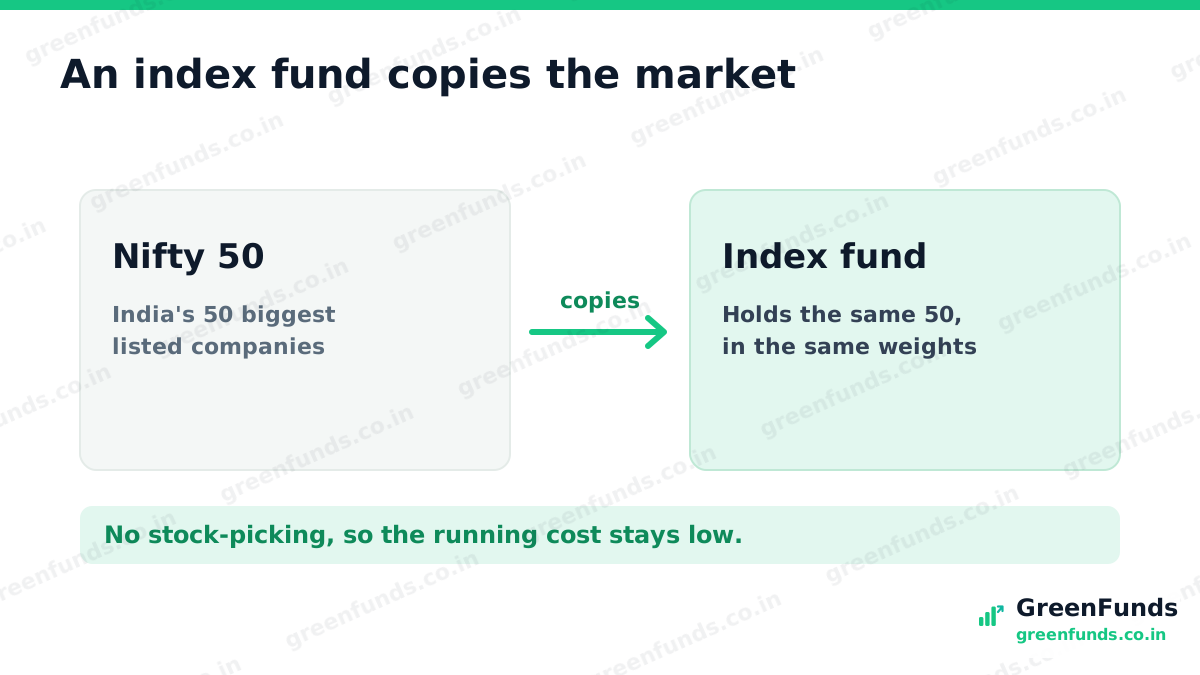
Nobody sits there trying to guess which stock will jump. The fund simply mirrors the basket. That one design choice is where all the advantages come from.
Why it usually costs less
Running an index fund is cheap. There is no star manager, no research team, no constant buying and selling. So the yearly fee, the expense ratio, is a small fraction of what an active fund charges.
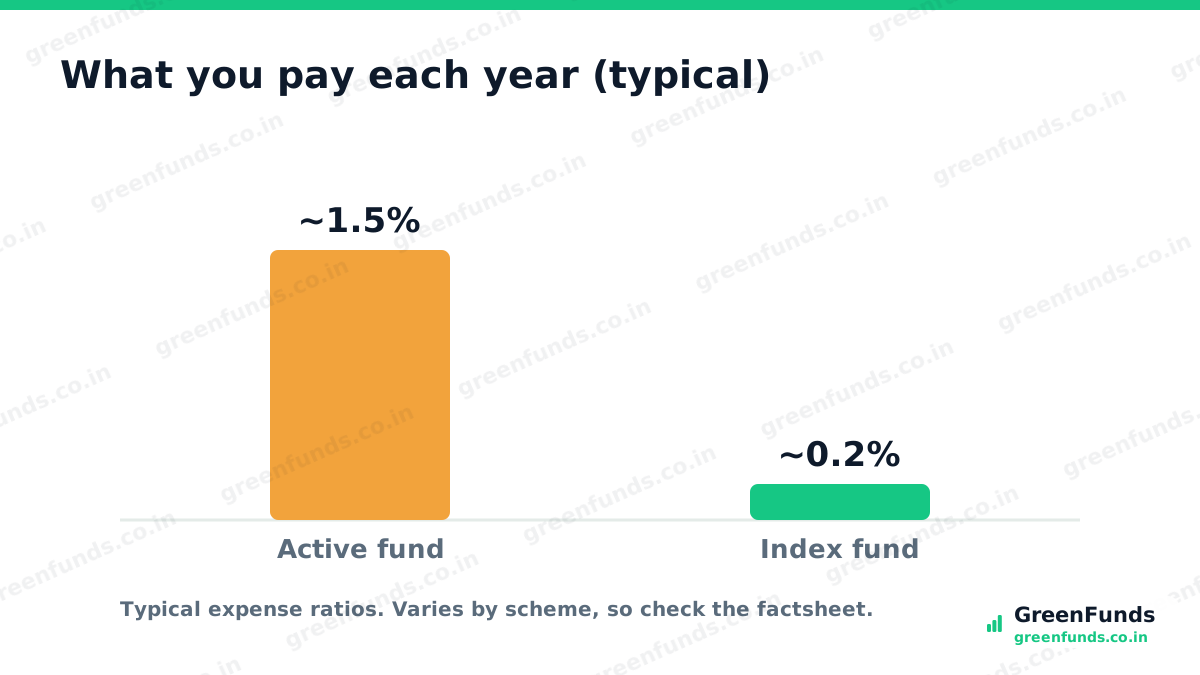
That gap sounds tiny and is not. As the compounding lesson shows, one percent a year leaking out as fees can cost lakhs over a few decades. Low cost is one of the very few edges you fully control. See what one percent a year really costs you.
What you give up, and what you avoid
An index fund will never be the year’s top performer, because it is not trying to be. You give up the chance of beating the market.
In exchange, you avoid the bigger risk: badly trailing it. Over the long run, most active funds have not beaten their index. Over the five years to end-2024, about 93% of active large-cap funds in India did worse than the market, per the SPIVA India Scorecard. That figure updates each period, so check the latest, but the long-run pattern has been remarkably steady. Matching the market cheaply often beats trying to beat it and missing.
Index fund or ETF?
Both copy an index. The practical difference:
- An index fund is bought at the day’s NAV, like any mutual fund, and works perfectly with a monthly SIP.
- An ETF trades on the exchange like a share and needs a demat account.
For a beginner running a monthly SIP, a plain index fund is usually the simpler choice.
How to use one
- Make it your core. A broad index fund (Nifty 50 or a broader market index) is a sensible base to build around.
- Automate it. Set up a monthly SIP so it runs without a fresh decision each month.
- Pick a low tracking error. Among funds copying the same index, prefer the one that mirrors it most closely, at the lowest cost.
- Choose the direct plan. The direct plan of the same fund costs less, which means more stays invested.
Common mistakes
- Chasing the index that did best last year. Pick a broad one and stay put.
- Comparing only returns, ignoring cost. Two funds copying the same index should be judged on cost and tracking error.
- Holding many index funds that overlap. One broad fund often does the job of three.
An index fund will not make you the cleverest investor in the room. It will quietly keep your costs low and your plan simple, which is what actually builds wealth.
Next, see the real trade-off in active vs passive investing, or start with SIP and mutual funds.
Questions people ask
What is an index fund?
A mutual fund that simply copies a market index, like the Nifty 50, by holding the same companies in the same proportions. Nobody picks stocks, so it tracks the index closely and costs very little to run.
Are index funds good for beginners?
For many people, yes. You do not have to judge a fund manager or chase last year's winner. You buy the whole market at a low cost and let it compound. It is simple, cheap and hard to get badly wrong.
What is the difference between an index fund and an ETF?
Both copy an index. An index fund is bought and sold at the day's NAV, like any mutual fund, and suits a monthly SIP. An ETF trades on the stock exchange like a share and needs a demat account. The idea is the same; the plumbing differs.
Do index funds give lower returns?
An index fund aims to match the market, not beat it, so it will never be the year's top performer. But over the long run most active funds fail to beat their index, so matching the market at low cost often ends up ahead of trying and missing.
What is tracking error?
The small gap between an index fund's return and the index it copies, caused by costs and cash holdings. A lower tracking error means the fund mirrors its index more closely, which is what you want.
Index fund or active fund, which is better?
Neither is right for everyone. An index fund wins on cost and simplicity and is a solid core. An active fund tries to beat the market but costs more and often does not. Many investors use an index fund as the base and keep costs low.
Sources
- SPIVA India Scorecard, S&P Dow Jones Indices, Year-End 2024 Underperformance figures update each period; check the latest scorecard.