How to read a mutual fund factsheet
Five things that actually matter
Figures checked 2026-10-23
Every mutual fund publishes a factsheet: a one-page monthly summary, free on the fund house’s website. It is packed with numbers and jargon, which is why most people never read it. The good news is that only about five things really matter. Learn to spot those and you can size up any fund in a couple of minutes.
What a factsheet is
A factsheet is the fund’s report card. It lists the scheme’s returns, its cost, its risk level, what it holds, and the rules for getting in and out, all as of a given month. You do not need to understand every line. You need to know which lines to look at.
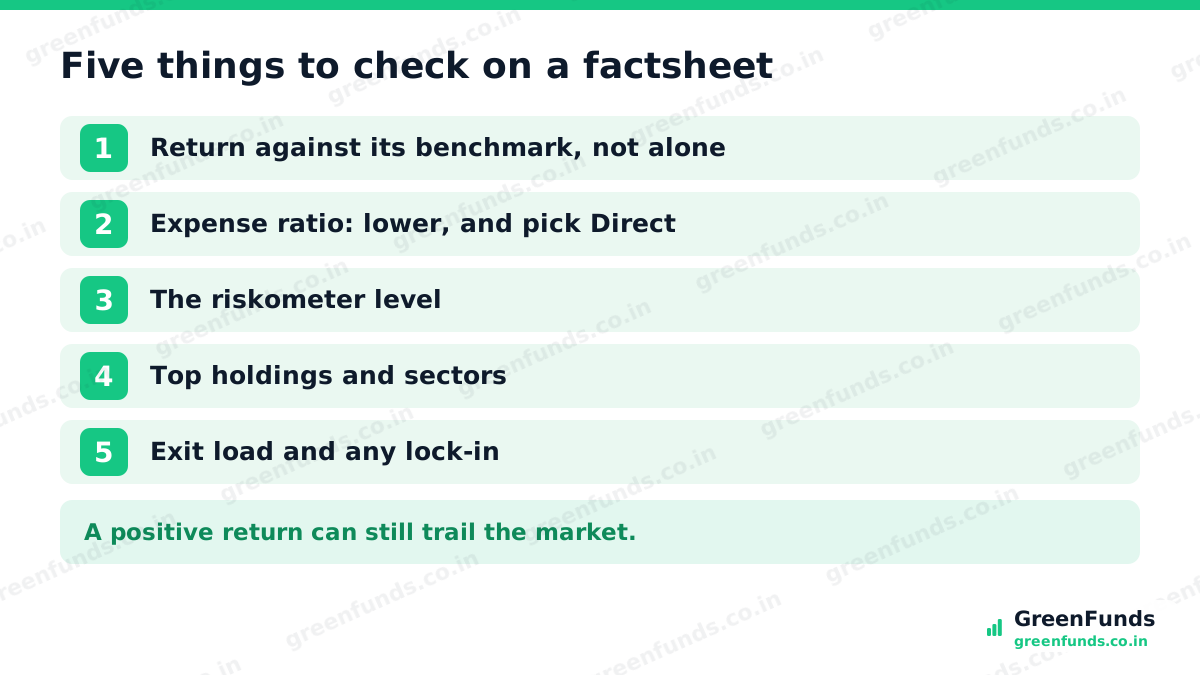
1. Return against its benchmark, not alone
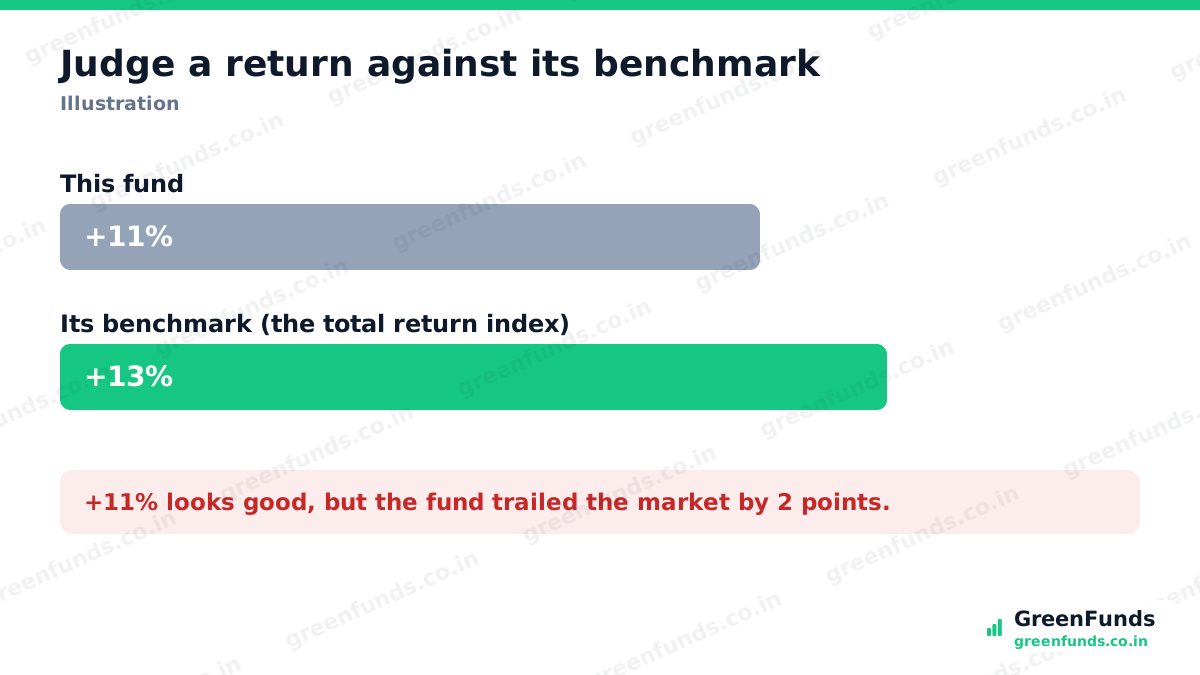
This is the one most people get wrong. A big return looks great until you see what the market did. Every fund has a benchmark, the index it is trying to beat, printed right next to its own returns. Compare the two.
Did you know? Since February 2018, Indian funds must be measured against the total return index (TRI), which counts dividends as well as price movement (AMFI rules). It raised the bar: a fund that once looked like it beat the market often did not, once dividends were counted fairly.
Look at returns over several periods (1, 3 and 5 years), not just the latest one, and always next to the benchmark.
2. The expense ratio
The expense ratio is the yearly fee, quietly deducted before returns are shown. Lower is better, and the Direct plan always costs less than the Regular plan of the same scheme. See direct versus regular.
Did you know? A fee of 1% a year sounds tiny, but over 30 years it can cost lakhs, because the fee compounds against you exactly as returns compound for you. On a factsheet, a small difference in the expense ratio is a big difference in your final corpus.
3. The riskometer
The riskometer is a dial with six levels from Low to Very High. It tells you, at a glance, how bumpy the ride is meant to be. Match it to your goal: Very High suits long-term money you will not touch for years, not your emergency fund.
4. Top holdings and sectors
The factsheet lists the fund’s biggest holdings and its sector mix. This shows what you actually own. If two funds you hold have the same top companies, you are less diversified than you think. Watch for heavy concentration in one stock or sector.
5. Exit load and lock-in
Check the exit load (a charge for leaving within a set period, often a year) and any lock-in (ELSS funds lock your money for three years). Know the cost and the timing of getting out before you put money in.
The numbers you can skip at first
Factsheets also show standard deviation, beta and the Sharpe ratio. These are genuine risk measures, but a beginner does not need them to make a sensible choice. Come back to them once the five basics are second nature. Do not let them stop you from starting.
Putting it together
A factsheet is not an exam. Read the return next to its benchmark, check the cost, glance at the riskometer and the holdings, and note the exit terms. Those five habits separate a fund that genuinely did well from one that just rode a good market. For the full selection framework, see how to pick a mutual fund.
New here? Start with the mutual funds guide or the money basics path.
Figures here are illustrations and returns are never guaranteed. A fund’s own factsheet and the current rules are the source of truth, so check them before investing.
Questions people ask
What is a mutual fund factsheet?
A one-page monthly summary every scheme publishes, free on the fund house's website. It lists the fund's returns, cost, risk level, top holdings and key terms, so you can judge it before investing.
What should I check first on a factsheet?
The return against the fund's own benchmark, not the return on its own. A fund up 11% while its benchmark rose 13% has actually underperformed, even though 11% looks good.
Why compare a fund's return to its benchmark?
Because a positive number alone tells you nothing about the manager. The benchmark is the market the fund is trying to beat, so beating it is what shows real skill. Funds are measured against the total return index, which counts dividends too.
Do I need to understand beta and the Sharpe ratio?
Not to start. They are useful risk measures, but a beginner can get most of the way with return versus benchmark, the expense ratio, the riskometer and the holdings. Learn the risk numbers later. This is general education, not financial advice.
Sources
- AMFI / SEBI, mutual fund disclosures Factsheet contents, benchmarking against the Total Return Index (since Feb 2018), and riskometer rules. Verify current rules here.