Investing vs trading: what is the difference?
Investing owns businesses for years; trading bets on short moves
Figures checked 2026-10-31
Investing and trading both involve buying shares, but they’re different games. Investing means owning a piece of businesses for years and letting their growth do the work. Trading means buying and selling often, sometimes within a day, to profit from short price moves.
Where the money comes from. An investor earns mainly because the companies earn more over time, and the share price follows. A trader earns only if they guess the next move right, and someone on the other side guesses wrong. Over short periods, prices are mostly noise, which is what makes that guessing so hard. Our lesson on how share prices move explains why.
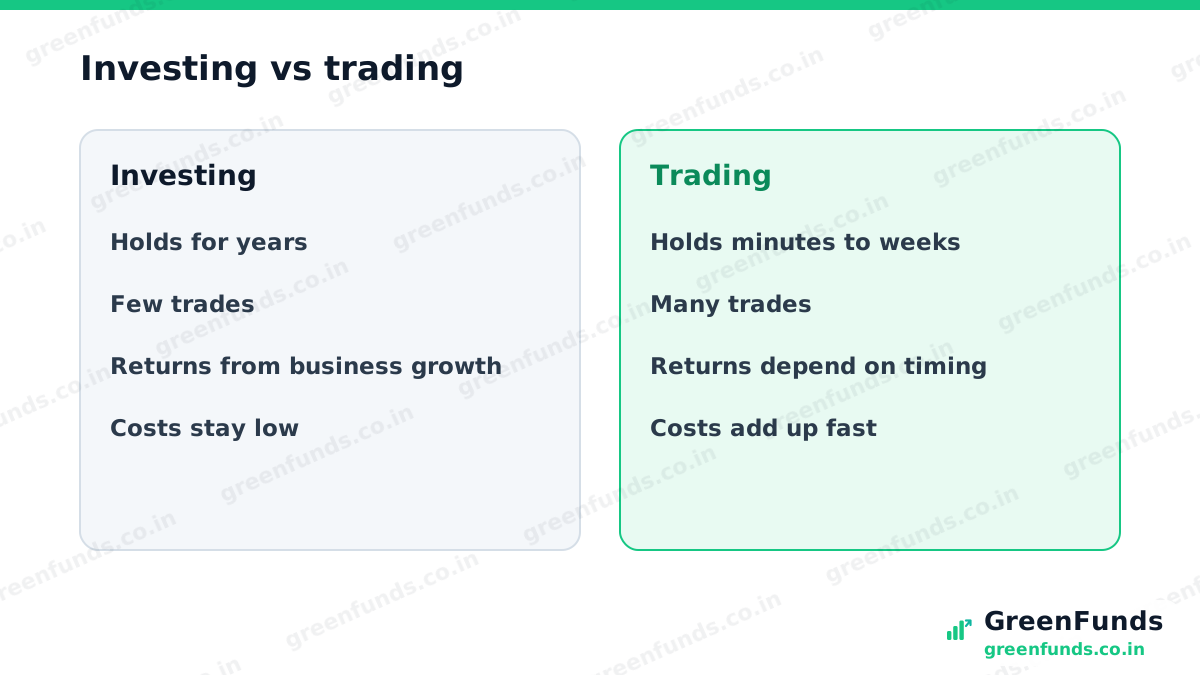
Costs add up with every trade. Each buy and sell carries charges: brokerage, taxes on the trade and exchange fees. An investor pays them a handful of times. An active trader pays them on every round trip, so even a small cost per trade can eat most of the gains. Our explainer on the cost of buying shares breaks them down.
The tax is different too. Selling shares you held as an investment is taxed as capital gains, with a lower rate once you’ve held them more than a year. Intraday trading, buying and selling on the same day without taking the shares into your account, is reported in your return as a speculative business, separately from capital gains. Check the current rules on incometax.gov.in, since tax rules change.
What the data says about traders. SEBI has studied this directly, for futures and options trading by individuals.
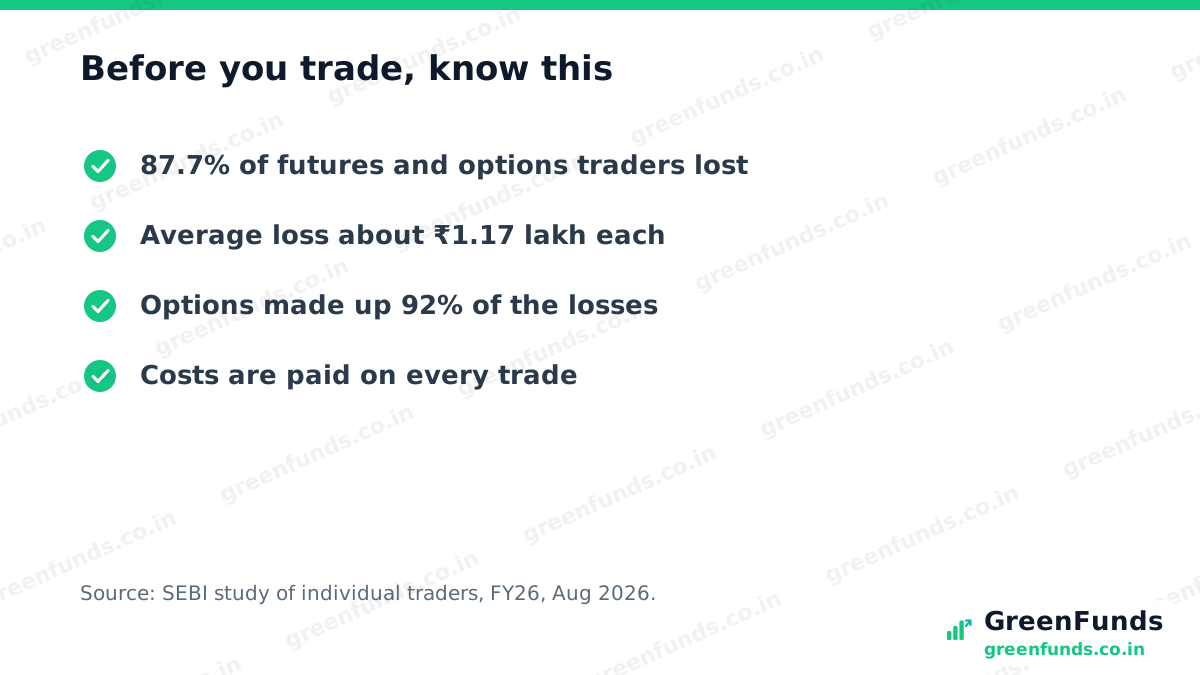
Did you know? SEBI’s August 2026 study found individual traders lost a combined 91,685 crore rupees in equity derivatives in FY26. The share of traders who lost money did fall, from 90.9% to 87.7%, but those who kept trading lost more on average, about 1.17 lakh rupees each. Our explainer on SEBI’s F&O loss study has more.
An illustration. Say two people each start with 1 lakh rupees. One puts it in an index fund and leaves it for ten years. The other trades it several times a week. The first pays a small yearly fee and very little else. The second pays charges on hundreds of trades and must keep guessing right. Whatever the market does, the trader starts each year behind on costs alone.
The takeaway. Investing and trading look alike on a screen, but they aren’t the same activity. Investing bets on businesses growing over years. Trading bets on short moves, at a high cost, and SEBI’s numbers show most individual traders in futures and options lose. Know which one you’re doing before you start.
More to read: what is a stock market index, fake trading apps and stock-tip groups, and how to buy your first share.
Questions people ask
What is the difference between investing and trading?
Investing means buying a share of businesses and holding for years, so returns come mainly from the companies growing their profits. Trading means buying and selling often, sometimes within a day, to profit from short price moves. The time frame, costs, tax treatment and odds of success are very different.
Do most traders make money?
SEBI's own studies say no, at least in futures and options. Its August 2026 study found 87.7% of individual traders in equity derivatives made a net loss in FY26, down from 90.9% in FY25, with an average loss of about 1.17 lakh rupees each.
How is intraday trading taxed?
Differently from investing. Gains from selling shares you held as an investment are taxed as capital gains. Income tax return forms treat intraday trading, where you buy and sell on the same day without taking delivery, as a speculative business, reported separately from capital gains. Check the current rules on incometax.gov.in.
Is investing risk-free if I hold for long?
No. Share prices can fall and stay down, and a single company can fail. Holding for longer gives time for short-term swings to even out, and spreading money across many companies, for example through an index fund, reduces the damage any one company can do.
Sources
- SEBI, Profitability of Individual Traders in the Equity Derivatives Segment (FY25 to FY26), August 2026 Share of loss-making individuals 87.7% in FY26, from 90.9% in FY25; aggregate net losses 91,685 crore rupees in FY26; average loss per person 1.17 lakh rupees; options made up 92% of individual losses.
- CBDT, e-filing ITR-3 validation rules for AY 2026-27 (rule 119) Net profit from speculative business in Schedule BP includes income from intraday trading (Trading account Sl. No. 12b). Tax rules change; check the current rules.