What is a stock market index? Nifty 50 and Sensex, simply
One number that tracks a basket of big companies
Figures checked 2026-10-31
A stock market index is one number that tracks how a chosen basket of companies is doing. When the news says “the market rose today”, it usually means an index went up. The two you’ll hear about most in India are the Nifty 50 and the Sensex.
Think of it as a thermometer. You can’t check thousands of shares every day. An index picks a basket, often the biggest and most traded companies, and turns their combined value into one figure. If that basket gains value overall, the index rises. If it loses value, it falls.
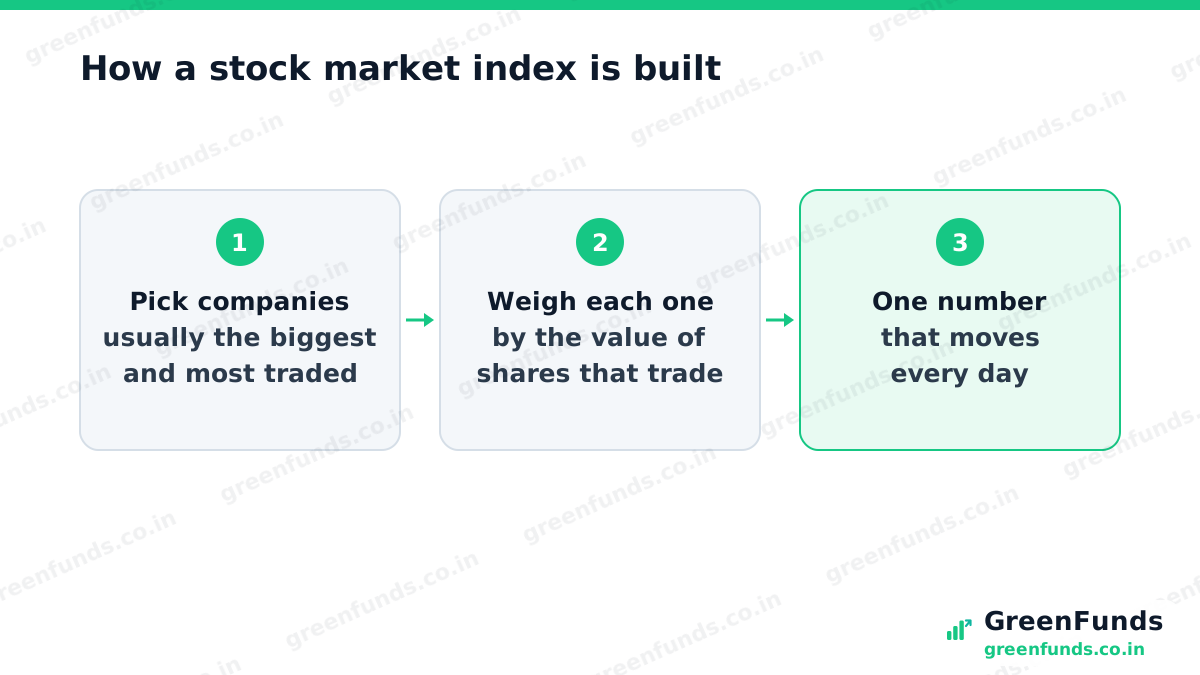
Bigger companies count for more. Both the Nifty 50 and the Sensex are weighted by free-float market value. That means each company counts by the value of its shares that are actually available to trade, leaving out the stakes held by promoters or the government that rarely change hands. So a 2% move in one of the largest companies shifts the index far more than a 2% move in the smallest one. It’s a version of market capitalisation, adjusted for what really trades.
The two big Indian indices.
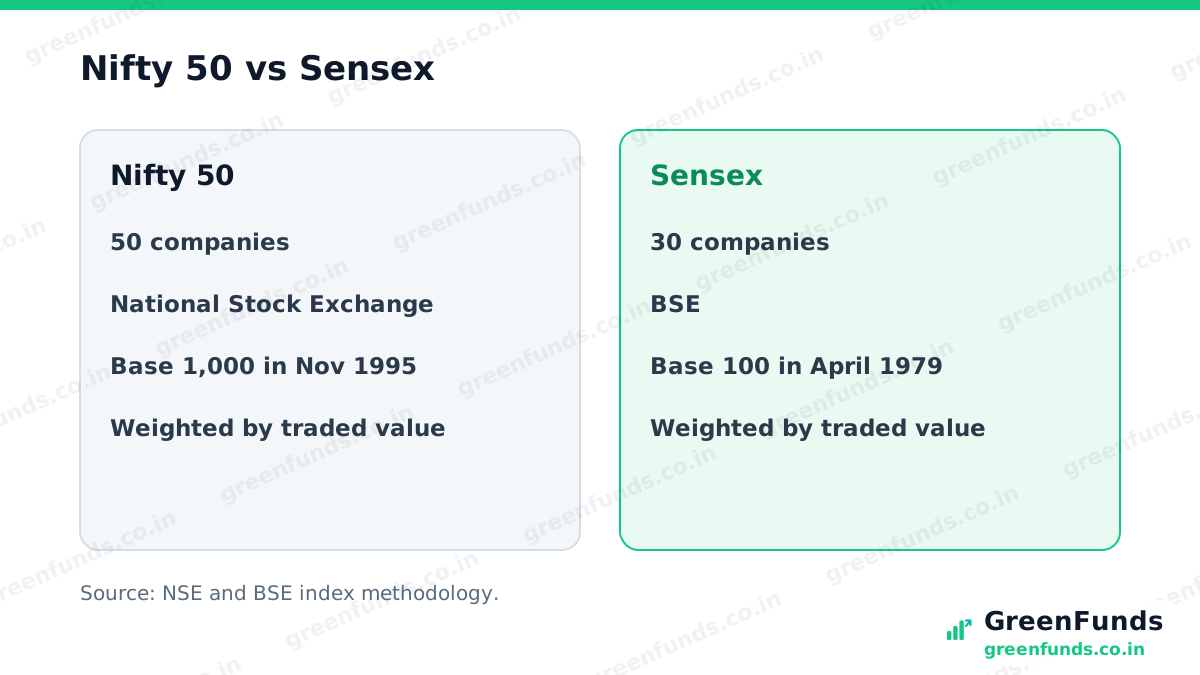
Because both hold many of the same large companies, they usually move in the same direction on the same day. The level itself, say 25,000 or 80,000, isn’t a price in rupees. It just shows how much the basket has grown since its starting base.
Did you know? The Nifty 50 started at a base of 1,000 on 3 November 1995, and the Sensex at a base of 100 on 3 April 1979, per NSE and BSE. Index makers also review the basket regularly; NSE reviews the Nifty 50 twice a year, so weak companies can drop out and rising ones join. Check the current methodology on the exchanges’ sites.
Why this matters to you. An index is the yardstick most funds are judged against, which is why you’ll see it on every factsheet. It’s also something you can own, indirectly. An index fund or ETF buys the same companies in the same proportions, so it rises and falls with the index, minus a small fee.
The takeaway. An index is a thermometer for a basket of shares, not a price tag. The Nifty 50 tracks 50 companies, the Sensex tracks 30, and both give bigger, more traded companies more weight.
More to read: what is the stock market, large, mid and small cap, explained, and how share prices move.
Questions people ask
What is a stock market index?
A stock market index is a single number that tracks the combined performance of a chosen basket of shares. If the companies in the basket gain value overall, the index rises; if they lose value, it falls. It's a quick way to see how a slice of the market is doing without checking every share.
What is the difference between the Nifty 50 and the Sensex?
Both track large Indian companies, but on different exchanges and with different baskets. The Nifty 50 tracks 50 companies on the National Stock Exchange and started at a base of 1,000 in November 1995. The Sensex tracks 30 companies on BSE and uses a base of 100 set on 3 April 1979. They usually move in the same direction because they hold many of the same big names.
What does free-float weighting mean?
It means each company counts in the index by the value of its shares that are actually available to trade, not all its shares. Shares held by promoters or the government, which rarely change hands, are left out. Bigger companies with more tradable shares move the index more.
Can I invest in the Nifty 50 or Sensex directly?
Not in the index itself, since it's just a number. But index funds and ETFs buy the same companies in the same proportions, so they rise and fall with the index, minus a small cost.
Sources
- NSE Indices, Nifty 50 methodology and NSE index FAQs Nifty 50 factsheet: 50 constituents, free-float market capitalisation method, base value 1,000 as of 3 November 1995, rebalanced semi-annually. Check the current methodology.
- BSE, Sensex index page and BSE derivatives introduction 30 companies, base date 3 April 1979 with a base value of 100, launched 2 January 1986; free-float market capitalisation method since 1 September 2003 (bseindia.com/markets/Derivatives/DeriReports/introduction.aspx). Check the current methodology.