How to buy your first share: accounts, orders and settlement
Two accounts, one KYC, one order, and the shares land the next working day
Figures checked 2026-10-31
To buy a share in India, you need two accounts and one check. A demat account holds your shares, a trading account places your orders, and KYC proves who you are. Once those are set up, buying is a few taps: place an order, and the trade settles the next working day.
The four steps.
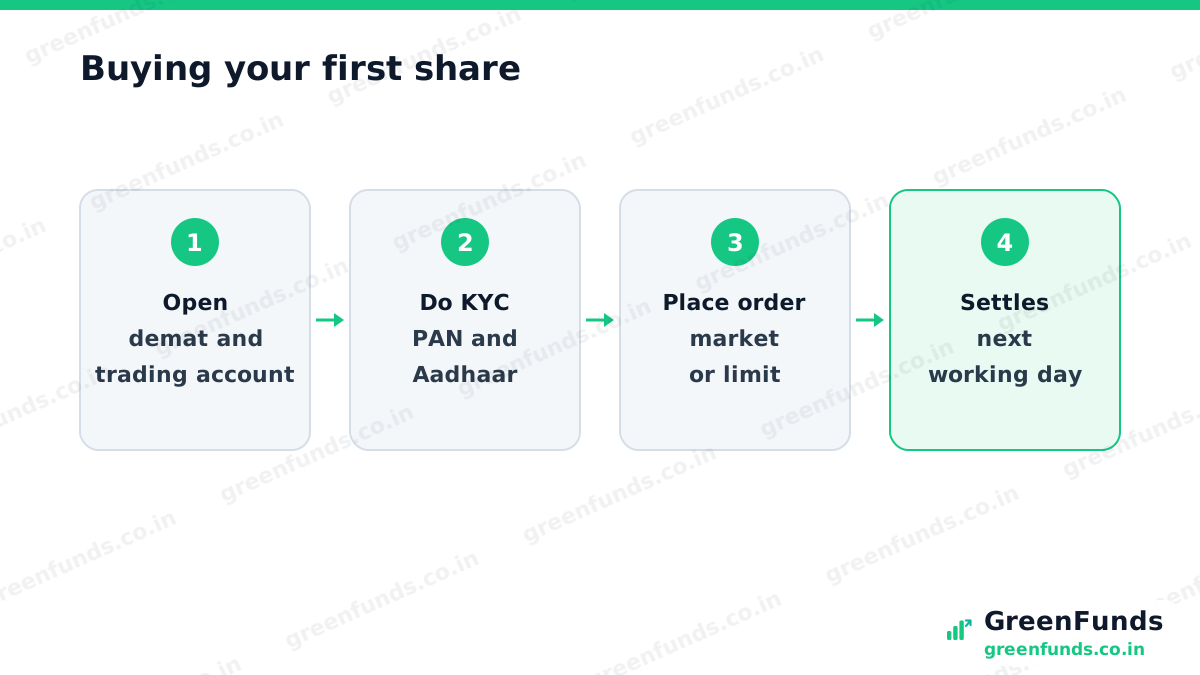
1. Open demat and trading accounts. A demat account holds your shares in electronic form, like a bank account for shares. A trading account is what you use to buy and sell. Most brokers open both together and link them to your bank account. Before you sign up, check the broker is registered with SEBI: fake trading apps are a real problem, as our explainer on fake trading apps shows.
2. Complete KYC. You’ll verify your identity with your PAN and Aadhaar, usually online. This KYC is a one-time step that the law requires before you can trade.
3. Place an order. You pick the share, the quantity and the order type. There are two you’ll use most.
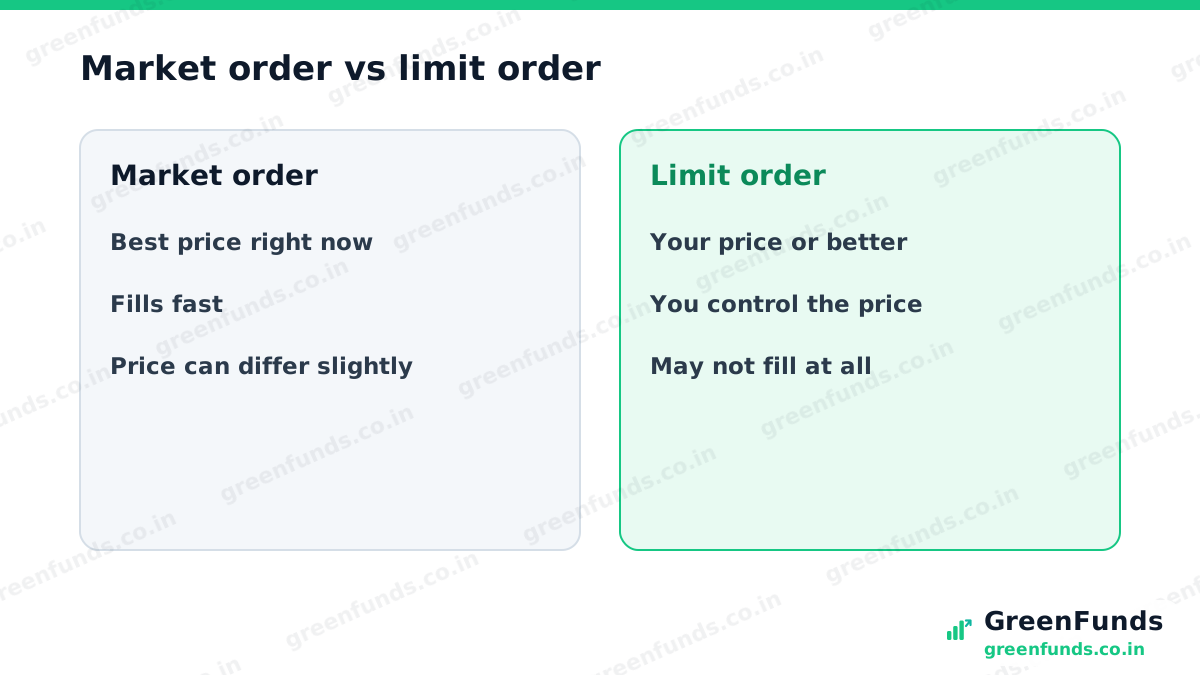
A market order is quick but you accept whatever the price is at that moment. A limit order gives you control over the price, at the risk of not buying at all. For a first purchase, many people find a limit order calmer, because you know exactly what you’ll pay. Our lesson on how share prices move explains the order book behind both.
4. Settlement and the paperwork. India settles share trades on T+1: one working day after the trade, the money and shares change hands and the shares are credited to your demat account. Your broker also sends a contract note, the official record of the trade with the price and every charge.
Did you know? India moved every share to T+1 settlement from 27 January 2023, per NSE and BSE, and SEBI has since allowed an optional same-day cycle for some of the largest listed shares, phased in from 2024. And SEBI requires your broker to send the contract note within 24 hours of the trade. Check it each time: it’s where you’ll spot a wrong price or an unexpected charge. Rules change, so check the current ones.
An illustration. Say you place a limit order for 5 shares at 400 rupees. If the price touches 400 or lower during the day, the order fills for about 2,000 rupees, plus small charges shown on the contract note. The next working day, the 5 shares appear in your demat account. If the price never comes down to 400, nothing happens and your money stays put.
The takeaway. Open a demat and trading account with a SEBI-registered broker, finish KYC, and choose between a market and a limit order. Trades settle the next working day, and the contract note is your receipt. Check it every time.
More to read: investing vs trading, the cost of buying shares, and what is a stock market index.
Questions people ask
What do I need to buy shares in India?
A demat account to hold the shares, a trading account to place buy and sell orders, a bank account linked to them, and completed KYC with your PAN and Aadhaar. Most brokers open the demat and trading accounts together.
What is the difference between a market order and a limit order?
A market order buys at the best price available right now, so it fills quickly but the exact price can differ slightly from what you saw. A limit order buys only at your chosen price or better, so you control the price but it may not fill if the share never reaches it.
When do the shares reach my demat account?
Indian shares settle on T+1, meaning one working day after the trade day. India moved all shares to T+1 settlement from 27 January 2023. After settlement, the shares are credited to your demat account.
What is a contract note?
A contract note is the official record of your trade from your broker, showing the share, quantity, price, time and every charge. SEBI rules require brokers to issue it within 24 hours of the trade. Check it against your order each time.
Sources
- BSE notice 20221226-37, list of scrips for T+1 settlement All remaining securities, including those with derivatives contracts, moved to T+1 rolling settlement from 27 January 2023. SEBI has since allowed an optional T+0 cycle, beta for 25 scrips from March 2024, extended in phases toward the top 500 shares by market value (SEBI circular of 10 December 2024). Check current rules.
- SEBI, FAQs on the secondary market Contract notes must be issued within 24 hours of trade execution. Check the current SEBI rules.