The real cost of buying shares: brokerage, STT and other charges
Every share trade carries several small charges on top of the price
When you buy or sell a share, you pay more than the share price. A handful of small charges are added to every trade: some go to your broker, some to the exchange and SEBI, and some to the government as tax. Each one looks tiny. Together, and over many trades, they add up.
The charges, one by one.
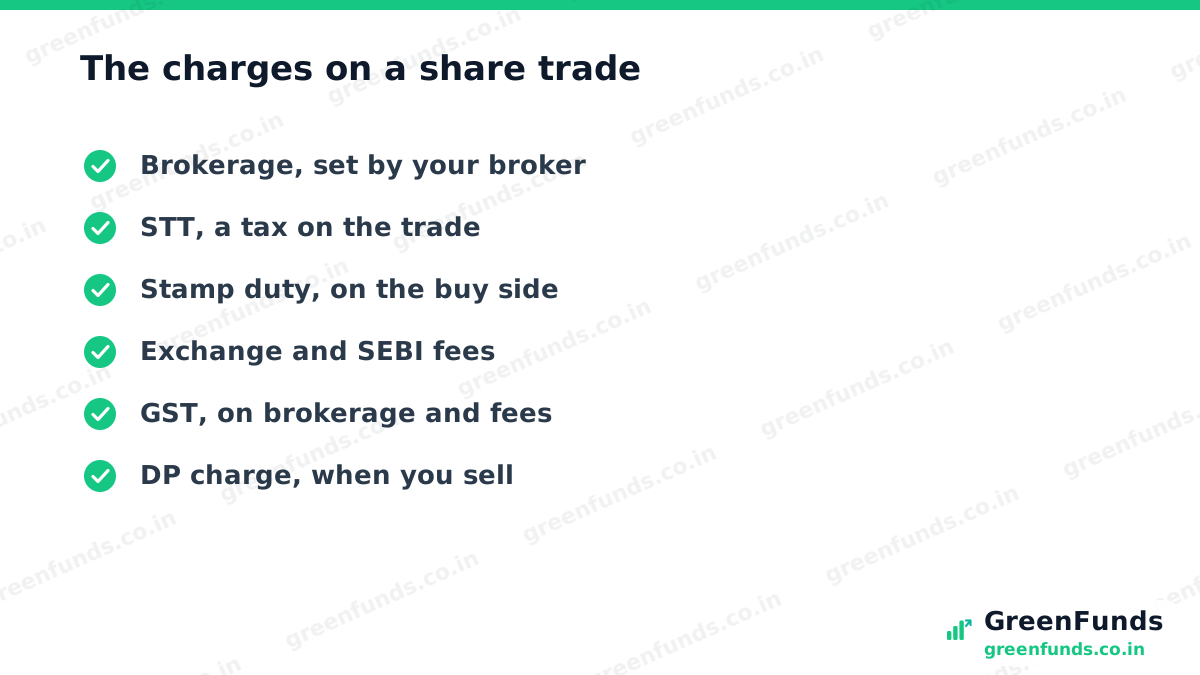
- Brokerage. What your broker charges per trade. Each broker sets its own: some charge a flat fee, some a percentage, and some charge nothing on delivery trades.
- STT, the securities transaction tax. A tax on the trade. For shares bought and held, it’s 0.1% on the buy and 0.1% on the sell, per NSE. For intraday trades, it’s 0.025% on the sell side only. Budget 2026 raised it on futures and options but left these rates unchanged.
- Stamp duty. Paid by the buyer: 0.015% on delivery purchases and 0.003% on intraday, per NSE.
- Exchange and SEBI fees. The exchange charges a small transaction fee, and SEBI a turnover fee. Both are tiny fractions of a percent.
- GST. 18% GST applies on brokerage and on the exchange and SEBI fees, per NSE, not on the share value.
- DP charges. When you sell shares from your demat account, your depository participant charges a fee per sale. It’s a flat amount per company sold, not a percentage.
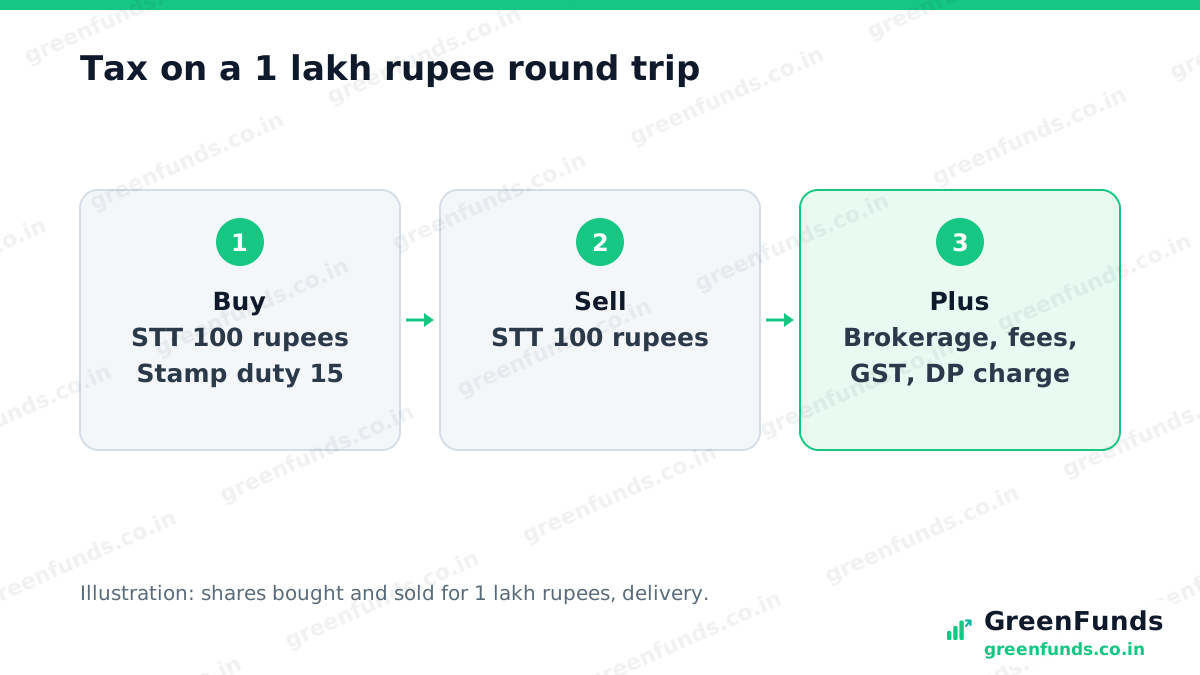
An illustration. Say you buy shares worth 1 lakh rupees and later sell them for 1 lakh rupees (made-up numbers, to keep it simple). STT is 100 rupees on the buy and 100 on the sell. Stamp duty is 15 rupees on the buy. Add brokerage, small exchange fees, GST and a DP charge on the sale. Even with zero brokerage, the round trip costs a few hundred rupees.
Did you know? The depository charges your DP a flat 3.50 rupees per sale under CDSL’s tariff since October 2024, but your DP sets what it charges you, and must publish that tariff. And SEBI’s August 2026 study found individual F&O traders paid about 25,000 crore rupees in transaction costs in a single year.
Why it matters. For someone who buys and holds for years, these costs are a small one-time hit. For someone who trades often, they’re charged every time and quietly eat returns. That’s one reason frequent F&O trading is so costly.
Where to check. Your broker sends a contract note after every day you trade. It lists each charge line by line. Your broker’s website also publishes its tariff, so compare before you open an account.
The takeaway. A share trade costs the price plus brokerage, STT, stamp duty, exchange and SEBI fees, GST and, on a sale, DP charges. Check your contract note, and remember that trading more often means paying them more often.
More to read: what a demat account is, IPOs explained, and splits, bonuses and buybacks.
Questions people ask
What charges do I pay when I buy shares?
Brokerage (set by your broker), securities transaction tax, stamp duty, exchange transaction charges, a small SEBI turnover fee, and GST on the brokerage and fees. When you sell from your demat account, a DP charge is usually added too.
What is the STT on buying shares for delivery?
0.1% of the trade value, paid on both the buy and the sell side, per NSE. The Finance Act 2026 left this rate unchanged. Check the current rate on nseindia.com.
What are DP charges?
A fee for moving shares out of your demat account when you sell. The depository charges your depository participant a fee per sale, and your DP passes on its own charge to you, as set in its published tariff.
Where can I see exactly what I paid?
On your contract note, which your broker sends after every trading day you trade. It lists the brokerage and every tax and fee line by line.
Source: NSE, SEBI turnover fees, STT and other levies, and stamp duty pages (nseindia.com); BSE Master Circular (Finance), April 2025 (STT table: delivery 0.1%, intraday sale 0.025%); Finance Act, 2026 (Gazette of India, 30 March 2026, section 159: STT changed only on futures and options); CDSL DP tariff structure, October 2024 (3.50 rupees per debit to DPs); SEBI depository FAQ. Check your broker's current tariff and contract note.
Found this useful? You can buy us a coffee. It keeps GreenFunds free.Flag a possible issue
Was this helpful?
Thanks for the signal.
Comments
Share your experience or a question. Be kind, stay on topic. This is reader discussion, not financial advice.
No comments yet. Be the first to share.