How share prices move: buyers, sellers and the order book
A share's price is simply the last price a buyer and seller agreed
Figures checked 2026-10-31
A share’s price is simply the last price at which a buyer and a seller agreed to trade. Nobody sets it from above. If more people want to buy than sell at today’s price, buyers offer more and the price climbs. If sellers are keener, they accept less and it falls.
The order book. On the exchange, every share has a live list of offers. Buyers post the most they’ll pay, called bids. Sellers post the least they’ll accept, called asks. When a bid and an ask meet, a trade happens, and that becomes the new price.
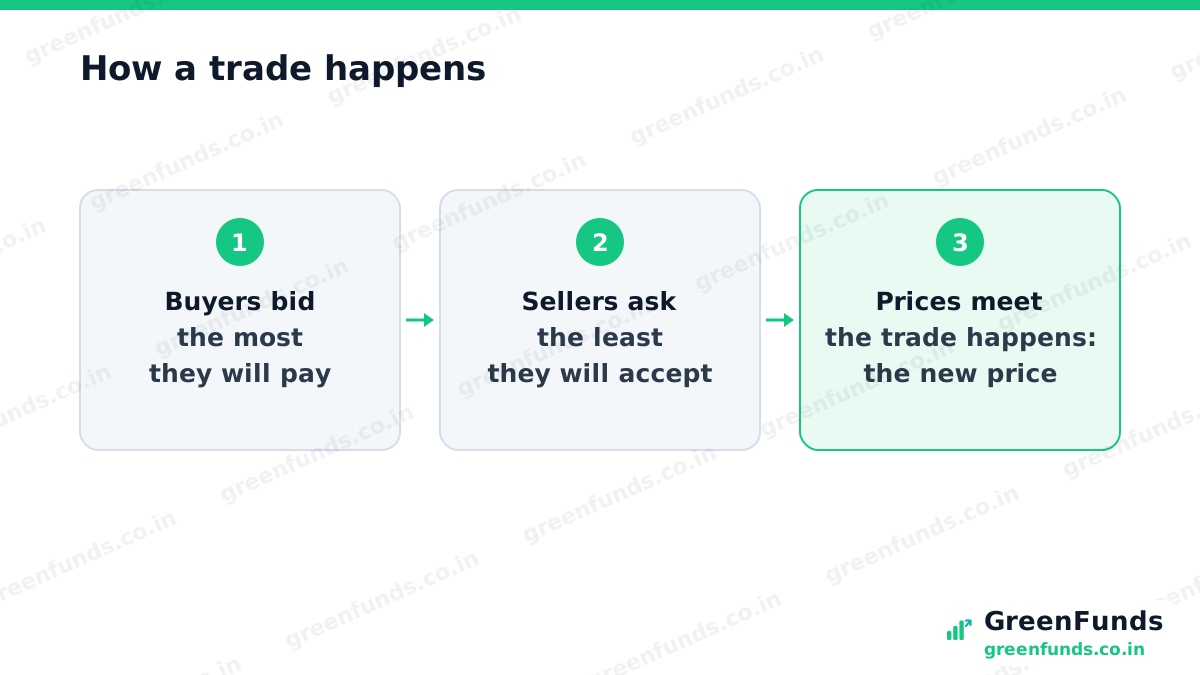
You join this queue when you place an order. A limit order waits at your chosen price. A market order takes the best price available right now.
What shifts buyers and sellers. Many things change how much people are willing to pay.
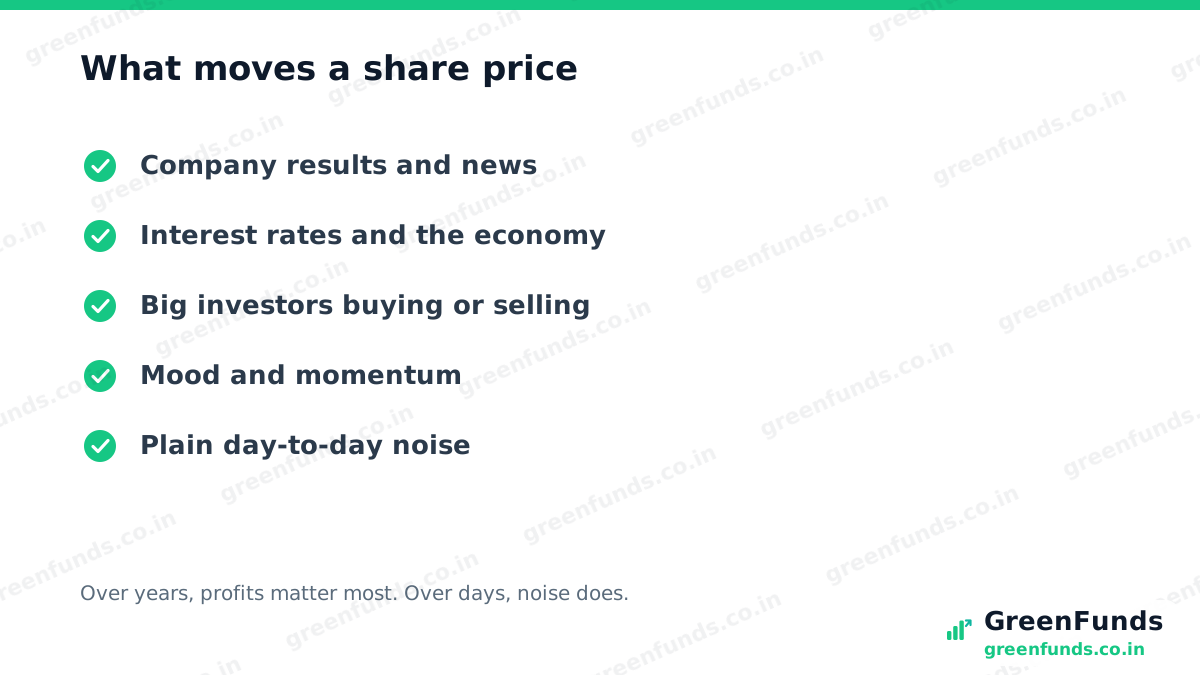
Over years, prices tend to follow how much the company actually earns. Over a day or a week, a lot of the movement is mood and noise. That’s why judging a share by one day’s move, up or down, tells you very little. It’s also why risk and return go together: the shorter your time frame, the bigger the swings feel.
Brakes for wild days. Markets have two kinds of brakes. Exchanges set a daily price band, or circuit limit, on many individual shares, so a share can’t move more than a set percentage in one day. And if the whole market moves sharply, a market-wide circuit breaker pauses trading so people can catch their breath.
Did you know? SEBI’s market-wide circuit breakers kick in when the Sensex or the Nifty 50 moves 10%, 15% or 20% in a single day, whichever index crosses the line first. At 20%, trading stops for the rest of the day. Halt timings have been updated over the years, so check the exchanges’ current rules.
An illustration. Say a share last traded at 200 rupees. A company announces results far better than expected. Buyers rush in, and sellers who were happy at 200 now want 210 or 215. Within minutes, trades happen at 212, and that’s the new price. Nothing about the company changed in those minutes except what people expect from it.
The takeaway. A price is just where buyers and sellers last agreed. It moves with news, money flows and mood, and in the short run much of that is noise. Circuit limits slow the wildest days, but they don’t stop prices falling.
More to read: what is a stock market index, P/E ratio and valuation basics, and investing vs trading.
Questions people ask
Who decides the price of a share?
Nobody sets it. The price is simply the last price at which a buyer and a seller agreed to trade on the exchange. If more people want to buy than sell at the current price, buyers bid higher and the price rises. If sellers are keener, they accept less and it falls.
Why do share prices go up and down every day?
Because buyers and sellers keep changing their minds. Company results, news, interest rates, big investors moving money, and plain mood all shift how much people are willing to pay. Over a day or a week, much of this movement is noise rather than a real change in the company's value.
What is a circuit limit?
A circuit limit is a brake. Exchanges set a daily price band on many shares, so a share can't move beyond a set percentage in a day. There is also a market-wide circuit breaker that pauses all trading if the Sensex or Nifty 50 moves 10%, 15% or 20% in a day.
Does a falling share price mean the company is in trouble?
Not necessarily. Prices fall for many reasons, including market-wide selling that has nothing to do with the company. A price shows what buyers and sellers agreed today, not a final verdict on the business.
Sources
- SEBI circular SMDRPD/Policy/Cir-37/2001, index-based market-wide circuit breakers Market-wide circuit breakers trigger on a 10%, 15% or 20% move in the Sensex or Nifty 50, whichever is breached first. Halt durations have been revised since; check the exchanges' current rules.
- NSE, equity market circuit breakers and price bands Price bands for individual shares are set by the exchanges and can change. Check the current band for any share on the exchange site.