Investing abroad from India: the basics, limits and currency risk
Owning companies outside India, and the rupee in between
Figures checked 2026-11-03
Investing abroad means owning shares, or funds holding shares, of companies outside India. The point isn’t that foreign markets are better. It’s that your savings stop depending on just one economy and one currency.
Two ways in. You can stay in rupees and let an Indian fund house do it, or send money abroad and buy shares yourself through a foreign broker.
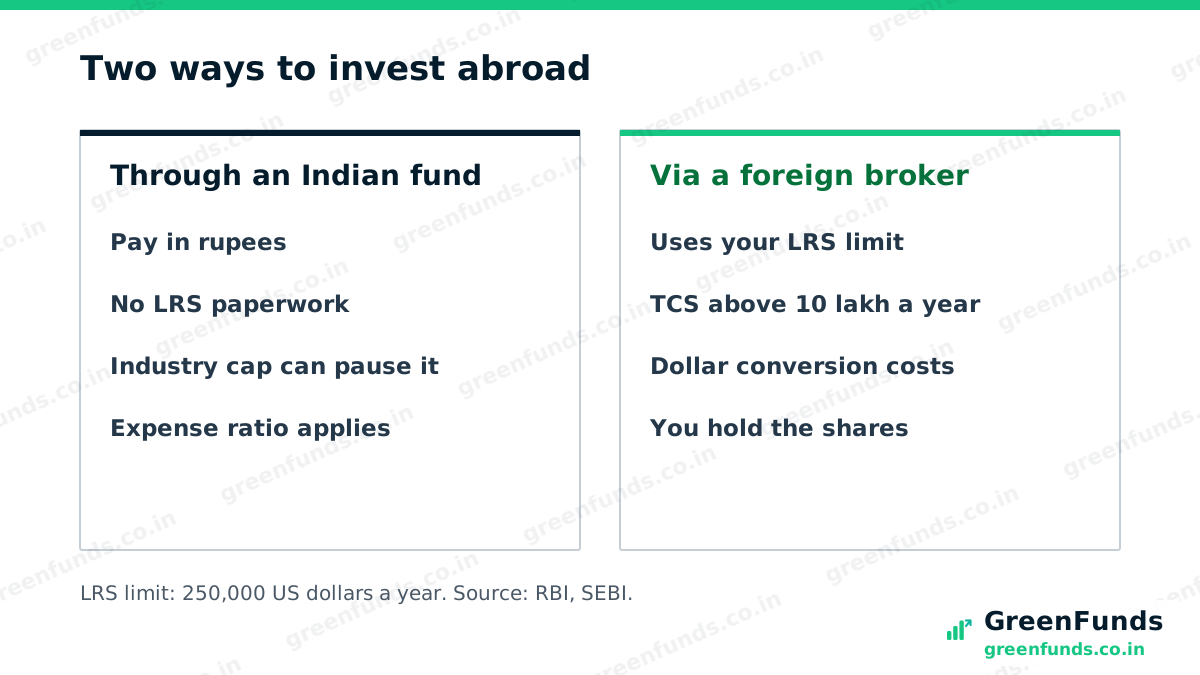
Route one: an Indian fund. Fund houses offer international funds, often a fund of funds that invests in a foreign fund, and some ETFs listed in India track foreign indices. You invest in rupees, SIPs work as usual, and you pay the fund’s expense ratio.
The catch is a cap. SEBI limits how much the whole Indian fund industry can invest overseas to 7 billion US dollars, with up to 1 billion per fund house. When a fund house nears its share, it can pause fresh money and SIPs in its international funds until room frees up.
Route two: a foreign broker. You send money abroad under the RBI’s Liberalised Remittance Scheme, which allows up to 250,000 US dollars per financial year for all purposes combined, including travel and education. Once your remittances in a year cross 10 lakh rupees, your bank collects TCS on the excess.
An illustration, computed: send 15 lakh rupees in a year to invest, and TCS at 20% applies to the 5 lakh above the threshold, so the bank collects 1 lakh rupees. That isn’t lost; it’s tax paid in advance that you claim in your return. Our guide to investing in US stocks covers the steps and the reporting.
Did you know? From 1 April 2026, the Finance Act, 2026 cut TCS on remittances for education or medical treatment to 2%, from 5%. Investing abroad still attracts 20% above the 10 lakh rupee threshold.
The rupee is part of your return. Your foreign holding is priced in dollars, so the exchange rate adds to or subtracts from what you earn in rupees.
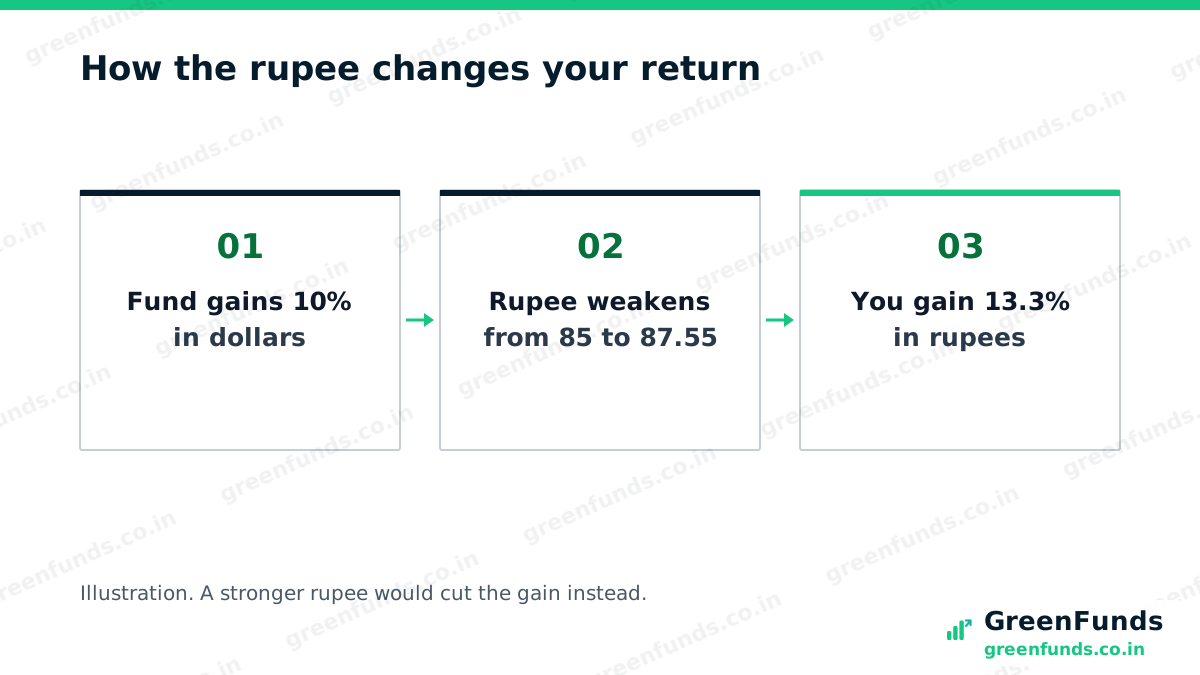
An illustration, computed: if your fund gains 10% in dollars and the rupee weakens from 85 to 87.55 per dollar, your gain in rupees is about 13.3%. If the rupee instead strengthens to 82.45, it’s about 6.7%. Currency can help or hurt, and nobody can reliably predict which.
How gains are taxed. The tax law’s equity test counts only shares of Indian companies, so international funds and foreign shares aren’t taxed like Indian equity funds. Held over 24 months, gains are taxed at 12.5%; sold sooner, at your slab rate.
The takeaway. Investing abroad spreads your money beyond one economy. Indian funds are simple but can pause under SEBI’s cap; a foreign broker uses your LRS limit and attracts TCS above 10 lakh. Either way, the rupee becomes part of your return.
More to read: asset allocation, risk and return, and card charges when you spend abroad.
Questions people ask
How can I invest abroad from India?
Two common routes. You can buy an international fund or a fund of funds from an Indian fund house in rupees, or an ETF listed in India that tracks a foreign index. Or you can send money to a foreign broker under the RBI's Liberalised Remittance Scheme and buy shares directly.
How much money can I send abroad to invest?
Under the Liberalised Remittance Scheme, a resident individual can send up to 250,000 US dollars per financial year, April to March. That one limit covers all permitted purposes together, including travel, gifts and education, not just investing. You need to give your PAN.
Is TCS charged when I send money abroad to invest?
Yes, once your remittances in a financial year cross 10 lakh rupees. Your bank collects 20% of the amount above 10 lakh for investing and other purposes; education and medical treatment carry 2% from 1 April 2026. TCS is tax paid in advance, which you claim in your return.
Why have some international mutual funds stopped taking new money?
SEBI caps how much the whole Indian fund industry can invest overseas, at 7 billion US dollars, with up to 1 billion per fund house. When a fund house nears its share, it can pause fresh investments and SIPs in its international funds until room frees up.
Flag a possible issue
Sources
- RBI, Liberalised Remittance Scheme FAQs (updated 6 April 2023) Resident individuals, including minors, can remit up to 250,000 US dollars per financial year for permitted current and capital account purposes; PAN is mandatory.
- Income-tax Act, 2025, section 394 (Gazette of India), and Finance Act, 2026, section 85 TCS on LRS remittances above 10 lakh rupees in a year: 20% for purposes other than education or medical treatment; 2% for education or medical treatment from 1 April 2026 (cut from 5% by the Finance Act, 2026). Act text: egazette.gov.in/WriteReadData/2025/265620.pdf.
- SEBI-filed scheme information document citing the Master Circular for Mutual Funds Overseas investment by mutual funds: aggregate industry ceiling of 7 billion US dollars, maximum 1 billion US dollars per mutual fund; overseas ETFs within a separate 1 billion dollar industry limit.
- Income-tax Act, 2025, definitions of short-term capital asset and equity oriented fund Equity oriented fund means more than 65% in equity shares of domestic companies; other units and unlisted shares are long-term after 24 months, with long-term gains taxed at 12.5%.