Hybrid funds explained: shares and bonds in one fund
One fund that mixes shares and bonds for you
Figures checked 2026-11-03
A hybrid fund holds more than one kind of asset in a single fund, most often shares and bonds. Instead of picking a share fund and a debt fund separately, you get a ready-made blend. How much of each it holds decides how much it swings, and also how it’s taxed.
Why mix at all. Shares can grow a lot but fall hard. Bonds grow slowly but steadily. Put them together and the bonds cushion the falls. That’s the same idea behind asset allocation, packaged into one fund.
An illustration, computed: put 1 lakh rupees into a fund with 70% in shares and 30% in bonds. If shares fall 20% in a year and bonds earn 7%, the fund ends at about 88,100 rupees, down 11.9%, not 20%. If shares rise 15% instead, it ends at about 1,12,600 rupees, up 12.6%. You give up some of the upside to soften the downside.
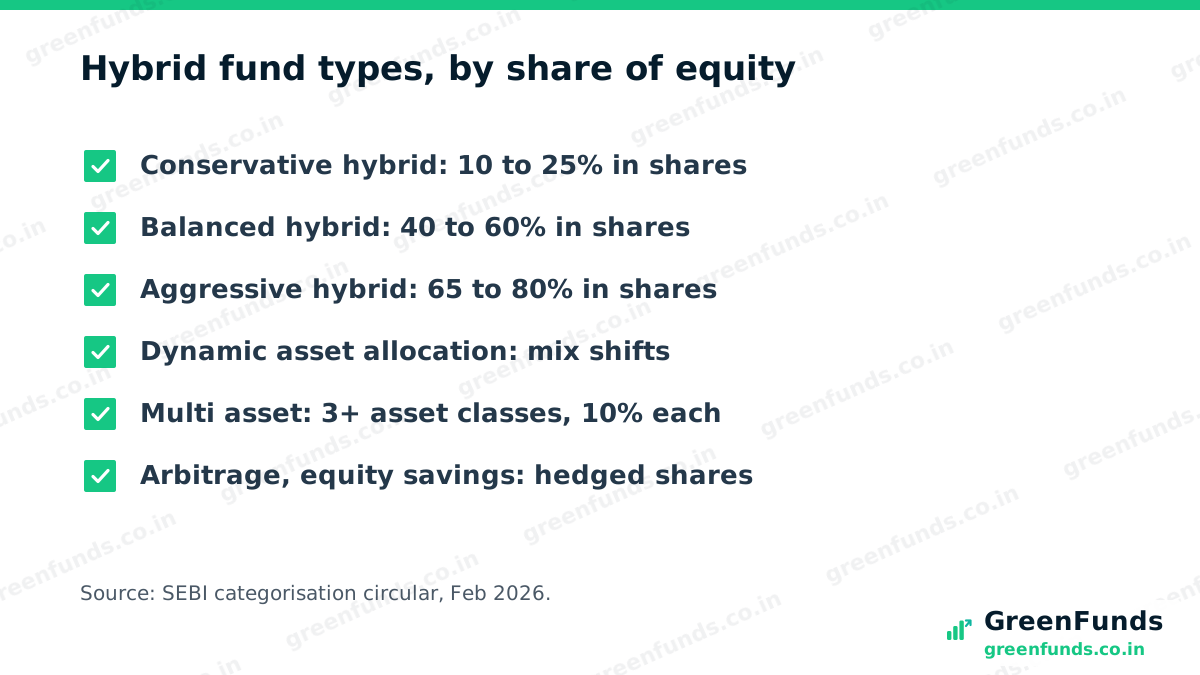
SEBI’s hybrid categories. Each hybrid fund must sit in one of these, with set limits on the mix.
A dynamic asset allocation fund moves money between shares and bonds based on its own model, with no fixed split. Many such funds were marketed as balanced advantage funds. Under SEBI’s 2026 rules, a scheme’s name must now match its category.
Arbitrage funds, the odd one out. An arbitrage fund buys a share in the cash market and sells it at the same moment in the futures market, earning the small gap between the two prices. Each position is hedged, so it behaves more like a short-term debt fund than like the stock market, even though it holds at least 65% in shares.
Did you know? SEBI’s February 2026 rules list seven hybrid categories and scrapped the old “solution oriented” category, the children’s and retirement funds, stopping new money into them. Multi asset funds must hold at least three asset classes, at least 10% in each.
Why the equity share decides your tax. The Income-tax Act, 2025 sorts funds by what they hold, not by their name.
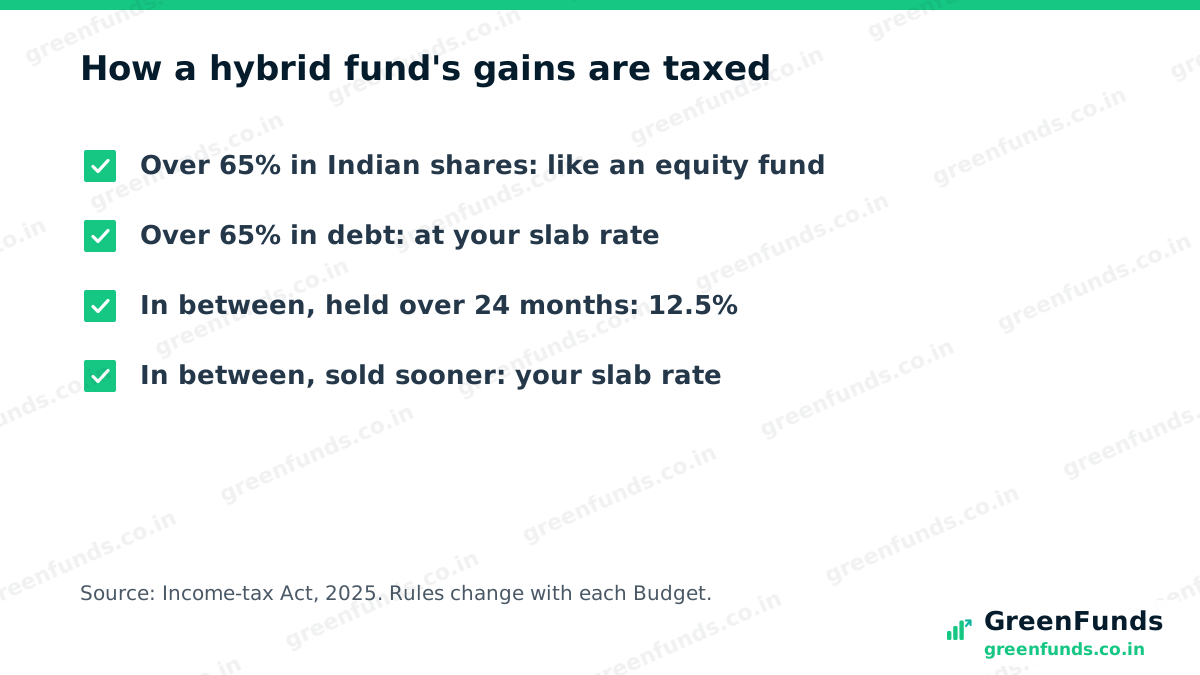
Taxed like an equity fund means gains on units held over 12 months are taxed at 12.5% above 1.25 lakh rupees a year, and at 20% if sold sooner. That’s why aggressive hybrid, arbitrage and equity savings funds usually keep their equity above 65%. A conservative hybrid, mostly bonds, is taxed much like a debt fund. Our mutual fund taxation lesson covers the detail.
The takeaway. A hybrid fund is a blend of shares and bonds in one place. The category tells you the mix, the mix tells you the risk, and the share of Indian equity decides the tax.
More to read: types of mutual funds, risk and return, and what a fund of funds is.
Questions people ask
What is a hybrid fund?
A hybrid fund is a mutual fund that invests in more than one kind of asset, usually shares and bonds, and in some categories gold or other assets too. The fund manager keeps the mix within limits SEBI sets for each category, so you get a ready-made blend in one fund.
What are the types of hybrid funds?
SEBI's February 2026 rules list seven: conservative hybrid (10 to 25% in shares), balanced hybrid (40 to 60%), aggressive hybrid (65 to 80%), dynamic asset allocation, multi asset allocation (at least three asset classes, 10% each), arbitrage, and equity savings.
Is an arbitrage fund risky?
Less than a share fund. It buys a share in one market and sells it at the same time in the futures market, earning the small gap between the two prices. Because each position is hedged, the return behaves more like a short-term debt fund than like the stock market.
How are hybrid funds taxed?
It depends on the mix. A fund with more than 65% in Indian shares is taxed like an equity fund. One with more than 65% in debt is taxed at your slab rate. Funds in between become long-term after 24 months, with gains taxed at 12.5%.
Flag a possible issue
Sources
- SEBI circular on Categorization and Rationalization of Mutual Fund Schemes, 26 February 2026 Hybrid categories and limits: conservative hybrid 10 to 25% equity; balanced hybrid 40 to 60% equity with no arbitrage; aggressive hybrid 65 to 80% equity; dynamic asset allocation; multi asset allocation with at least 10% in each of three asset classes; arbitrage at least 65% equity; equity savings at least 65% equity with 15 to 40% net equity and at least 10% debt. Scheme names must match the category.
- Income-tax Act, 2025 (Gazette of India), equity oriented fund, Specified Mutual Fund, holding periods and rates Equity oriented fund: more than 65% in equity shares of domestic companies; short-term gains at 20%, long-term gains above 1,25,000 rupees at 12.5% after 12 months. Funds with more than 65% in debt: units bought from 1 April 2023 taxed as short-term gains. Other units: long-term after 24 months, taxed at 12.5%.