Bonds and government securities, explained simply
A loan you give, paid back with interest
Figures checked 2026-11-03
A bond is a loan you give. The borrower, a government, a bank or a company, pays you interest at set times and returns your money on a fixed date. Fixed deposits work in a similar way, but a bond can be sold to someone else before it matures, and its price can change.
Three words to know. The face value is what you get back at the end, often 100 or 1,000 rupees. The coupon is the interest rate the bond pays on that face value. The yield is what you actually earn based on the price you pay, which can differ from the coupon.
The seesaw: rates up, prices down. Say a 10-year bond pays a 7% coupon on 1,000 rupees, and market rates are 7%. Its price is 1,000 rupees. Now rates rise to 8%. New bonds pay 80 rupees a year; yours pays 70. To compete, its price has to drop.
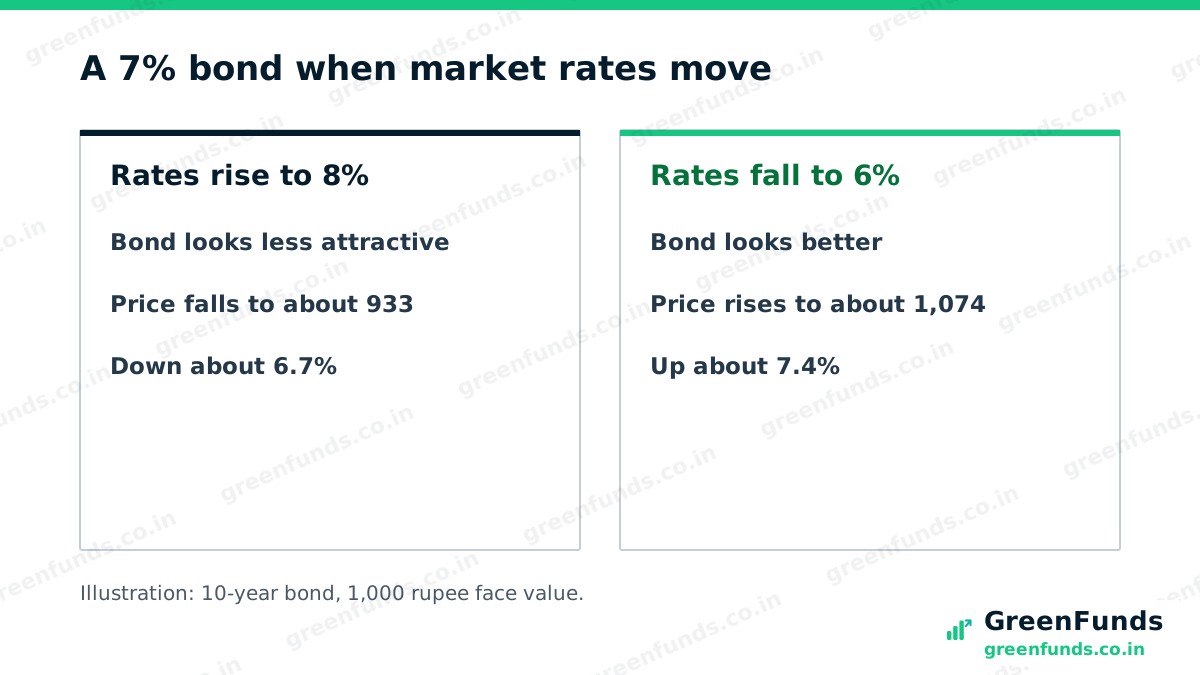
An illustration, computed: at 8%, that bond is worth about 933 rupees, and at 6%, about 1,074. Buy it at 933 and your coupon of 70 rupees is a 7.5% current yield. Hold it to maturity and you get 1,000 back either way. The yield to maturity rolls the coupons and that final gain into one yearly figure. Longer bonds move more, which is what duration measures.
Government securities. When the Government of India borrows, it issues a G-sec. The RBI describes these as free of credit risk, meaning there’s no real chance of the government failing to repay. The risk left is the price seesaw if you sell before maturity.
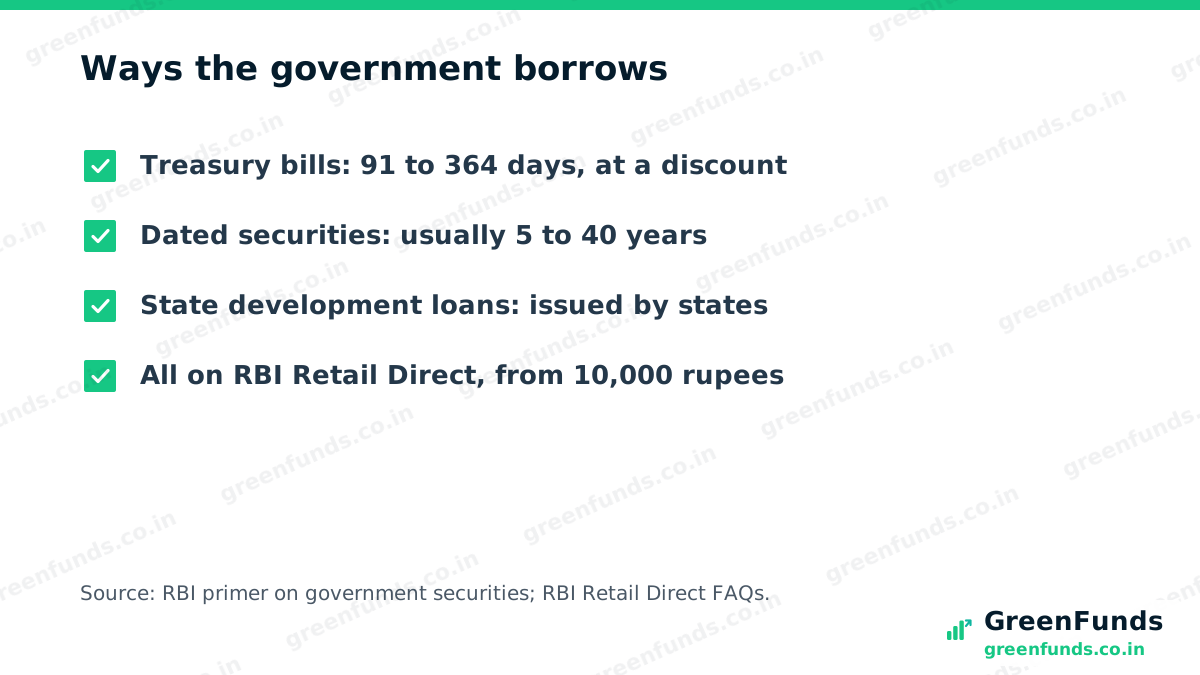
A Treasury bill pays no coupon. The RBI’s own example: a 91-day bill with a face value of 100 rupees is issued at 98.20 and repaid at 100. That 1.80 rupee gain works out to about 7.35% a year.
Did you know? You don’t need a broker to buy government bonds. The RBI Retail Direct portal lets individuals open a gilt account with the RBI itself, with no account fee, and buy in auctions from 10,000 rupees. Since August 2025 it can also place T-bill bids automatically, including reinvesting when a bill matures.
How it’s taxed. Coupon interest is added to your income and taxed at your slab rate, the same as FD interest. If you’d rather not pick bonds yourself, a debt fund holds many for you, at a small yearly cost.
The takeaway. A bond is a loan that pays a coupon and returns face value at maturity. Prices move opposite to rates, and longer bonds move more. Government bonds remove default risk, not price risk.
More to read: debt funds explained, fixed deposits explained, and FD vs debt fund.
Questions people ask
What is a bond?
A bond is a loan you give to a government, a bank or a company. In return, it pays you interest, called the coupon, at set times, and repays the face value on a fixed maturity date. You can usually sell it to someone else before then, at whatever the market price is that day.
Why do bond prices fall when interest rates rise?
Because new bonds start paying the higher rate, an older bond with a lower coupon is worth less to a buyer, so its price drops until its yield matches the market. When rates fall, the reverse happens and older bonds rise in price. The RBI's primer on government securities describes this inverse link.
What is a Treasury bill?
A Treasury bill, or T-bill, is a short-term loan to the Government of India, issued for 91, 182 or 364 days. It pays no coupon. Instead, it's sold at a discount and repaid at full face value, and the difference is your return.
Can I buy government bonds directly?
Yes. Through the RBI Retail Direct portal, individuals can open a free gilt account with the RBI and buy T-bills, dated government securities and state development loans in primary auctions, and trade them in the secondary market. The minimum is 10,000 rupees.
Flag a possible issue
Sources
- RBI, Government Securities Market in India: A Primer T-bills are issued in 91, 182 and 364 day tenors, are zero coupon and issued at a discount; dated G-secs generally run 5 to 40 years with half-yearly coupons; bond price and yield are inversely related.
- RBI, Retail Direct Scheme FAQs Individuals can buy T-bills, dated G-secs, state development loans and Sovereign Gold Bonds; minimum 10,000 rupees for T-bills, G-secs and SDLs; no fee for opening or maintaining the Retail Direct Gilt account; G-secs are free of credit risk but carry market risk if sold before maturity.
- RBI, Statement on Developmental and Regulatory Policies, 6 August 2025 Auto-bidding facility for investment and re-investment in T-bills enabled on Retail Direct.