Fixed deposits explained: how FDs work, and the fine print
Lock money for a set time at a fixed rate
Figures checked 2026-10-31
A fixed deposit is money you lend to a bank for a set time, at an interest rate fixed on day one. Rates can fall or rise later; yours stays put until maturity. That certainty is the whole appeal.
How it pays you. You choose one of two styles when you open it.
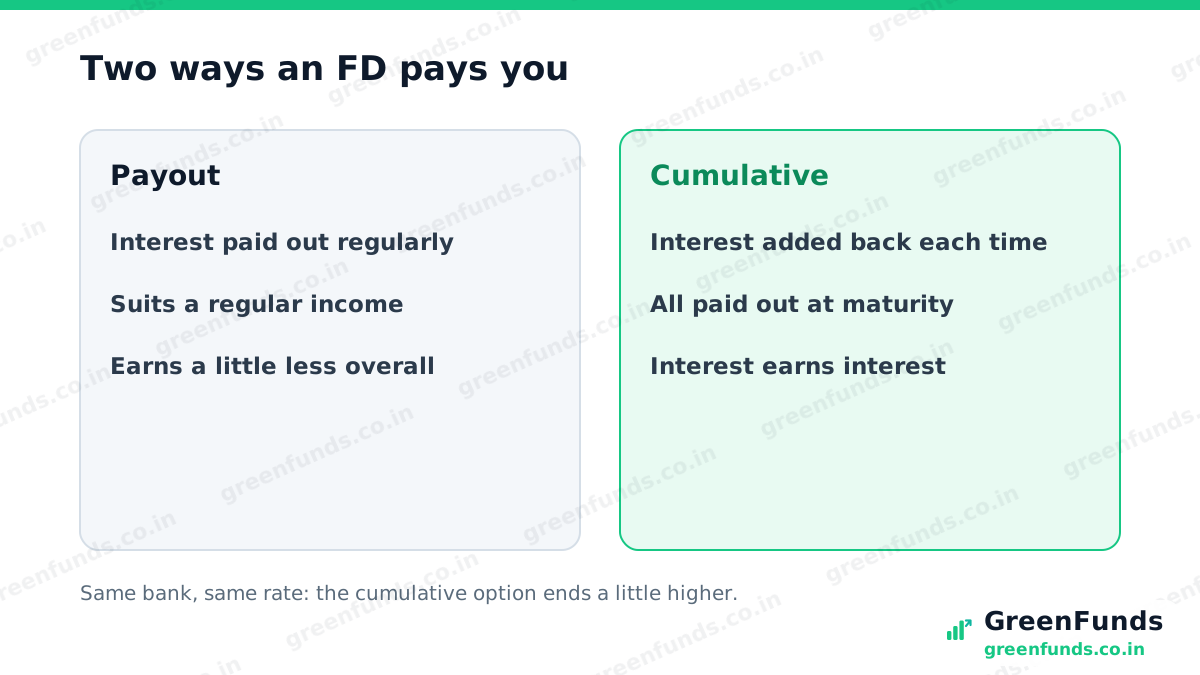
An illustration, with a made-up rate: put 1 lakh rupees in for one year at 7%. A payout FD sends you about 7,000 rupees over the year. A cumulative FD that adds interest back every quarter ends at about 1,07,186 rupees, so roughly 186 rupees more, because the interest earned interest. Small here, much bigger over five or ten years. Your bank’s actual rate will differ.
Breaking it early. Life happens, and banks must let you withdraw a regular term deposit before maturity if you ask. The exception is a non-callable deposit, usually a large one, which you agree upfront not to break, and which can carry a slightly different rate. The cost: you usually get the rate for the time the money actually stayed, minus a small penalty. RBI lets each bank set its own penalty but says it must tell you upfront. Look for it before you open the FD, not after.
Did you know? Deposits in a bank, FDs included, are insured up to 5 lakh rupees per person per bank, counting both principal and interest, by the Deposit Insurance and Credit Guarantee Corporation. If you hold more than that, splitting it across banks keeps more of it covered. Check the current limit before you rely on it.
Tax on FD interest. FD interest is taxable income, added to your other income and taxed at your slab rate. Separately, the bank deducts tax at source, called TDS, once your interest from that bank crosses a yearly limit. From April 2025, the limit is 50,000 rupees for most people and 1 lakh rupees for senior citizens, with TDS at 10% if your PAN is linked. If your total income is below the taxable limit, you can file a declaration with the bank so it does not deduct TDS. Our guide to TDS on FD interest explains how. Tax rules change often, so check the current limits on incometax.gov.in.
The ladder trick. Locking everything into one long FD means it is all stuck if you need cash. A ladder fixes that.
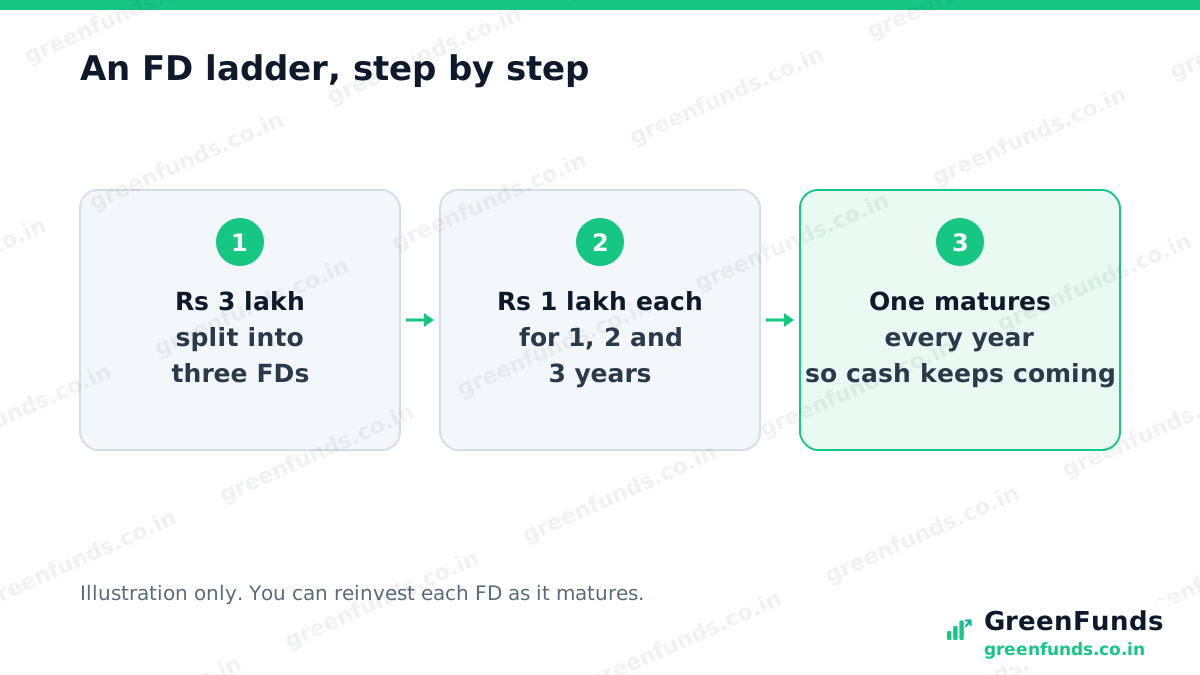
Split the money into a few FDs with different maturities. One matures every year, so you always have cash arriving and can reinvest at whatever rate is going then. It also means you rarely need to break an FD and pay the penalty.
The automatic version. Some banks offer a sweep-in FD: money above a level you set in your savings account moves into an FD on its own, and breaks back into the account when your balance runs short. You earn FD interest on idle cash without locking it away. Terms vary by bank, so check yours.
Where FDs fit. FDs suit money with a date on it: a sinking fund, part of an emergency fund, or a goal two or three years out. Over long periods, after tax and inflation, the real return can be thin, which is why long-term goals usually look elsewhere.
The takeaway. An FD buys certainty: a known rate, a known date and insured safety up to the limit. Pick cumulative if you do not need the interest, check the early-break penalty first, and ladder if you might need the cash. To see what your own FD would pay at maturity, try our FD calculator.
More to read: FD vs debt fund, ELSS vs PPF vs FD for tax saving, recurring deposit vs SIP, and how much of your FD is insured if a bank fails.
Questions people ask
What happens if I break a fixed deposit early?
Banks must let you withdraw a regular term deposit before maturity on request. The exception is a 'non-callable' deposit, usually a large one, which you agree upfront not to break. You usually get the rate for the period the money actually stayed, minus a small penalty the bank sets and must tell you upfront. Check your bank's penalty before you open the FD.
Is TDS cut on FD interest?
Yes, once the interest from one bank crosses a yearly limit. From April 2025, that limit is 50,000 rupees for most people and 1 lakh rupees for senior citizens, and the TDS rate is 10% when your PAN is linked. Check the current limits, since tax rules change. TDS is only an advance: the interest is still taxed at your slab when you file your return.
Are fixed deposits safe?
Bank deposits, FDs included, are insured by the Deposit Insurance and Credit Guarantee Corporation up to 5 lakh rupees per depositor per bank, counting principal and interest together. Above that, your money depends on the bank's own health. Check the current cover limit before relying on it.
Which is better, a cumulative or a payout FD?
It depends on whether you need the interest now. A payout FD sends interest to you monthly or quarterly, which suits a regular income. A cumulative FD adds the interest back so it earns more interest, which ends slightly higher if you do not need the money until maturity.
Sources
- RBI, Interest Rates on Deposits directions (premature withdrawal of term deposits) Banks set their own penalty and must disclose it with the deposit rate.
- Income Tax Department, TDS on interest other than interest on securities (thresholds revised from 1 April 2025) Rs 50,000 a year (Rs 1 lakh for senior citizens) from banks and post offices. Tax rules change; check the current limits.
- DICGC, A Guide to Deposit Insurance Up to Rs 5 lakh per depositor per bank, principal and interest together.