If your bank fails, is your money safe? The 5 lakh rupee cover
Your bank deposits are insured up to 5 lakh rupees per bank
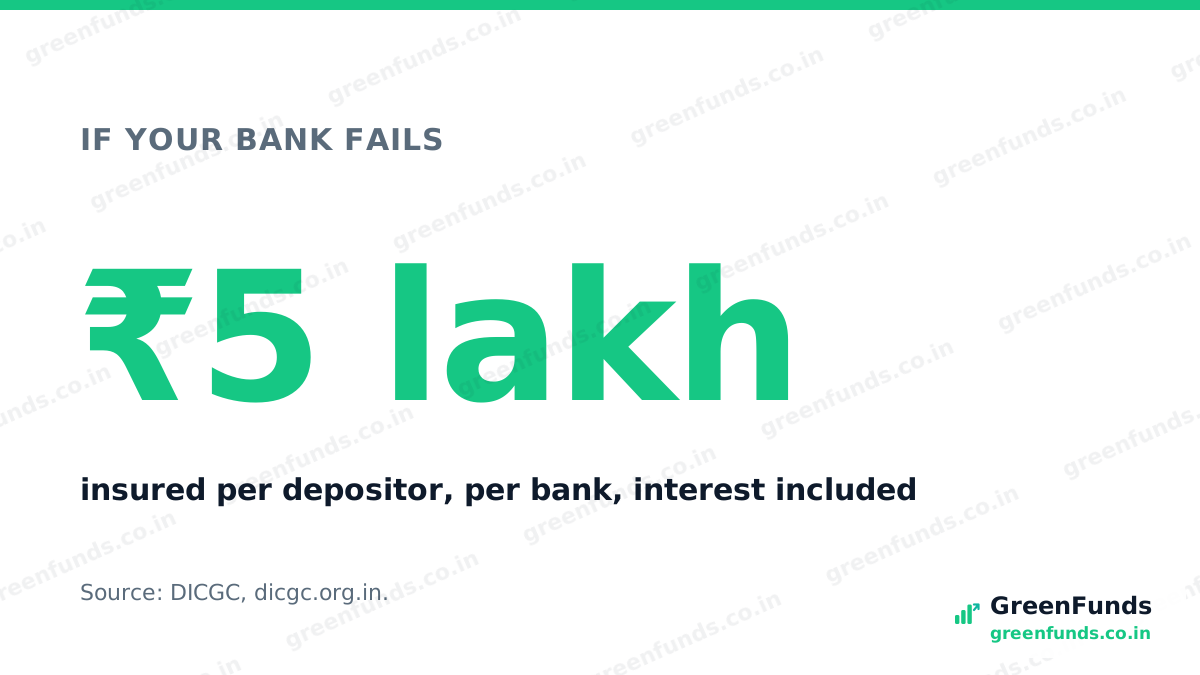
When you put money in a bank, it’s insured. If the bank fails, a government-backed insurer pays you back up to 5 lakh rupees, counting both what you deposited and the interest on it. You don’t apply for this or pay for it. The bank pays the premium.
Who does this. The insurer is the DICGC (Deposit Insurance and Credit Guarantee Corporation), a fully owned arm of the RBI. It raised the cover from 1 lakh to 5 lakh rupees on February 4, 2020, per the RBI.
How the 5 lakh is counted. This is where most people get it wrong. The cover is per depositor, per bank, not per account. DICGC adds up every deposit you hold in that bank, across all its branches, plus the interest due, and covers the total up to 5 lakh rupees.
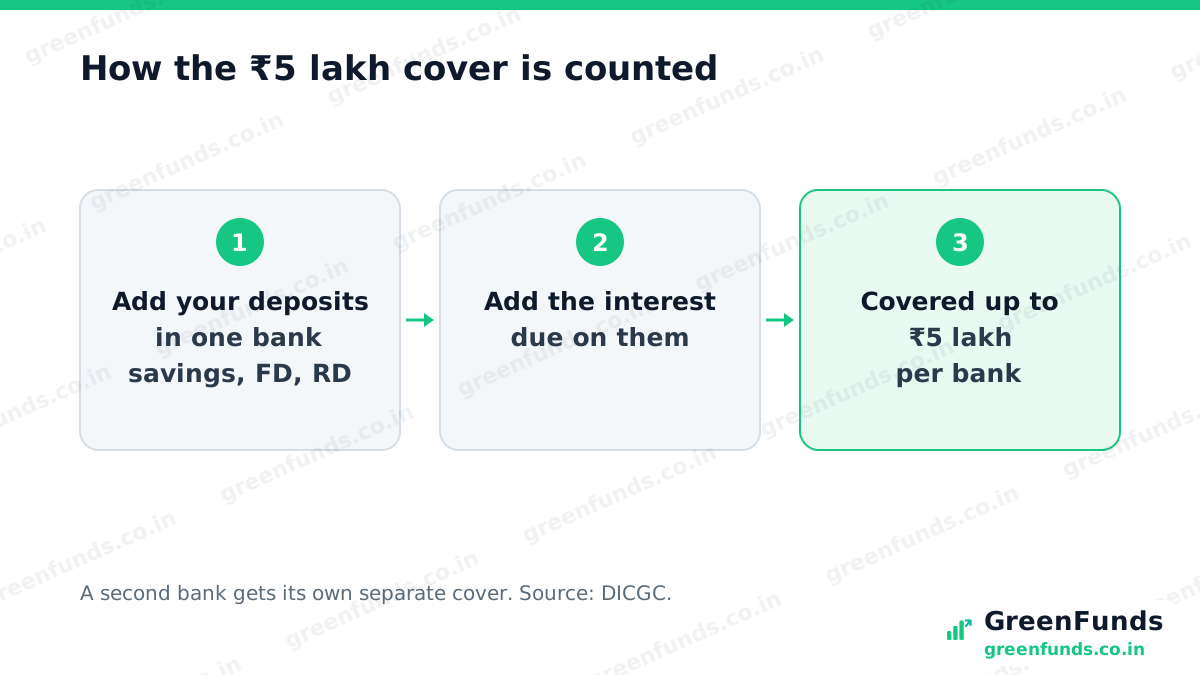
An example. Say you hold a ₹4 lakh fixed deposit and ₹2 lakh in a savings account, both in the same bank (an illustration). That’s ₹6 lakh. If the bank fails, ₹5 lakh is insured and ₹1 lakh is not. Put the FD in a second bank instead, and both pots are fully covered, since each bank gets its own 5 lakh limit.
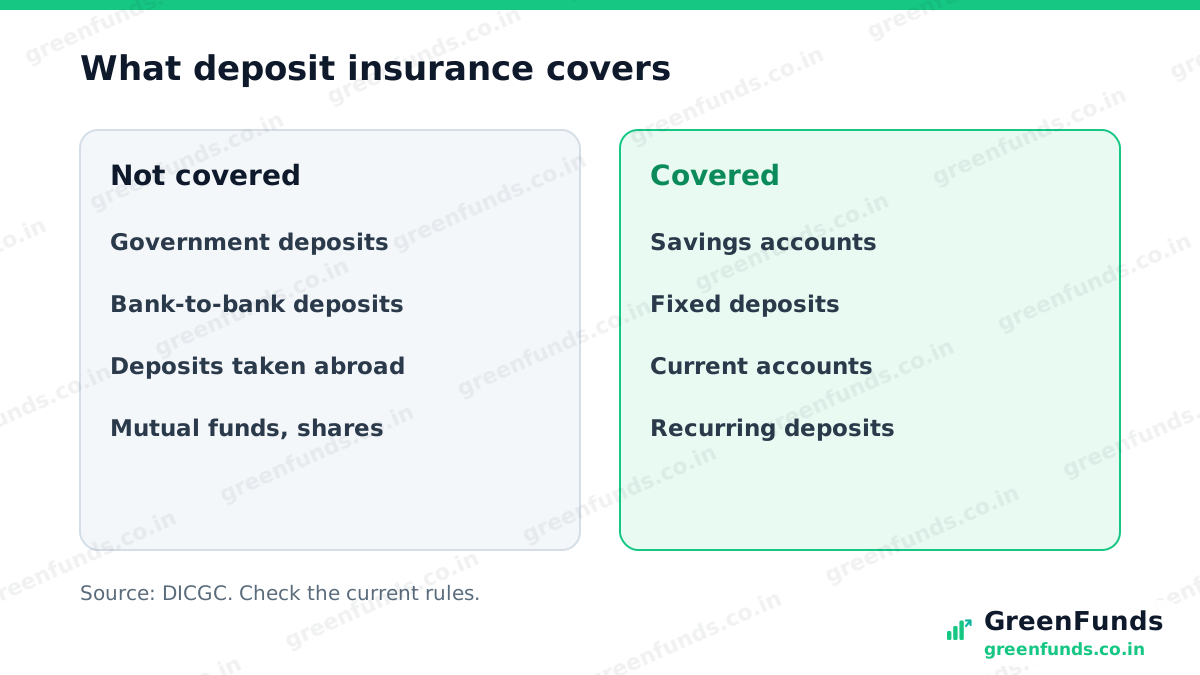
What’s covered, and what isn’t. Savings, fixed, current and recurring deposits are all covered. Deposits of governments, money one bank keeps with another, and deposits taken outside India are not. Mutual funds, shares and insurance policies you bought through a bank are not deposits at all, so this cover doesn’t apply to them.
Did you know? Since a 2021 change to the law, you don’t have to wait for a failed bank to be wound up. Once the RBI puts a bank under all-inclusive directions, DICGC must pay insured depositors within 90 days, per its FAQs. Joint accounts count separately too: an account in the names of A and B gets a different 5 lakh cover from one in A’s name alone.
What this means for you. For most people, the cover is plenty: a regular salary account and an FD rarely add up to more than 5 lakh rupees in one bank. If yours do, you can spread them across banks so each pot sits under the limit. Also keep your nominee details current, so a claim reaches your family without a fight. The cover amount can change, so check DICGC’s site for the current figure.
The takeaway. Your bank deposits are insured up to 5 lakh rupees per bank, interest included, and the cover pays within 90 days of the RBI freezing a bank. Above 5 lakh in one bank, the extra is at risk. Spreading deposits across banks is the simple fix.
More to read: FD vs debt fund, which bank transfer to use, and how to spot a fake investment.
Questions people ask
How much of my bank deposit is insured in India?
Up to 5 lakh rupees per depositor in each insured bank, covering your money and the interest due on it together, under the Deposit Insurance and Credit Guarantee Corporation (DICGC). The limit has stood at 5 lakh rupees since February 4, 2020. Check the DICGC website for the current figure.
Does the 5 lakh rupee cover apply per account or per bank?
Per depositor, per bank. All your savings, fixed, current and recurring deposits across every branch of the same bank are added together, and the total is covered up to 5 lakh rupees. Deposits in a different bank get their own separate 5 lakh rupee cover.
How long does it take to get my money if a bank fails?
When the RBI puts a bank under all-inclusive directions, DICGC pays insured depositors within 90 days under the 2021 amendment to its law. The bank must first send the depositor list within 45 days. If a bank is liquidated instead, DICGC pays the liquidator within two months of getting the claim list, and the liquidator pays you.
Are co-operative bank deposits insured?
Co-operative banks are covered by DICGC, per its FAQs, along with commercial banks, foreign bank branches in India, local area banks and regional rural banks. Primary co-operative societies are not insured, so a deposit with a society does not get this cover.
Source: DICGC FAQs (dicgc.org.in); RBI press release, February 4, 2020; DICGC (Amendment) Act, 2021. The cover amount can change, check the current DICGC rules.
Found this useful? You can buy us a coffee. It keeps GreenFunds free.Flag a possible issue
Was this helpful?
Thanks for the signal.
Comments
Share your experience or a question. Be kind, stay on topic. This is reader discussion, not financial advice.
No comments yet. Be the first to share.