NEFT, RTGS, IMPS or UPI: which bank transfer to use
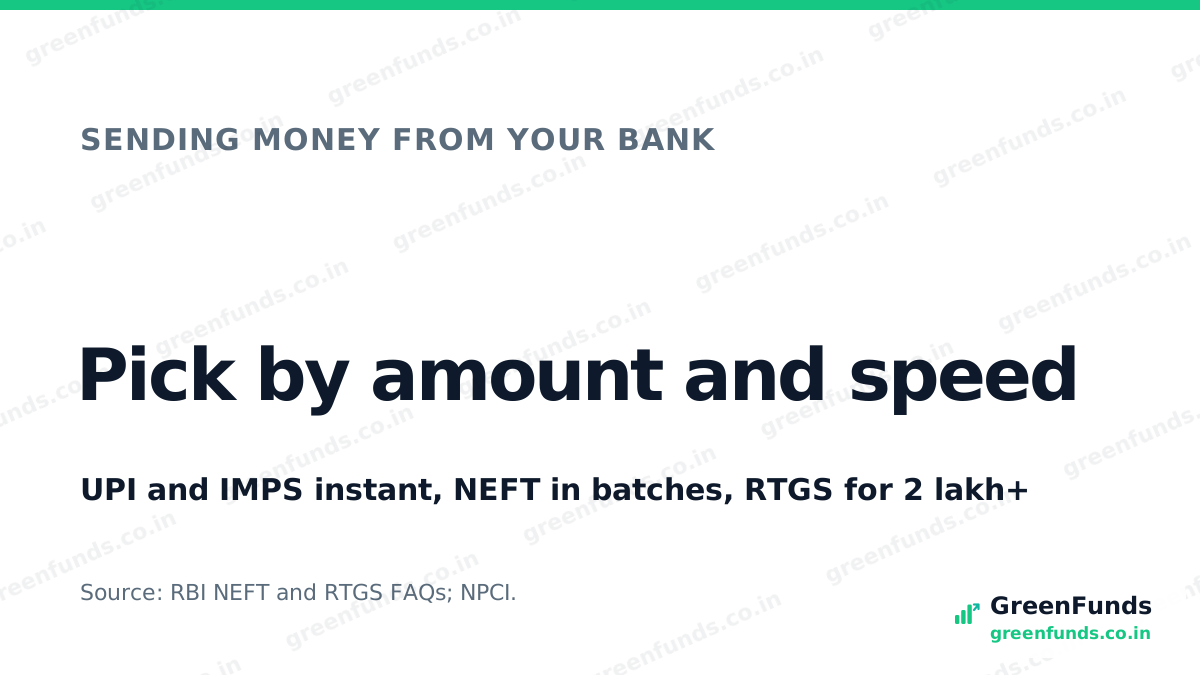
Four ways to move money, picked by amount and speed
There are four main ways to send money from your bank account to someone else’s. They all do the same job. What changes is how fast the money lands, how much you can send in one go, and whether there is a fee. Pick the right one and even a big payment is quick and free.
The quick map. UPI (Unified Payments Interface) is the everyday one: scan, tap, done. IMPS (Immediate Payment Service) is instant too, and handles bigger sums through net banking or your bank app. NEFT (National Electronic Funds Transfer) moves any amount, but in batches. RTGS (Real Time Gross Settlement) is built for large payments and lands almost in real time.
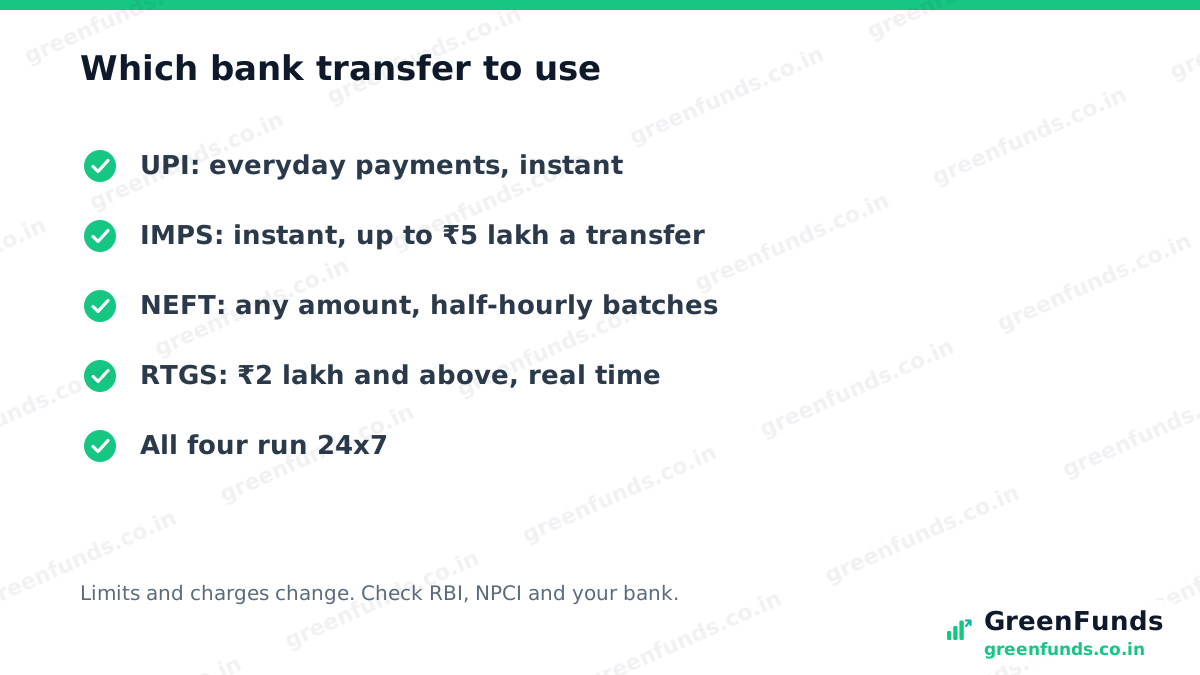
| Speed | Amount | Hours | |
|---|---|---|---|
| IMPS | Instant | Up to ₹5 lakh per transfer | 24x7 |
| NEFT | Half-hourly batches, usually within 2 hours | No RBI limit, your bank may set one | 24x7 |
| RTGS | Credited within 30 minutes | ₹2 lakh and above, no upper limit | 24x7 |
What it costs. For a savings account, the RBI told banks not to charge for NEFT you send online. RTGS can carry a small fee: the RBI caps it at ₹25 for ₹2 lakh to ₹5 lakh, and ₹50 above that, plus tax. Receiving money by RTGS is free, per the RBI. Your own bank’s fee page has the current numbers, since banks can charge less than the cap.
Did you know? NEFT has run round the clock since December 2019, and RTGS since December 14, 2020, per the RBI. Before that, a big transfer on a Sunday had to wait for Monday. Today the slowest rail is still NEFT, only because it settles in half-hourly batches.
An example. Say you are paying a ₹3 lakh deposit for a flat (an illustration). IMPS can send it in one go, as long as your bank’s own daily limit is that high, which can be lower. RTGS handles it easily, and the landlord’s bank must credit it within 30 minutes. NEFT works too, with a wait of up to a couple of hours. A busy weekday afternoon or a Sunday night makes no difference now.
Check before you send. A wrong account number is the costliest mistake here, because money sent to the wrong account is hard to pull back. Since April 2025, banks must show the receiver’s name for NEFT and RTGS once you enter the account number and IFSC (the branch code), a free check the RBI asked for. Read that name before you hit pay.
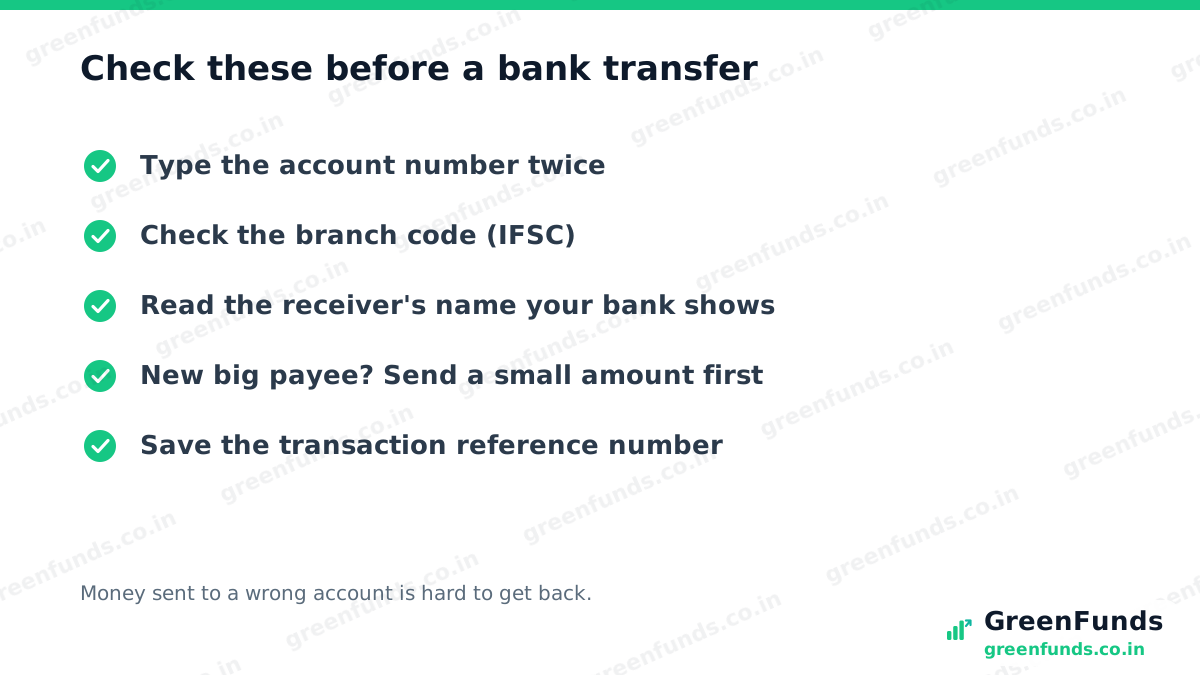
The takeaway. Small and quick: UPI or IMPS. Large: RTGS. No rush and any amount: NEFT. Whatever you pick, check the name before you pay, and keep the reference number. If money ever goes out that you did not send, report it fast: here is how to report UPI and bank fraud.
More to read: safe habits on UPI, what happens to your money if a bank fails, and how a cheque clears today.
Questions people ask
What is the difference between NEFT, RTGS and IMPS?
All three move money from one bank account to another. IMPS is instant and works round the clock, with a per-transaction cap of 5 lakh rupees under the NPCI rule. NEFT has no RBI-set limit and settles in half-hourly batches, so money usually lands within a couple of hours. RTGS is for 2 lakh rupees and above and credits the receiver within about 30 minutes. All three now run 24x7.
Which is the fastest way to transfer money?
For everyday amounts, UPI and IMPS are both instant. For large sums of 2 lakh rupees or more, RTGS is the fast option, since the receiving bank has to credit the money within 30 minutes of getting it, per the RBI. NEFT is slower because it moves in half-hourly batches.
Are NEFT transfers free?
For savings account holders, banks have been told by the RBI not to charge for NEFT transfers you make online, a rule in place since January 2020. Branch transfers and other account types can still carry a fee. For RTGS, the RBI caps what banks may charge on outward transfers. Check your bank's current fee page.
Can I check the receiver's name before an NEFT or RTGS transfer?
Yes. The RBI told banks to offer a free beneficiary name look-up for NEFT and RTGS by April 2025. Once you enter the account number and IFSC, your bank app or net banking shows the account holder's name, so you can catch a wrong account before you pay.
Source: RBI FAQs on NEFT and RTGS (rbi.org.in); NPCI IMPS circular on the 5 lakh rupee limit; RBI circular on beneficiary name look-up, December 2024. Limits and charges change, check the current rules.
Found this useful? You can buy us a coffee. It keeps GreenFunds free.Flag a possible issue
Was this helpful?
Thanks for the signal.
Comments
Share your experience or a question. Be kind, stay on topic. This is reader discussion, not financial advice.
No comments yet. Be the first to share.